
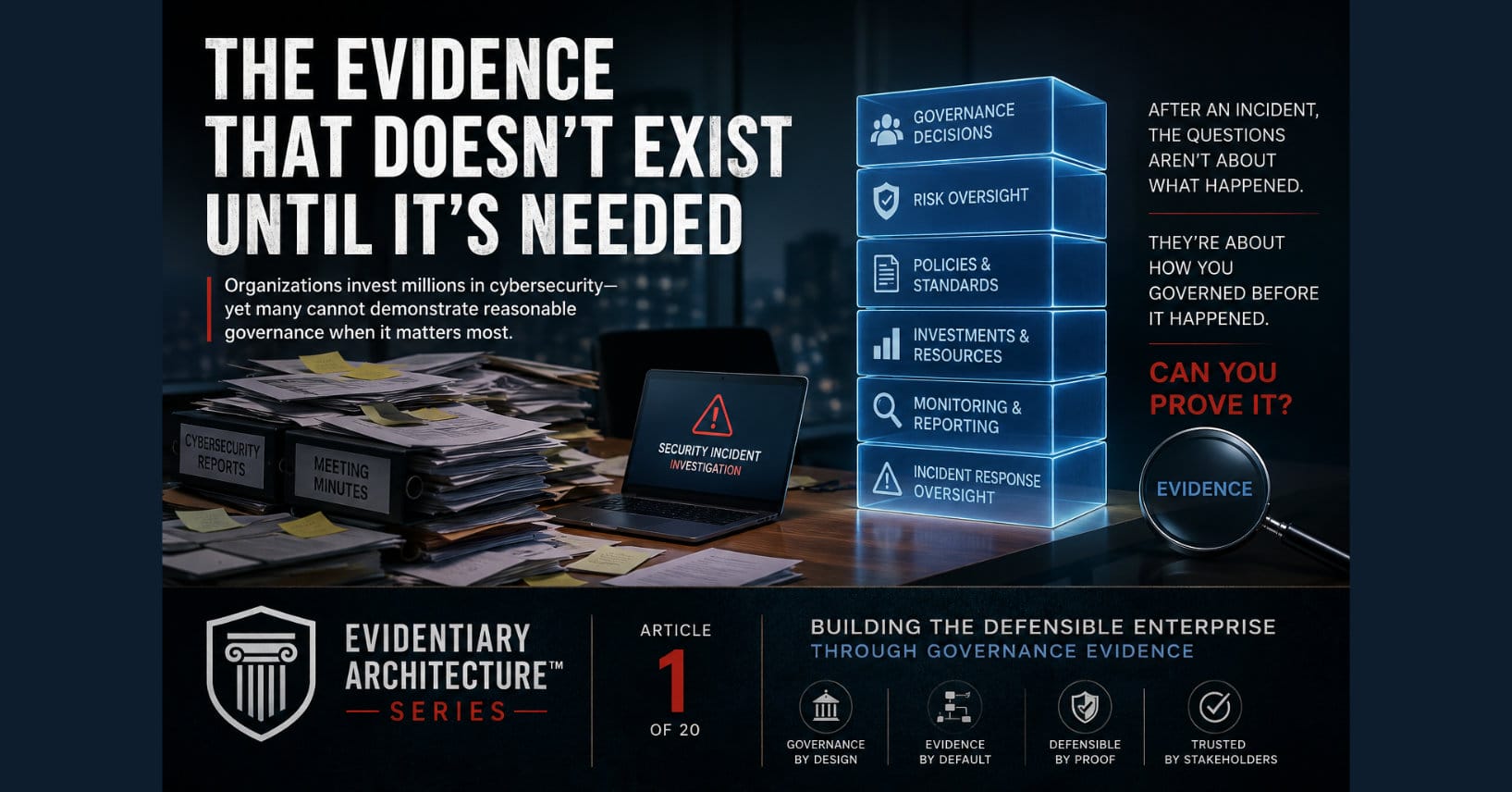
Evidentiary Architecture™ Series | Article 1 of 20
Building the Defensible Enterprise through Governance Evidence
Organizations often discover too late that the evidence needed to demonstrate reasonable cybersecurity governance was never created. This article explains why governance evidence cannot be reconstructed after an incident and how boards can build defensible oversight before it is tested. It introduces the concept of evidence readiness as a core governance responsibility rather than a compliance exercise.
Every organization generates evidence.
The problem is that very few generate the right evidence, and almost none do it intentionally.
That distinction rarely matters—until a ransomware attack cripples operations, customer data is exposed, regulators begin asking questions, cyber insurance carriers request documentation, or attorneys start issuing discovery requests.
Only then does leadership discover a difficult truth:
They can describe what they believe happened.
They cannot prove how they governed before it happened.
That is a governance problem—not a cybersecurity problem.
The Question Has Changed
For years, organizations measured cybersecurity success by prevention.
Did the firewall block the attack?
Was multi-factor authentication enabled?
How quickly were systems patched?
These remain important operational questions, but they are no longer the questions that matter most after a significant cyber incident.
Instead, boards and executive teams increasingly face a different set of questions:
- How did leadership oversee cyber risk?
- Who accepted the organization’s residual risk?
- Were critical decisions documented?
- What evidence demonstrates reasonable oversight?
- Can the organization show that governance functioned as intended before the incident occurred?
These are governance questions.
And they require governance evidence.
Technology Is Easy to Demonstrate. Governance Is Not.
Most organizations can produce impressive technical artifacts.
Security dashboards.
Vulnerability scans.
Penetration test reports.
Configuration baselines.
Threat intelligence feeds.
These documents demonstrate that security activities occurred.
They do not necessarily demonstrate that leadership exercised reasonable governance.
There is an important difference between proving that security controls existed and proving that the organization governed cybersecurity responsibly.
One measures activity.
The other demonstrates accountability.
The Missing Layer
Imagine asking a board to explain why it accepted the risk of delaying a critical security investment.
The discussion probably occurred.
The decision was likely reasonable given the information available at the time.
Resources were limited.
Other business priorities competed for funding.
Leadership made a judgment.
Months later, after a cyber incident, someone asks a simple question:
Show us the evidence of that decision.
Not the recollection.
Not the explanation.
The evidence.
In many organizations, that evidence simply does not exist.
Perhaps there is a vague reference buried in meeting minutes.
Maybe someone remembers the conversation.
An email chain might still exist somewhere.
But none of those artifacts were created as part of an intentional governance process.
They became evidence by accident.
Cybersecurity Has an Evidence Problem
Organizations have spent decades improving technical controls.
They have invested millions in endpoint protection, identity management, cloud security, monitoring platforms, and incident response capabilities.
Yet comparatively little attention has been given to the evidence those governance processes should produce.
Ironically, many organizations can detect an attack within minutes but cannot demonstrate six months later why a key governance decision was made.
That imbalance is becoming increasingly important.
Regulators, insurers, auditors, investors, and courts are not simply evaluating whether an organization experienced a cyber incident.
They are evaluating how leadership governed cyber risk before it happened.
Evidence Is a Governance Product
This realization changes how we should think about governance.
Good governance does more than produce sound decisions.
It produces evidence that those decisions were made deliberately, reasonably, and with appropriate oversight.
That evidence should not depend on someone’s memory.
It should not require reconstructing events from scattered emails and disconnected documents.
It should be created naturally as governance occurs.
When governance is functioning properly, evidence should be a byproduct of the process—not an emergency reconstruction after a breach.
The Cost of Missing Evidence
Organizations often assume that if they can recover operationally, they have succeeded.
Operational recovery is only part of the story.
After the technical response comes another phase that can last months—or even years.
Regulatory inquiries.
Insurance reviews.
Board investigations.
Shareholder actions.
Civil litigation.
Independent audits.
Public scrutiny.
Every one of these asks essentially the same question:
Can you demonstrate that leadership exercised reasonable governance?
Organizations that cannot answer that question frequently discover that the absence of evidence becomes a risk in its own right.
A Different Way to Think About Cybersecurity
Cybersecurity governance is evolving.
The discussion is moving beyond controls, frameworks, and compliance.
It is becoming a discipline centered on accountability, traceability, and defensibility.
That evolution requires something most organizations have never intentionally designed:
An architecture for governance evidence.
Not more documents.
Not more reports.
Not more compliance checklists.
An intentional way of ensuring that governance decisions create trustworthy, traceable, defensible evidence from the moment they are made.
That discipline is what I call Evidentiary Architecture™.
Over the coming weeks, we’ll explore how organizations can move beyond documenting cybersecurity activities to deliberately designing the evidence that demonstrates effective governance.
Because when the questions finally come, the evidence you need should already exist—not because someone remembered to save it, but because your governance process was designed to produce it.
Governance Takeaway
Organizations invest heavily in protecting their systems but rarely invest in protecting the evidence of their governance. In the years ahead, the ability to demonstrate reasonable oversight may prove just as important as the ability to prevent an attack. Evidence should not be something organizations search for after an incident—it should be something governance produces every day.
Coming Next
Documentation Is Not Evidence
Most organizations believe they have plenty of cybersecurity evidence because they have policies, meeting minutes, dashboards, audit reports, and compliance documentation. But documentation and evidence are not the same thing. In the next article, we’ll examine why so much of what organizations produce cannot actually demonstrate reasonable governance—and what separates ordinary documentation from evidence that can withstand regulatory, legal, and board-level scrutiny.