AI Governance Series | Article 13 of 20
Governing Intelligence Before It Governs You
Summary: Many organizations believe AI governance only applies to systems they build themselves. In reality, AI is increasingly embedded within third-party software, cloud platforms, and enterprise applications that organizations rely upon every day. This article explains why vendor AI introduces significant governance, legal, operational, and reputational risks that cannot be outsourced. It explores third-party AI governance, vendor due diligence, contractual oversight, transparency, continuous monitoring, and evidence-based assurance, showing why boards must govern AI across the entire technology ecosystem—not just within their own enterprise.
Many organizations believe they don’t have significant AI risk because they haven’t built their own AI systems.
They’re wrong.
Every day, organizations use AI embedded inside software they didn’t develop, cloud services they don’t control, and platforms they didn’t design.
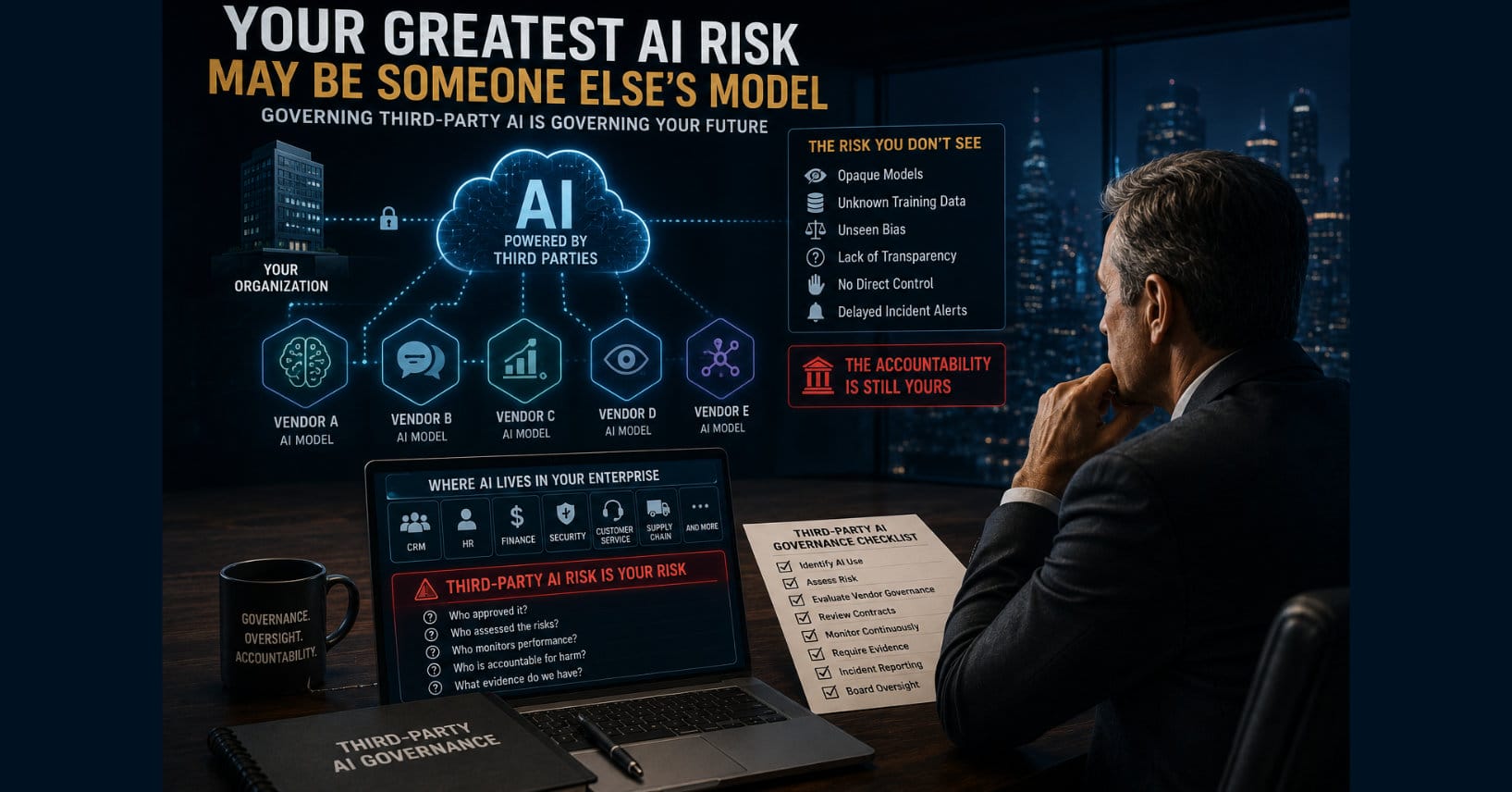
The greatest AI risk in your enterprise may already belong to someone else.
Governing third-party AI is rapidly becoming one of the board’s most important responsibilities.
AI Is Already Inside Your Vendors
Artificial intelligence is no longer purchased as a standalone product.
It is embedded within:
- Customer relationship management (CRM) platforms
- Human resources systems
- Financial software
- Security tools
- Productivity suites
- Customer service applications
- Marketing platforms
- Healthcare systems
- Supply chain software
Many organizations adopt AI without ever approving an AI initiative.
Their vendors do it for them.
The Risk Still Belongs to You
A vendor’s AI may make recommendations.
Score applicants.
Approve transactions.
Flag suspicious activity.
Generate customer communications.
Summarize legal documents.
Analyze medical records.
If those decisions create harm, regulators rarely stop at the software vendor.
They ask the organization using the technology.
Who approved it?
Who assessed the risks?
Who understood its limitations?
Who monitored its performance?
Purchasing software does not transfer governance responsibility.
Third-Party AI Expands Your Risk Surface
Traditional third-party risk management focused on questions such as:
Can we trust the vendor?
Can they protect our data?
Will they remain financially stable?
AI introduces new questions:
- What models are they using?
- How are those models trained?
- What data is processed?
- Can outputs be explained?
- How are hallucinations managed?
- How frequently are models updated?
- Can decisions be audited?
- What governance framework does the vendor follow?
These questions belong in vendor governance—not just technical due diligence.
The Invisible AI Problem
One of the greatest governance challenges is identifying where AI already exists.
Business units often enable AI capabilities without realizing they have changed the organization’s risk profile.
Software updates quietly introduce:
- AI assistants
- Automated recommendations
- Predictive analytics
- Intelligent workflows
- Document generation
- Decision-support features
Suddenly, AI is influencing business decisions without a corresponding governance review.
Boards cannot govern risks they cannot see.
Governance Must Extend Beyond the Enterprise
Effective AI governance reaches beyond organizational boundaries.
It should include expectations for third-party providers regarding:
- Governance policies
- Risk management practices
- Security controls
- Data handling
- Regulatory compliance
- Model transparency
- Incident notification
- Independent assurance
Organizations should expect evidence—not marketing claims—that vendors govern AI responsibly.
Contracts Matter More Than Ever
Vendor agreements increasingly need AI-specific provisions.
Examples include:
- Disclosure of AI use
- Notification of material model changes
- Security obligations
- Audit rights
- Data ownership protections
- Incident reporting timelines
- Regulatory cooperation
- Evidence retention requirements
Contracts define governance expectations before problems occur.
Boards Should Ask Different Questions
Directors should no longer ask only:
“Which AI systems have we built?”
They should also ask:
- Which vendors use AI on our behalf?
- Which business decisions rely upon vendor AI?
- Which vendors present our highest AI risk?
- How do we evaluate their governance?
- What evidence do we receive?
- How quickly would they notify us of an AI incident?
Those questions reveal whether third-party AI governance exists.
Trust Requires Verification
Vendor presentations often emphasize innovation.
Boards require assurance.
Independent assessments.
Contractual commitments.
Audit reports.
Security certifications.
Evidence of governance.
Trust is strengthened through verification—not vendor marketing.
The Supply Chain Is Becoming an AI Ecosystem
Modern enterprises operate through interconnected technology partners.
One vendor’s AI decision may influence:
Customer experience.
Financial reporting.
Cybersecurity operations.
Regulatory compliance.
Healthcare outcomes.
Supply chain decisions.
Your governance responsibilities extend throughout that ecosystem.
Because your customers, regulators, and shareholders ultimately hold your organization accountable—not your software providers.
Boardroom Takeaway
Organizations cannot outsource AI risk simply by purchasing technology. Third-party AI requires the same governance discipline as internally developed systems, including due diligence, contractual oversight, continuous monitoring, and evidence that vendors govern AI responsibly. The greatest AI risk facing your organization may already reside inside someone else’s software.
Coming Next
Buying AI Doesn’t Outsource Accountability
Purchasing an AI solution does not transfer responsibility for its decisions. The next article examines vendor governance, contractual accountability, and why organizations remain responsible for AI outcomes—even when the technology belongs to someone else.