Summary
CIRCIA is approaching its final-rule stage, bringing mandatory cyber incident reporting closer for covered critical-infrastructure entities. The 72-hour reporting requirement exposes a deeper governance challenge: whether an organization can reliably move from incident detection to an accountable reporting decision under pressure.
This Cyber Brief examines the governance architecture behind regulatory reporting, including escalation, impact assessment, classification, decision rights, legal review, and evidence preservation. It also distinguishes CIRCIA’s reporting clock from the SEC’s four-business-day disclosure regime and explains why organizations facing multiple regulatory obligations need a regulatory decision architecture rather than a collection of disconnected compliance procedures.
The central question for boards and executives is no longer simply whether management knows the deadline. It is whether the organization has engineered a governance system capable of making and defending the required decision inside it.
The Cybersecurity and Infrastructure Security Agency is approaching one of the most consequential moments in federal cyber regulation since Congress enacted the Cyber Incident Reporting for Critical Infrastructure Act of 2022.
CIRCIA is moving toward its final rule.
The current federal regulatory agenda targets September 2026 for publication of CISA’s final rule. Once the regulations take effect, covered critical-infrastructure entities will face mandatory federal reporting requirements for covered cyber incidents and ransomware payments.
The headline numbers are straightforward:
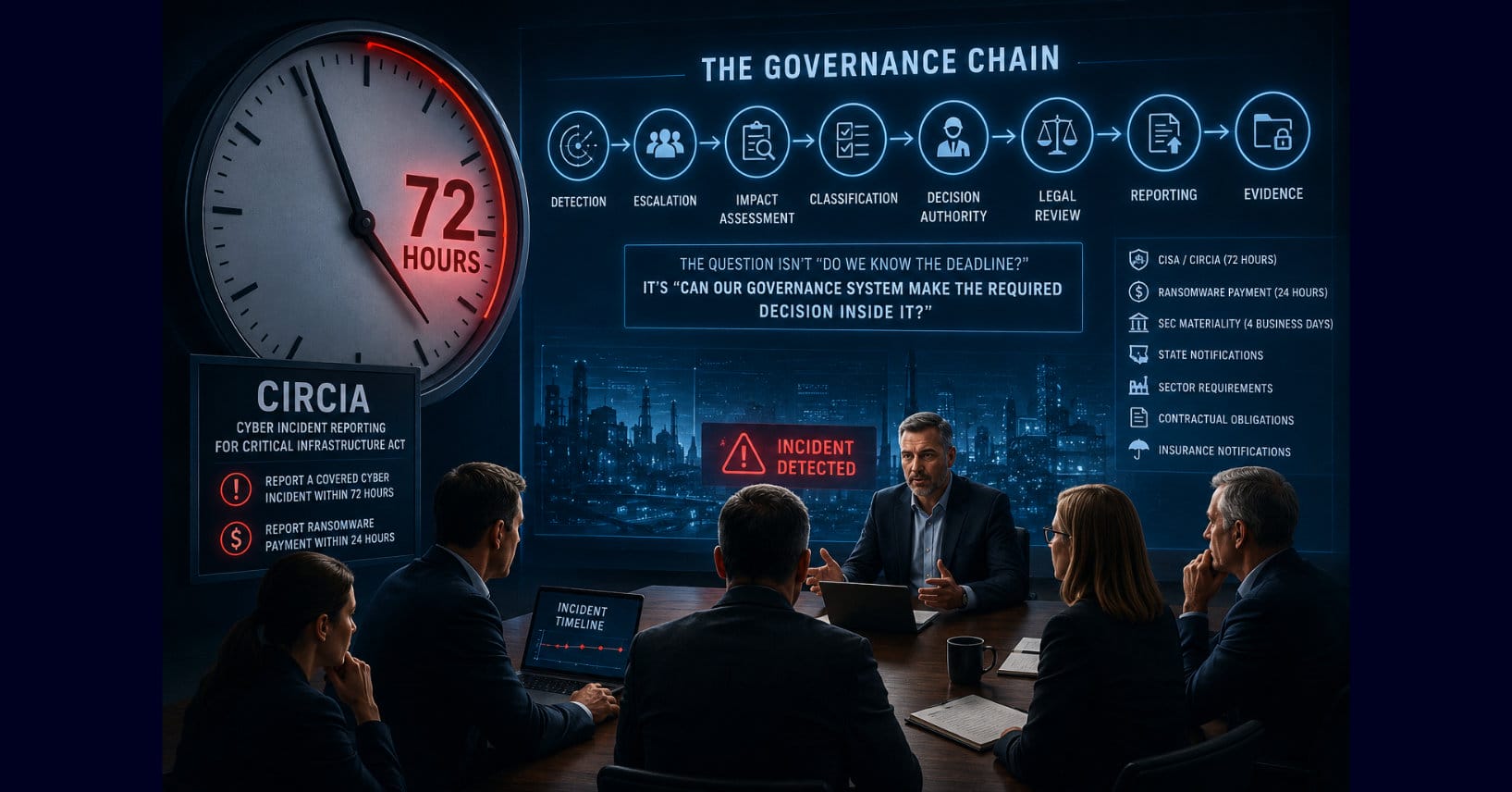
72 hours to report a covered cyber incident.
24 hours to report a ransomware payment.
Those deadlines make CIRCIA sound like an incident-reporting requirement.
It is something considerably more important.
CIRCIA is about to test whether organizations have actually engineered cyber governance into their incident-response operating models.
Because when a serious cyber incident occurs, the hardest part may not be sending a report to the government.
The harder problem is determining—quickly, defensibly and with incomplete information—whether the organization is required to send one.
The Clock Exposes the Governance System
Organizations frequently think about cyber incident response primarily as a technical process.
Detect the attack.
Contain it.
Investigate it.
Restore operations.
Those activities remain essential. But regulatory reporting introduces another operational chain running alongside technical incident response:
Detection → Escalation → Impact Assessment → Classification → Decision Authority → Legal Review → Reporting → Evidence
Every step requires someone to know what happens next.
Every handoff requires authority.
Every decision requires information.
And increasingly, every significant decision may need evidence showing how it was reached.
That is why a reporting deadline is ultimately a governance deadline.
A security operations center may detect suspicious activity almost immediately. That does not mean the enterprise has determined what happened.
The incident-response team may understand the technical scope while still lacking information about operational impact.
Legal counsel may need to evaluate regulatory obligations.
Business leadership may need to determine whether critical services have been affected.
Executives may need to understand financial, customer or safety consequences.
Other regulators may have separate reporting requirements.
Meanwhile, the clock is moving.
The question therefore becomes much larger than:
Do we know that CIRCIA requires reporting within 72 hours?
The better question is:
Can our organization reliably produce an accountable reporting decision within that window?
Those are very different capabilities.
Seventy-Two Hours Is Longer Than It Sounds
Three days may appear generous when written into a compliance policy.
During an actual cyber incident, it can disappear remarkably quickly.
The first several hours may involve uncertainty about whether an event is even malicious.
Investigators may still be establishing which systems were affected.
The organization may not know whether data was accessed, operations disrupted or safety systems affected.
Third-party providers may control critical evidence.
Executives may receive different assessments from cybersecurity, legal, operations and outside forensic teams.
And the people who ultimately carry reporting authority may not yet have enough information to make the decision confidently.
That uncertainty is normal.
What cannot be improvised during the incident is the governance system for resolving it.
If nobody knows who owns the reporting determination, 72 hours is not much time.
If legal and cybersecurity have never established escalation thresholds, 72 hours is not much time.
If operational impact must be reconstructed manually across business units, 72 hours is not much time.
If executives first encounter the reporting criteria during the incident, 72 hours is not much time.
If third-party evidence cannot be obtained quickly, 72 hours is not much time.
The clock does not create these weaknesses.
It reveals them.
CIRCIA and the SEC Clock Are Not the Same Clock
For public companies that may also fall within CIRCIA’s scope, another governance challenge emerges.
They may have more than one regulatory clock running.
The Securities and Exchange Commission’s cybersecurity disclosure rule generally requires a public company to file an Item 1.05 Form 8-K within four business days after determining that a cybersecurity incident is material.
The SEC has also made clear that the materiality determination must be made without unreasonable delay.
CIRCIA operates differently.
Its statutory framework requires covered entities to report covered cyber incidents to CISA within 72 hours after the entity reasonably believes the covered cyber incident occurred. Ransom payments must be reported within 24 hours after payment.
That means organizations cannot simply build one generic workflow labeled “regulatory cyber reporting.”
Different regimes can have:
Different triggers.
Different definitions.
Different decision standards.
Different clocks.
Different audiences.
Different reporting requirements.
And yet they may depend upon much of the same underlying incident evidence.
That creates a governance architecture problem.
An organization could potentially be evaluating the same incident simultaneously for CIRCIA reporting, SEC materiality, sector-specific requirements, state breach-notification laws, contractual obligations, insurance requirements and other regulatory regimes.
The technical incident is singular.
The governance obligations surrounding it may not be.
One Incident, Multiple Decisions
This distinction matters because regulatory reporting increasingly depends upon classification.
An incident occurs.
Then the organization must determine what that incident means under multiple governance frameworks.
The decision structure may look something like this:
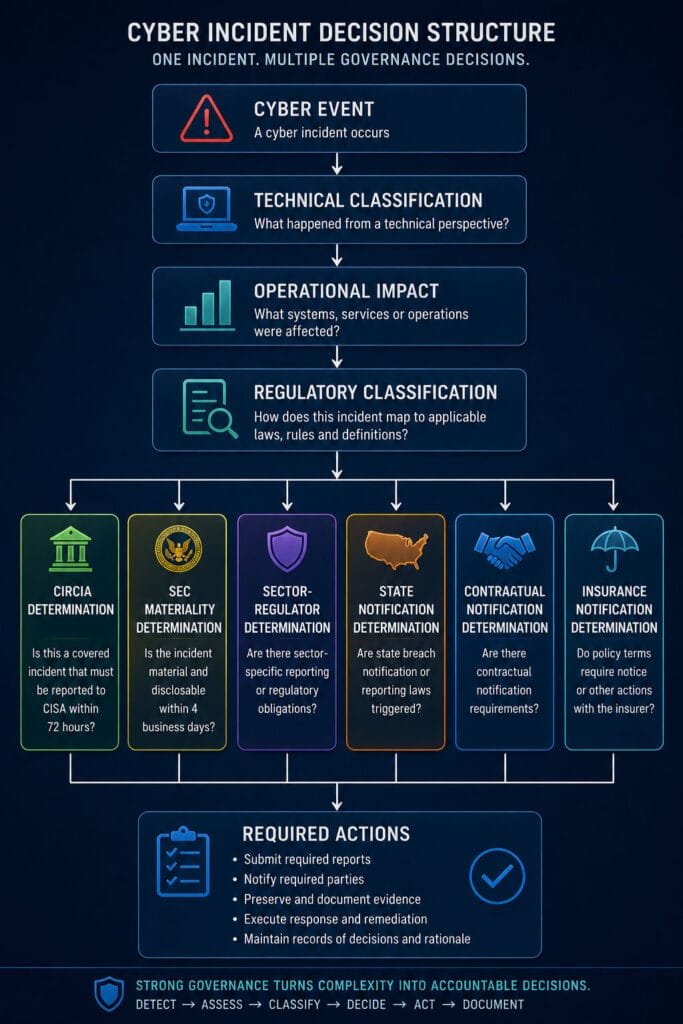
The organization therefore needs more than an incident-response plan.
It needs a regulatory decision architecture.
That architecture should establish who evaluates each obligation, what information is required, who possesses decision authority, when escalation occurs and what evidence must be retained.
Without that structure, reporting becomes dependent upon heroic coordination during precisely the moment when the enterprise is least capable of providing it.
That is not resilience.
That is improvisation.
The Missing Control Is Often Decision Authority
Many organizations have invested heavily in detection and response capabilities.
Far fewer have invested equally in defining decision rights.
Suppose the security team believes an incident may qualify for CIRCIA reporting.
Who decides?
The CISO?
General counsel?
Chief risk officer?
CEO?
An incident-response committee?
Does the decision change depending upon the affected business unit?
What happens if cybersecurity and legal disagree?
Who has authority to resolve the disagreement?
What happens at 2:00 a.m. on Saturday?
Who is the alternate decision-maker?
What evidence must be presented before that person can decide?
These questions may sound procedural until an organization encounters an actual reporting deadline.
Then they become operational controls.
A governance framework that names committees but does not establish decision authority is incomplete.
The enterprise needs to know not merely who participates, but who decides.
Evidence Will Matter Almost as Much as the Decision
CIRCIA also reinforces another development occurring across cybersecurity governance.
The organization increasingly needs to preserve evidence not only of the incident, but of its governance response to the incident.
Consider an organization that determines an event does not meet the applicable reporting threshold.
Months later, someone asks why.
Can the organization reconstruct the decision?
It should be able to show:
What information was available.
When that information became available.
Who reviewed it.
Which reporting criteria were evaluated.
What assumptions were made.
Who possessed decision authority.
What determination was reached.
When the determination was made.
What subsequent information changed—or did not change—the analysis.
That creates another important chain:
Incident Evidence → Assessment Evidence → Decision Evidence → Reporting Evidence
This is where regulatory compliance begins converging with evidentiary architecture.
A defensible organization should not have to reconstruct its governance process months after an incident from email fragments, meeting recollections and scattered forensic reports.
The governance process itself should create evidence as it operates.
The Board Does Not Need to Run the Clock
None of this means directors should participate in every CIRCIA determination.
That would confuse governance with management.
The board’s responsibility is different.
Directors should understand whether management has established a reporting system capable of functioning under compressed regulatory deadlines.
That leads to a much more useful board-level discussion than simply asking whether the organization is “CIRCIA compliant.”
The questions should include:
Does management know whether the organization is likely to fall within CIRCIA’s covered-entity definition?
Have reporting decision rights been explicitly assigned?
Can cybersecurity, legal, risk and operations rapidly assemble the information required for classification?
Have conflicting federal, state, sector and contractual reporting obligations been mapped?
Can critical third parties provide incident evidence within the organization’s regulatory timeline?
Are after-hours and executive escalation procedures defined?
Can management demonstrate the reporting decision trail afterward?
And perhaps most importantly:
Has the organization ever tested the entire process against the clock?
A tabletop exercise that stops after containment is no longer enough.
The exercise should continue until the organization has made the regulatory decisions the real incident would require.
Test the Decision System, Not Just the Incident-Response Plan
This may be the most important preparation organizations can undertake as CIRCIA approaches finalization.
Run the clock.
Create a realistic cyber incident.
Do not tell participants in advance whether it meets the reporting threshold.
Introduce incomplete information.
Make a third-party provider slow to respond.
Allow cybersecurity and legal to interpret one fact differently.
Introduce operational consequences midway through the exercise.
Make senior leadership unavailable for part of it.
Then ask the organization to determine:
Do we report?
And document exactly how long it takes to reach the answer.
The objective is not simply to see whether someone remembers the 72-hour deadline.
The objective is to discover whether the enterprise can move reliably through:
Detection → Escalation → Impact Assessment → Classification → Decision Authority → Legal Review → Reporting → Evidence
That is the real control system.
The Governance Takeaway
CIRCIA’s final rule will eventually settle important details about precisely which entities and incidents fall within the reporting regime.
But organizations should not wait for every final regulatory detail before addressing the larger governance problem.
The direction is already clear.
Cyber incident reporting is becoming faster, more structured and more consequential.
The SEC already requires public companies to make materiality determinations without unreasonable delay and, once an incident is determined to be material, generally disclose it within four business days.
CIRCIA adds another reporting architecture for critical infrastructure.
Other regulators have their own requirements.
More will follow.
Organizations therefore need to stop treating cyber reporting as the final administrative step of incident response.
Reporting is becoming part of the incident governance system itself.
The organizations best prepared for that environment will not necessarily be those with the longest incident-response plans.
They will be the organizations that already know:
Who receives the signal.
Who evaluates the impact.
Who interprets the obligation.
Who has authority to decide.
Who reports.
And what evidence proves that the process worked.
The 72-hour clock is coming.
But the real test will begin long before anyone starts counting hours.