Part One: When an Opportunity Sounds Impressive but the Evidence Does Not Align
Summary: Executive recruiting is built on trust, but trust should never replace verification. In this first installment, I document my experience evaluating what appeared to be an ideal board advisory opportunity. Rather than relying on impressive titles, compensation, and repeated assurances, I applied the principles behind The Defensible Evidence Framework™ and Evidentiary Architecture™ to examine the process itself. The result was a growing list of inconsistencies that deserved explanation, not assumption. This article does not accuse; it demonstrates how governance professionals should distinguish evidence from assertions before making important decisions.
Executive recruiting depends heavily on trust.
A candidate is asked to believe that the recruiter represents a legitimate client, that the opportunity exists as described, that the compensation is real, that confidential information is being handled appropriately, and that the process is progressing through actual decision-makers.
Most candidates evaluate that trust informally. They consider whether the recruiter sounds professional, whether the opportunity appears plausible, and whether the correspondence feels credible.
I approached one recent recruiting interaction differently.
I applied the same governance discipline I expect boards to apply when evaluating cybersecurity, artificial intelligence, enterprise risk, and regulatory exposure.
I separated assertions from evidence.
I examined inconsistencies.
I asked whether the facts supported the narrative.
I am presenting the evidence here without identifying the recruiter. Readers can draw their own conclusions.
The Initial Contact
The recruiter approached me regarding senior executive opportunities based on my background in enterprise technology, cybersecurity governance, artificial intelligence governance, enterprise architecture, organizational resilience, and board-level oversight.
The first opportunities presented were full-time corporate operating roles with major global organizations. The positions included extraordinary compensation packages, broad executive authority, substantial teams, and highly detailed mandates.
I declined.
At 72, I own three businesses and have no interest in returning to a traditional corporate operating position. I explained that I would only consider independent consulting engagements, fractional assignments, board director positions, or board advisory roles.
The recruiter responded immediately and professionally. He said he understood and would focus exclusively on opportunities aligned with those parameters.
Soon afterward, he presented a new mandate.
The Board Advisory Opportunity
The new position was described as:
Senior Independent Board Advisor—Artificial Intelligence Governance, Cybersecurity and Enterprise Risk
The client was identified only as a “Global Healthcare and Life Sciences Organization.”
The engagement was remote and reportedly involved advising the board risk committee and lead independent director.
The compensation package included:
- A $350,000 annual advisory retainer
- $250,000 in equity participation
- Committee fees
- Additional special-project compensation
The stated mandate closely matched my work.
It included enterprise artificial intelligence governance, cybersecurity oversight, organizational resilience, fiduciary accountability, board education, technology dashboards, third-party technology risk, and evidence-based governance.
The recruiter specifically referenced my work through the Cyber Governance Center, The Defensible Evidence Framework™, Evidentiary Architecture™, and my artificial intelligence governance research.
On its face, the opportunity appeared unusually well aligned.
I authorized him to proceed.
The Positive Review
The recruiter later reported that the review team had responded favorably to my board profile.
He said my work in cybersecurity governance, enterprise risk, artificial intelligence governance, organizational resilience, and evidence-based board oversight had been viewed as differentiated strengths.
However, he also said the review team believed parts of my profile should be repositioned to emphasize:
- Enterprise artificial intelligence oversight
- Regulatory preparedness
- Fiduciary accountability
- Technology governance at scale
- Measurable governance outcomes
- Board advisory contributions
He then offered to introduce me to a board-profile and executive-branding specialist.
That recommendation changed the risk profile of the interaction.
There is nothing inherently improper about recommending professional assistance. Candidates regularly retain résumé writers, executive coaches, branding consultants, and board-positioning specialists.
The concern arises when a recruiting process begins with an attractive opportunity, advances through repeated expressions of strong interest, and then introduces a third-party service that may require payment.
At that point, the candidate must determine whether the recruiter is being compensated to place a candidate—or whether the candidate is being converted into a customer.
I declined the outside assistance and asked for specific feedback from the search committee instead.
That was the first governance test.
Evidence Before Revision
My position was simple.
I was willing to revise my materials if the organization had identified specific gaps or wanted particular experience presented more prominently.
I was not willing to purchase generic branding services merely because a vaguely identified review team supposedly preferred a different presentation.
A legitimate governance process should produce actionable feedback.
For example:
“The board wants more detail about your work with regulated artificial intelligence systems.”
“The risk committee wants examples of board-level cyber oversight.”
“The organization needs evidence of experience with healthcare regulatory frameworks.”
“The directors want measurable outcomes from prior advisory engagements.”
Those would be concrete requirements.
Instead, the feedback remained broad enough to apply to almost any technology governance candidate.
The distinction matters.
A specific requirement can be addressed.
A general concern can be repeated indefinitely.
The ATS Evidence
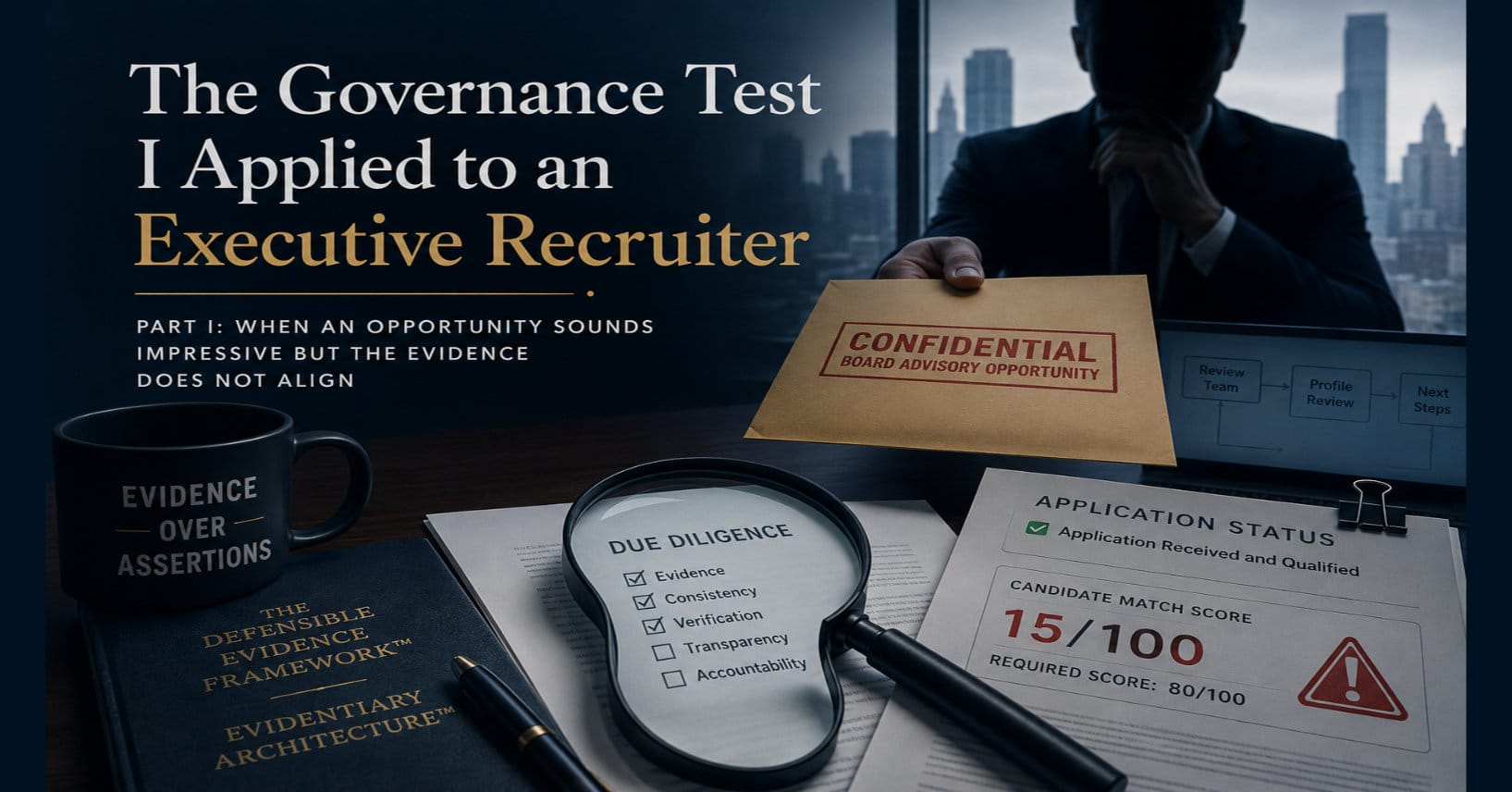
The recruiter also provided an applicant-tracking-system image showing the status of my candidacy.
The page stated:
Application Received and Qualified
It also showed:
Candidate Match Score: 15/100
The same page appeared to indicate that a score of 80/100 was required.
That created a direct contradiction.
The application could not logically have both met the qualification threshold and scored 65 points below the stated minimum without some additional explanation.
There may have been an innocent reason.
The score could have represented an incomplete profile.
The threshold could have applied to another stage.
The display could have contained a software defect.
The status may have been manually overridden.
But governance does not resolve contradictions by inventing explanations.
It asks for evidence.
I asked the recruiter to identify the ATS platform and explain how the scoring model produced a “qualified” status alongside a score of 15 when 80 was apparently required.
I also asked whether the search was being conducted on a retained basis, when the client’s identity would be disclosed, and whether an NDA would be required before disclosure.
Those questions were not answered.
The Response That Did Not Respond
The recruiter sent a lengthy and polished reply.
He explained why some candidates benefit from board-positioning specialists.
He clarified that the service was provided by a collaborative team rather than an individual consultant.
He emphasized that there was no requirement to use the service.
He repeated that my qualifications were strong.
He reiterated the review team’s interest in artificial intelligence governance, fiduciary oversight, enterprise risk, board education, measurable outcomes, and evidence-based governance.
What he did not do was answer the questions.
He did not identify the ATS.
He did not explain the 15/100 score.
He did not say whether the search was retained.
He did not explain when the client would be disclosed.
He did not address whether an NDA would be required.
This is an important governance distinction.
A response is not necessarily an answer.
Length is not evidence.
Professional language is not verification.
Reassurance is not transparency.
When a direct question produces a detailed reply that avoids the substance of the question, the absence itself becomes relevant evidence.
That led to the second phase of my investigation to be continued tomorrow.