Part Two: Following the Evidence Behind the Opportunity
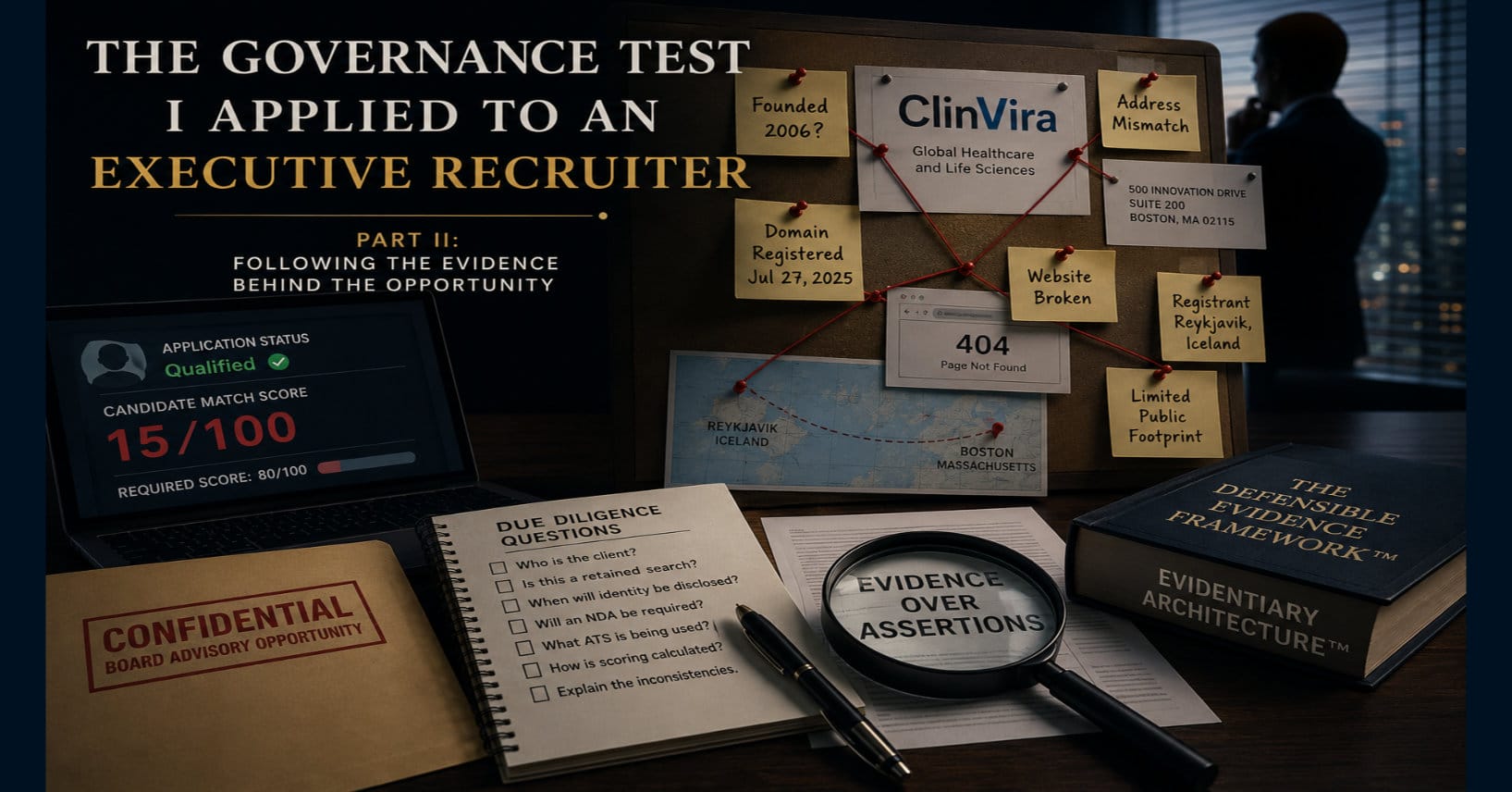
Summary: The second part of this case study moves beyond the recruiting narrative and examines publicly available evidence. Rather than attempting to prove fraud or legitimacy, I evaluate whether observable facts support the claims surrounding a confidential board opportunity. The investigation explores domain registration history, corporate addresses, website integrity, applicant tracking system inconsistencies, and public company information through the lens of evidence-based governance. The objective is not to accuse, but to demonstrate how governance professionals should reconcile inconsistencies before placing confidence in high-stakes opportunities.
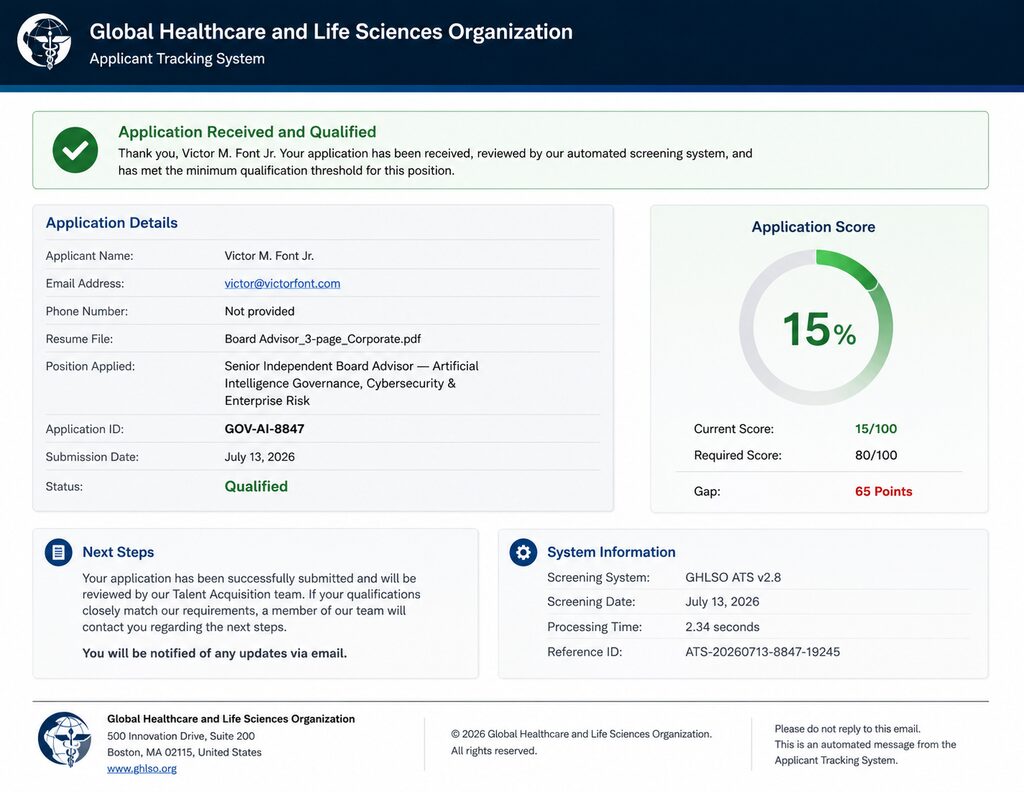
The applicant-tracking-system image contained an address.
That address became the starting point for independent verification.
The address appeared to be associated with a company called ClinVira, which presented itself as a healthcare and life sciences organization involved in clinical research, drug safety, digital health, or related services.
The recruiter had never identified ClinVira as the client.
I did not assume that ClinVira was the client.
I treated the connection as a hypothesis requiring verification.
That distinction is essential. Governance professionals should not convert circumstantial evidence into a factual conclusion merely because the pattern appears persuasive.
The proper question was not:
“Is ClinVira definitely the organization?”
The proper question was:
“Why does the evidence appear to point toward ClinVira, and can the recruiter explain the relationship?”
The Address Discrepancy
The address shown in the ATS appeared to be:
500 Innovation Drive, Suite 200 Boston, Massachusetts 02115
Public references associated ClinVira with the same general location, but the suite information did not consistently match.
An incorrect suite number may be trivial.
Organizations move within buildings.
Directories contain outdated information.
Virtual offices and shared workspaces may use different suite designations.
Data aggregation platforms frequently reproduce errors.
But this discrepancy did not exist in isolation.
It became part of a larger evidentiary pattern.
The Reported Founding Date
Search results and company profiles reportedly indicated that ClinVira was founded in 2006.
A company established in 2006 would have approximately two decades of operating history.
That does not guarantee a large public footprint, particularly for a privately held life sciences organization. Some clinical research, consulting, and specialized healthcare firms operate quietly.
Even so, a long operating history would normally produce some combination of:
- Archived websites
- Regulatory references
- Leadership histories
- Conference participation
- Scientific publications
- Client announcements
- Employment records
- Industry memberships
- Longstanding domain records
- Historical news coverage
The public footprint I found appeared much thinner and more recent than the reported founding date would suggest.
Again, that did not prove misconduct.
It required explanation.
The Domain Registration
A historical registration search for the company’s domain produced the following information:
Domain: clinvira.com
Registered: July 27, 2025
Expiration: July 27, 2027
Updated: June 28, 2026
The company was reportedly founded in 2006, but the current domain registration dated only to 2025.
There are legitimate reasons for this.
A company may have operated under another domain.
A prior registration may have expired.
The business may have changed ownership.
The domain may have been acquired recently.
The company may have rebranded.
Historical WHOIS data may not reflect the full history of a domain that was deleted and registered again.
Therefore, the registration date alone does not establish that the company itself began in 2025.
But it does establish that the current registration requires reconciliation with the reported 2006 history.
That is the difference between suspicion and governance analysis.
Suspicion says, “The dates do not match, so the company must be fraudulent.”
Governance analysis says, “The dates do not match. What evidence explains the difference?”
The Domain Registrant
The registration information appeared to connect the domain with an individual or privacy-related registration presence in Reykjavik, Iceland, rather than Boston, where the company reportedly maintained its headquarters.
Domain privacy services are common.
Many legitimate companies use registrars, privacy providers, hosting services, and technical administrators located in countries where they have no operational presence.
A Reykjavik registration reference is therefore not inherently suspicious.
However, governance risk is rarely determined by a single fact.
It is determined by relationships among facts.
In this case, the domain geography mattered because it accompanied:
- A recently registered domain
- A reported 2006 founding date
- A thin public history
- An apparently inconsistent corporate address
- A broken website
- An anonymous search mandate
- An unexplained ATS
- A contradictory applicant score
- An unaddressed question about an NDA
- A recommendation for outside branding services
The cumulative pattern justified a higher level of scrutiny.
The Website
The company’s website loaded a home page.
Most or all of the navigation links I tested returned 404 errors.
That meant the website appeared to present a corporate front page without functioning underlying content.
Websites break.
Content-management systems fail.
Permalinks become corrupted.
A deployment may be incomplete.
A company may be rebuilding its site.
A hosting migration may temporarily disrupt internal pages.
No responsible analysis should declare a business fraudulent merely because its website is poorly maintained.
But a broken website becomes more material when the organization is supposedly conducting a sophisticated board-level governance search involving artificial intelligence, cybersecurity, regulatory preparedness, fiduciary oversight, global operations, and compensation exceeding half a million dollars annually.
The issue was not merely technical quality.
It was organizational congruence.
Did the visible organizational footprint align with the scale, sophistication, and compensation represented in the recruiting narrative?
That question remained unanswered.
The LinkedIn Presence
ClinVira also appeared to have a LinkedIn company profile.
The page reportedly contained approximately 15 posts, primarily from seven to nine months earlier, followed by no recent activity.
A quiet LinkedIn page is not unusual.
Some companies do not prioritize social media.
Others post in campaigns and then stop.
Smaller organizations may lack dedicated marketing staff.
Yet the apparent timing of the LinkedIn activity roughly corresponded with the recent domain registration period rather than the reported 2006 founding date.
That did not prove the company was newly created.
It did, however, reinforce the need for historical evidence.
The Third-Party Profile
A short ClinVira profile also appeared on RocketReach.
Third-party business directories can be useful starting points, but they are not authoritative evidence of corporate existence, size, leadership, revenue, or operating history.
Such services often aggregate information from public databases, scraped websites, professional profiles, user submissions, and other secondary sources.
The presence of a company in a commercial directory does not independently validate every claim associated with it.
It shows that data about the company exists.
It does not establish that the data is accurate.
The Questions Sent to the Recruiter
After identifying these discrepancies, I wrote to the recruiter again.
I explained that my work through The Defensible Evidence Framework™ and Evidentiary Architecture™ is grounded in a simple principle:
Significant decisions should be supported by verifiable evidence rather than assertions.
I then asked him to address the unresolved questions.
Was this a retained search?
When would the client be identified?
Would an NDA be required?
What ATS platform generated the candidate record?
How could the system classify the application as qualified while reporting a 15/100 score against an 80/100 threshold?
Was ClinVira connected to the mandate?
Why did the ATS address appear inconsistent with the company’s public address?
How did the organization reconcile a reported 2006 founding date with a domain registered in 2025?
Why was the website largely nonfunctional?
What explained the limited and recent public activity?
These were not accusations.
They were requests for reconciliation.
A credible answer could have resolved every one of them.
The Silence
Before that email, the recruiter had typically responded by the next day.
After the evidentiary questions became explicit, the communication stopped—at least as of the time this article was written.
Silence is not proof of wrongdoing.
People become busy.
Recruiters wait for clients.
Legal counsel may need to review a response.
A company may determine that a candidate’s questioning is incompatible with its preferred process.
The recruiter may still respond.
But timing is evidence.
A change in communication pattern after specific due-diligence questions is relevant, even though it is not conclusive.
The appropriate conclusion is not that silence proves deception.
The appropriate conclusion is that silence does not resolve the discrepancies.
What This Process Demonstrated
This experience was not ultimately about whether one recruiter was legitimate.
It was about how professionals evaluate credibility.
The recruiting narrative contained many persuasive elements:
A prestigious role.
Exceptional compensation.
Direct board access.
Repeated praise.
A limited candidate pool.
Time-sensitive decision-making.
A highly aligned mandate.
A review team that supposedly recognized the candidate’s distinctive strengths.
Each statement may have been true.
But none was independently verified.
That is the governance problem.
Boards encounter the same pattern every day.
Management says a control is effective.
A technology team says a system is secure.
A vendor says a platform is compliant.
An artificial intelligence provider says its model is explainable.
A risk report says exposure is acceptable.
An audit dashboard says remediation is complete.
A policy says oversight exists.
The words may be accurate.
But governance cannot stop with the words.
It must ask:
What evidence supports the statement?
Who produced the evidence?
Can it be independently verified?
Are the records internally consistent?
Do the organization’s actions align with its claims?
What remains unexplained?
What should exist but does not?
Assertions and Evidence
The recruiter asserted that a review team had examined my profile.
No individuals were identified.
He asserted that the client had specific governance priorities.
No committee charter, board structure, or client identity was provided.
He asserted that my profile was qualified.
The ATS displayed 15/100 against an apparent 80/100 threshold.
He asserted that timing was important.
No interview, NDA, or client disclosure followed.
He asserted that outside board-positioning support might strengthen my candidacy.
No specific deficiencies were documented.
He asserted that the process was continuing.
The foundational due-diligence questions remained unanswered.
Any one of those facts might have an innocent explanation.
The governance issue was not whether an explanation was possible.
The issue was whether an explanation was provided.
The Governance Test
The test I applied was straightforward.
I did not ask whether the opportunity sounded credible.
I asked whether the evidence was coherent.
I did not ask whether the recruiter sounded professional.
I asked whether direct questions produced direct answers.
I did not ask whether the company might be legitimate.
I asked whether its observable footprint aligned with the represented scale of the mandate.
I did not conclude that a contradiction proved fraud.
I asked for the contradiction to be reconciled.
I did not reject the opportunity based on instinct.
I followed the evidence until the process either substantiated itself or failed to do so.
That is the governance test.
The Reader’s Decision
I am deliberately not declaring that this was a scam.
The available evidence does not justify a definitive public accusation.
There may be explanations I have not received.
The recruiter may eventually provide documentation establishing that the mandate, organization, ATS, compensation, and review process were legitimate.
ClinVira may have a long and credible operating history that is not apparent from its current public footprint.
The website may be undergoing repair.
The address may reflect a simple directory error.
The ATS score may be a display defect.
The domain may have been recently reacquired after years of prior use.
The branding referral may have been entirely well-intentioned.
All of those explanations are possible.
But possibility is not evidence.
The audience can decide how much confidence should be placed in a recruiting process that produced substantial praise, extraordinary compensation, apparent urgency, and repeated assurances—but did not produce clear answers to basic verification questions.
My conclusion is narrower.
When a professional opportunity depends upon trust, trust should not require the suspension of due diligence.
A credible process should become more transparent as it advances.
It should produce more evidence, not merely more persuasion.
And when reasonable questions expose inconsistencies, the questions should be answered directly.
That standard should apply in the boardroom.
It should apply to artificial intelligence governance.
It should apply to cybersecurity oversight.
It should apply to third-party risk.
And it should apply when an executive recruiter arrives with what appears to be the perfect opportunity.