AI Governance Series | Article 1 of 20
Governing Intelligence Before It Governs You
Summary: Artificial intelligence is no longer a technology initiative that can be delegated entirely to IT. As AI increasingly influences strategic decisions, customer interactions, regulatory compliance, and organizational risk, oversight has become a board-level responsibility. This article explains why directors must shift from viewing AI as an operational tool to governing it as an enterprise capability. It introduces the governance principles that enable boards to oversee AI responsibly through accountability, risk management, and informed decision-making rather than technical implementation.
For years, organizations viewed artificial intelligence as another technology initiative. It belonged to the CIO. Data scientists built the models. IT deployed the infrastructure. Security assessed the risks. Legal reviewed the contracts.
That governance model is already becoming obsolete.
AI is no longer confined to the technology department. It is influencing hiring decisions, customer interactions, financial forecasting, legal research, software development, healthcare, supply chains, cybersecurity, and strategic planning. It is shaping business outcomes across nearly every function of the enterprise.
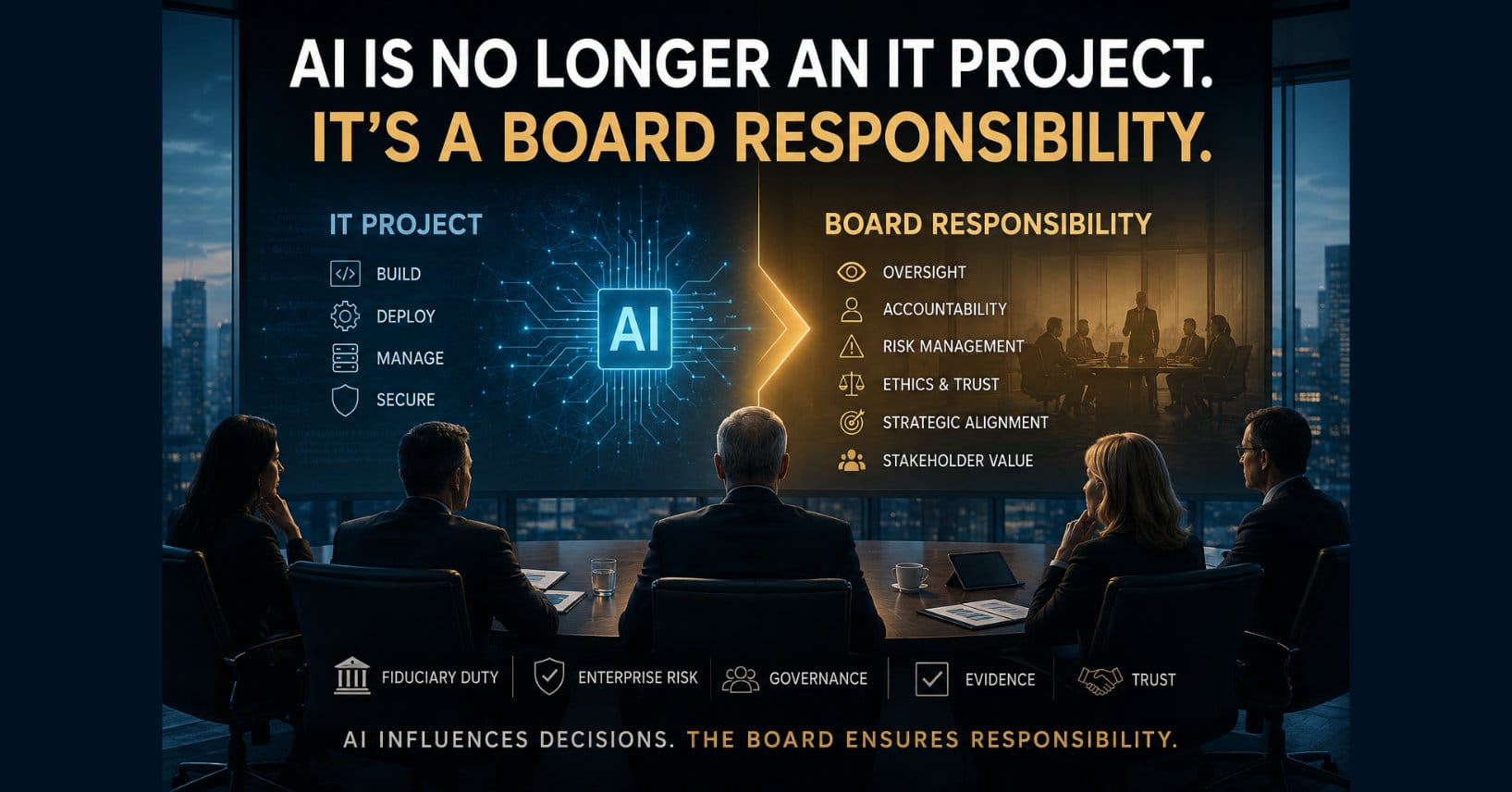
When technology begins influencing business decisions, it ceases to be merely an IT issue.
It becomes a board issue.
Organizations that recognize this shift early will build AI on a foundation of accountability and trust. Those that do not may discover that the greatest risk AI introduces isn’t technological failure—it’s governance failure.
AI Is Moving Faster Than Governance
Every major technological revolution follows the same pattern.
Innovation arrives first.
Governance catches up later.
Cloud computing, social media, cybersecurity, and digital transformation all experienced rapid adoption long before organizations developed mature governance practices. Artificial intelligence is following the same path—but at an unprecedented pace.
Generative AI entered the workplace in months, not years. Employees began using public AI tools before many organizations had written a single policy. Business units acquired AI-powered applications without centralized oversight. Vendors quietly embedded AI into existing products, often without customers fully appreciating the governance implications.
Technology has never evolved this quickly.
Governance has never had less time to respond.
The Board’s Role Has Changed
Many directors still assume AI oversight belongs somewhere within management.
Operational responsibility does.
Governance responsibility does not.
Management is responsible for implementing and operating AI systems.
The board is responsible for overseeing the risks those systems introduce.
That distinction is critical.
Boards are not expected to understand neural networks, large language models, or transformer architectures. They are expected to ensure the organization understands the risks associated with those technologies, establishes appropriate oversight, and holds management accountable for responsible use.
That means asking governance questions such as:
- Where is AI being used across the enterprise?
- Who approved those uses?
- How are AI-related risks identified and assessed?
- Who owns AI governance?
- How are controls monitored?
- How does management demonstrate effective oversight?
- What evidence exists that governance is actually working?
These are not technical questions.
They are governance questions.
AI Is Becoming a Fiduciary Matter
Boards already have a fiduciary responsibility to oversee enterprise risk.
Artificial intelligence is rapidly becoming part of that responsibility.
An AI model that introduces discriminatory hiring practices creates legal and reputational exposure.
An AI-generated financial recommendation can influence investor confidence.
An AI-assisted clinical decision can affect patient safety.
An AI-powered cybersecurity platform can either prevent or contribute to significant incidents.
Each of these scenarios extends well beyond technology.
Each represents a governance event.
The question after a significant AI failure will not simply be:
“Why did the AI fail?”
It may instead become:
“How did the board oversee AI before it failed?”
That is a very different conversation.
Enterprise Governance, Not IT Governance
One of the most common misconceptions surrounding AI is that it belongs within the IT department.
It doesn’t.
AI now affects Human Resources, Finance, Legal, Marketing, Operations, Customer Service, Product Development, Cybersecurity, Compliance, and nearly every other business function.
No single department owns those risks.
Enterprise governance must.
Effective AI governance requires collaboration among executive leadership, legal counsel, compliance, enterprise risk management, cybersecurity, privacy, internal audit, and business leaders. Boards should expect AI governance to be presented as an enterprise capability—not simply another software implementation.
Governance Requires More Than Policy
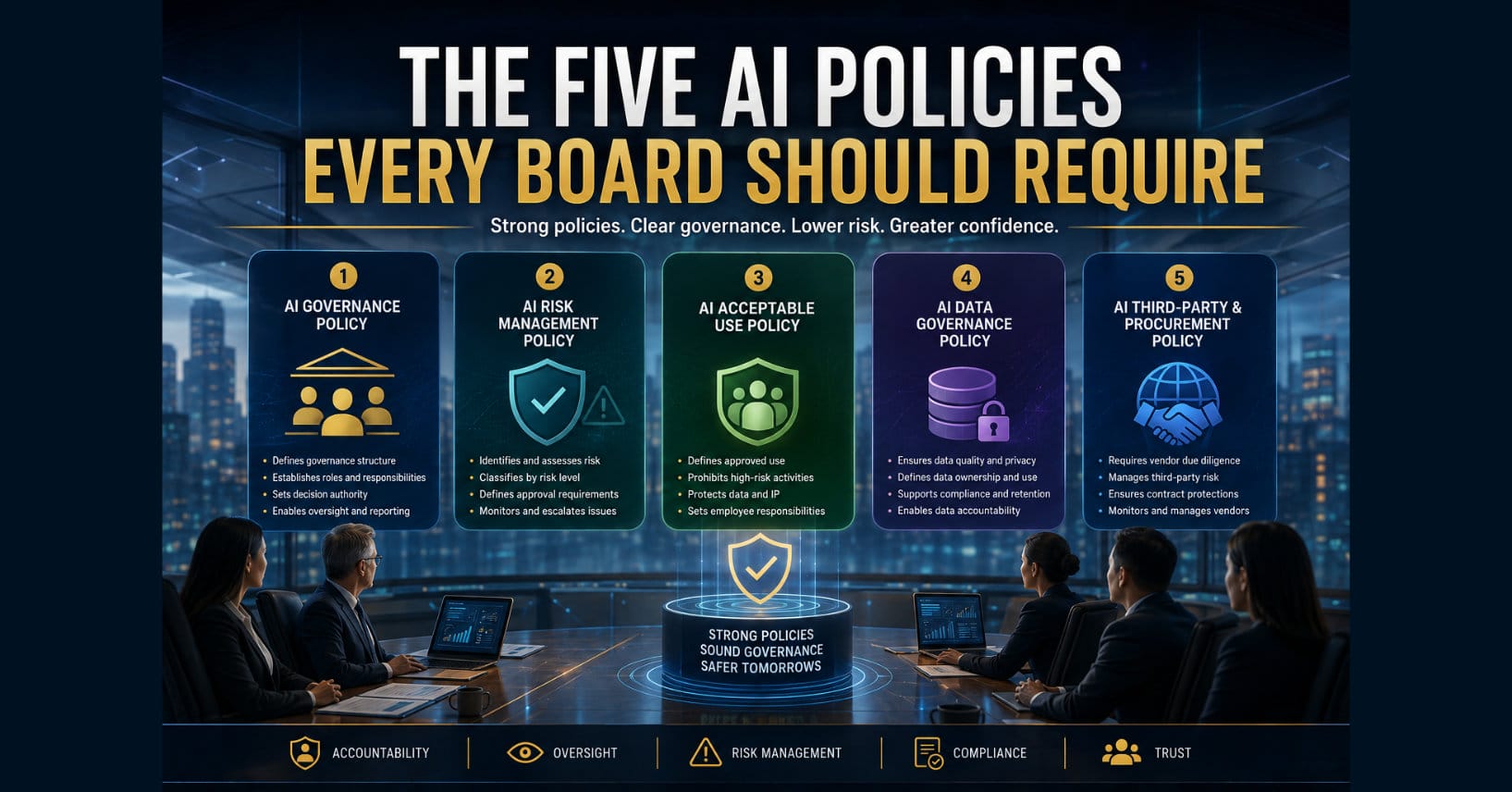
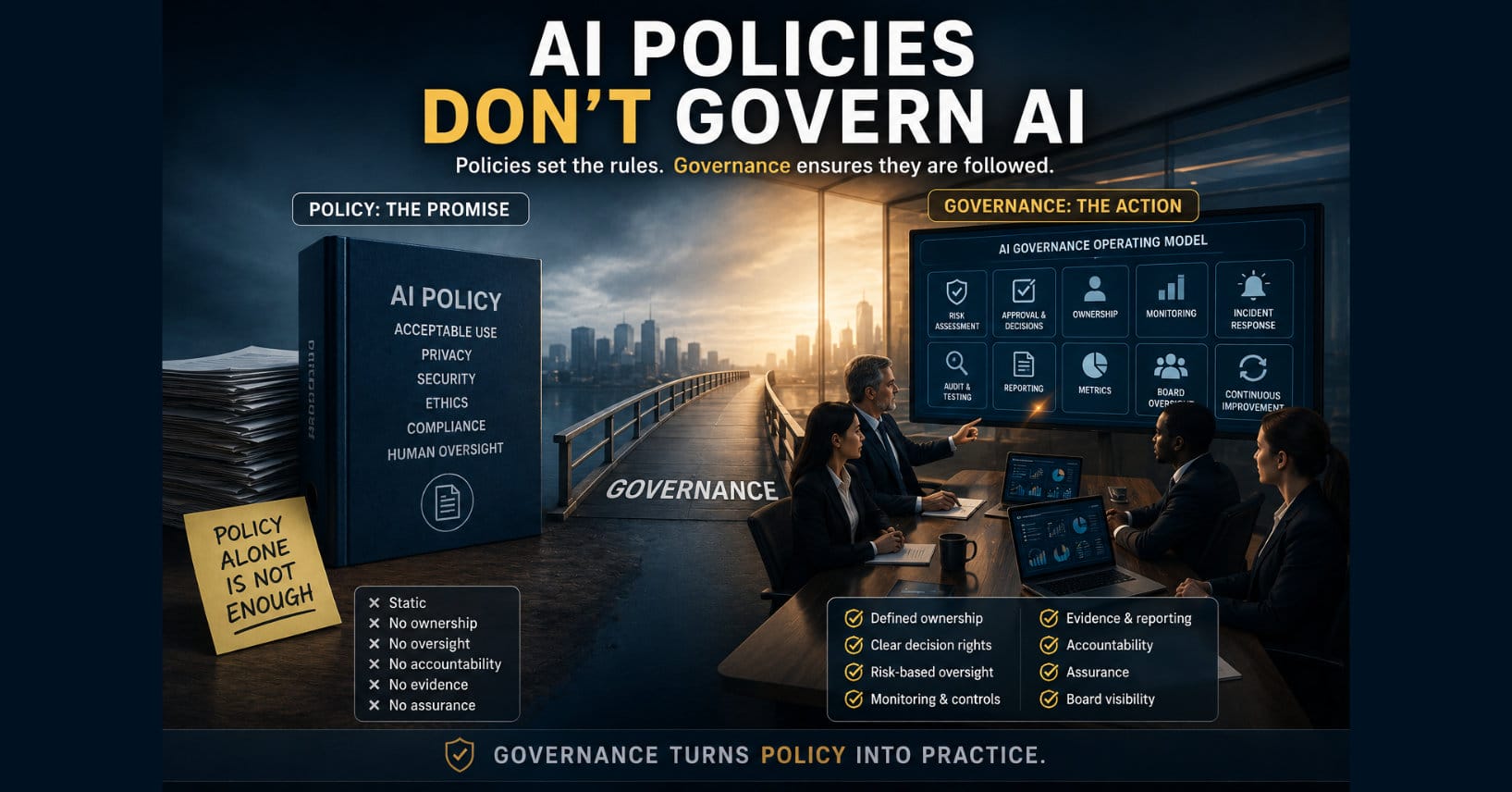
Many organizations believe they have addressed AI governance because they published an AI policy.
Policies are important.
They are only the beginning.
Governance requires clear authority.
Governance requires accountability.
Governance requires oversight.
Governance requires continuous monitoring.
Governance requires assurance.
Most importantly, governance requires organizations to demonstrate that these activities are actually occurring.
A policy describes what should happen.
Governance demonstrates what did happen.
That distinction will become increasingly important as regulators, investors, insurers, and other stakeholders begin asking not whether an organization has an AI policy, but whether it can demonstrate effective AI oversight.
Governance Enables Innovation
Some executives still view governance as an obstacle to innovation.
The opposite is often true.
Organizations with mature governance structures adopt emerging technologies more confidently because they establish decision rights, define accountability, and create repeatable oversight processes before problems emerge.
Good governance accelerates responsible innovation.
Poor governance delays innovation through uncertainty, inconsistent decisions, and reactive crisis management.
The organizations that lead the AI era will not necessarily have the most sophisticated models.
They will have the strongest governance.
The Boardroom Conversation Is Changing
For decades, board discussions about technology focused on infrastructure investments, cybersecurity, digital transformation, and budgets.
Artificial intelligence changes that conversation.
Boards should now be asking:
- Which critical business decisions are influenced by AI?
- Where does executive accountability begin and end?
- How is AI incorporated into enterprise risk management?
- How are third-party AI services governed?
- How does management demonstrate responsible oversight?
These are no longer questions for the future.
They are governance questions for today.
Organizations that continue treating AI as simply another IT initiative risk building transformative technology on an immature governance foundation.
That foundation often isn’t tested until something goes wrong.
By then, the discussion is no longer about innovation.
It is about accountability.
Boardroom Takeaway
Artificial intelligence has crossed the line from operational technology to enterprise governance. Boards are not expected to build AI systems, but they are expected to ensure those systems are governed, accountable, and aligned with the organization’s fiduciary responsibilities. Organizations that recognize this shift early will be better positioned to innovate responsibly, earn stakeholder trust, and demonstrate effective oversight as expectations continue to rise.
Coming Next
The AI Accountability Gap
Most organizations can explain what their AI systems do. Far fewer can explain who is accountable for them. In the next article, we’ll examine why accountability—not technology—is becoming the defining challenge of AI governance and why clear ownership is the foundation of responsible AI oversight.