AI Governance Series | Article 6 of 20
Governing Intelligence Before It Governs You
Summary: AI hallucinations dominate headlines, but they are rarely the root cause of organizational failure. The greater risk is weak governance—unclear ownership, missing oversight, inadequate controls, and poor accountability. This article explains why boards should focus less on eliminating every technical error and more on building governance structures that prevent isolated AI failures from escalating into regulatory, operational, financial, or reputational crises. Mature governance assumes technology will occasionally fail and ensures the organization is prepared to respond.
Ask someone to name the greatest risk in artificial intelligence, and you’ll likely hear the same answer.
Hallucinations.
AI generating false information has become the defining image of AI risk. News headlines reinforce it. Product demonstrations showcase it. Vendors build features to reduce it.
Hallucinations are real.
They are not the greatest governance risk.
The most dangerous AI failures rarely begin with technology.
They begin with governance.
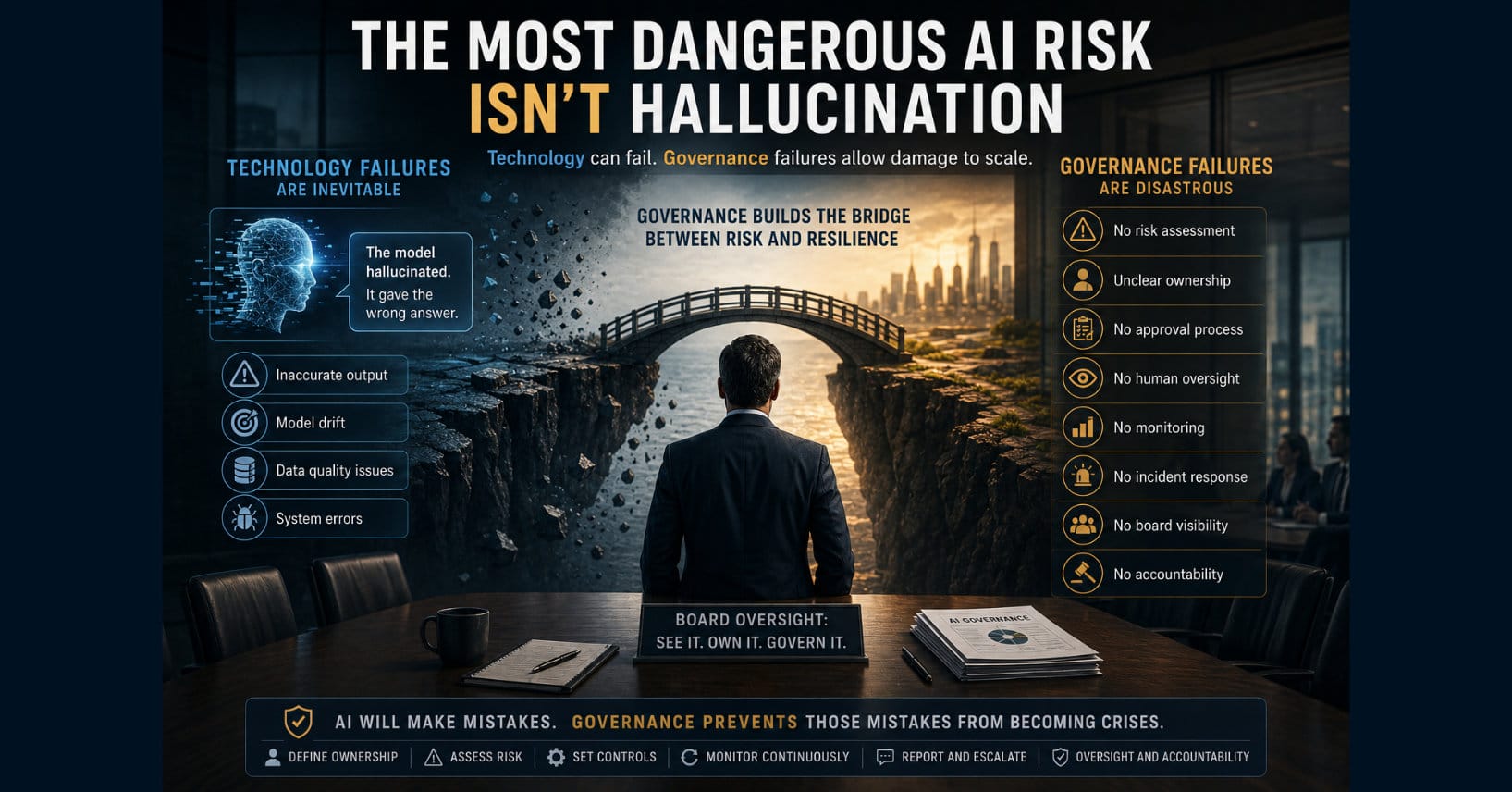
Technology Fails. Governance Allows Failure to Scale.
An AI model may produce an inaccurate answer.
Good governance asks a different question:
Why was the organization in a position where that inaccurate answer could create material harm?
Perhaps no one identified the system as high risk.
Perhaps no approval process existed before deployment.
Perhaps no human review was required.
Perhaps ownership was unclear.
Perhaps monitoring stopped after implementation.
The hallucination was merely the final event in a chain of governance failures.
Technology produced the symptom.
Governance created the conditions.
Most Enterprise AI Incidents Are Preventable
Organizations often invest enormous effort in improving model performance while investing relatively little in governing how AI is introduced into the enterprise.
The result is predictable.
Excellent technology.
Immature governance.
An AI system doesn’t suddenly become dangerous because it produces one incorrect response.
It becomes dangerous when the organization lacks controls that recognize, contain, and respond to that failure.
Governance exists precisely because perfection is impossible.
The Bigger Risk Is Uncontrolled Deployment
Consider two organizations using identical AI models.
The first organization:
- Identifies business risks before deployment.
- Defines ownership.
- Requires executive approval for high-risk use cases.
- Documents decision rationale.
- Monitors outcomes.
- Reviews incidents.
- Adjusts controls over time.
The second organization:
- Allows business units to deploy AI independently.
- Has no inventory of AI systems.
- Assigns no decision owner.
- Conducts no periodic governance review.
- Assumes the technology team will solve problems as they appear.
The models are identical.
The enterprise risk is not.
The difference is governance.
Governance Failures Compound
Technology failures are usually isolated.
Governance failures multiply.
An undocumented AI deployment can create regulatory exposure.
Unclear ownership delays incident response.
Missing oversight allows bias to persist unnoticed.
Poor reporting prevents executives from understanding enterprise risk.
Weak board visibility leaves directors unable to exercise effective oversight.
Each governance weakness amplifies the next.
By the time a technical failure becomes visible, multiple governance opportunities may already have been missed.
Boards Cannot Eliminate Technical Errors
Directors should not expect AI systems to become flawless.
They should expect management to build governance systems that anticipate imperfection.
Boards ask questions like:
What controls exist?
Who reviews high-risk decisions?
How are incidents escalated?
How often are governance controls tested?
What evidence demonstrates ongoing oversight?
Those questions remain valuable whether the AI is 90% accurate or 99.9% accurate.
Governance assumes technology will occasionally fail.
It prepares the organization for that reality.
Governance Creates Organizational Resilience
Organizations with mature governance recover more quickly because they already know:
Which AI systems are affected.
Who owns them.
Which business processes depend upon them.
Which controls should activate.
Who communicates with regulators.
Who informs customers.
Who reports to the Board.
Governance transforms unexpected failures into manageable events.
Without governance, even minor technical problems can become enterprise crises.
Hallucinations Are Easy to Notice
Governance failures are much harder to detect.
A fabricated answer is visible.
A missing approval process is invisible.
A biased output attracts attention.
An undefined decision owner does not.
A model failure becomes public.
Weak oversight often remains hidden until investigators begin asking questions.
That’s why governance deserves more attention than technology alone.
The most damaging risks are often the ones organizations never thought to govern.
Boardroom Takeaway
Technical failures such as hallucinations are inevitable. Governance failures are preventable. Effective boards focus less on eliminating every AI error and more on ensuring the organization has the oversight, ownership, controls, and accountability needed to prevent isolated technology failures from becoming enterprise-wide crises.
Coming Next
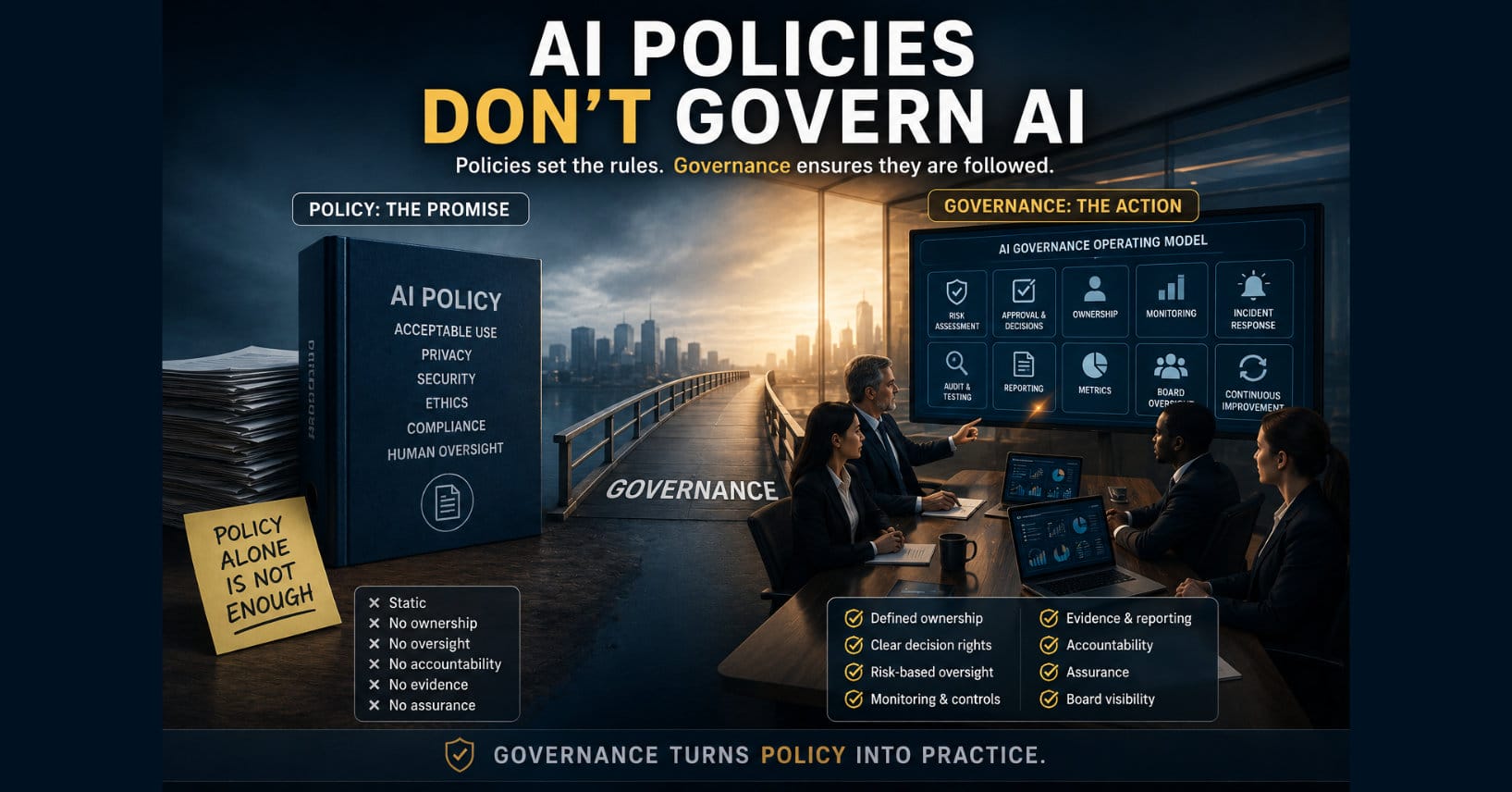
AI Policies Don’t Govern AI
Many organizations respond to AI by writing new policies. Policies are necessary—but they are only one component of governance. The next article explains why policies alone cannot govern AI, and why effective governance requires accountability, decision rights, oversight, and evidence in addition to written rules.