Summary
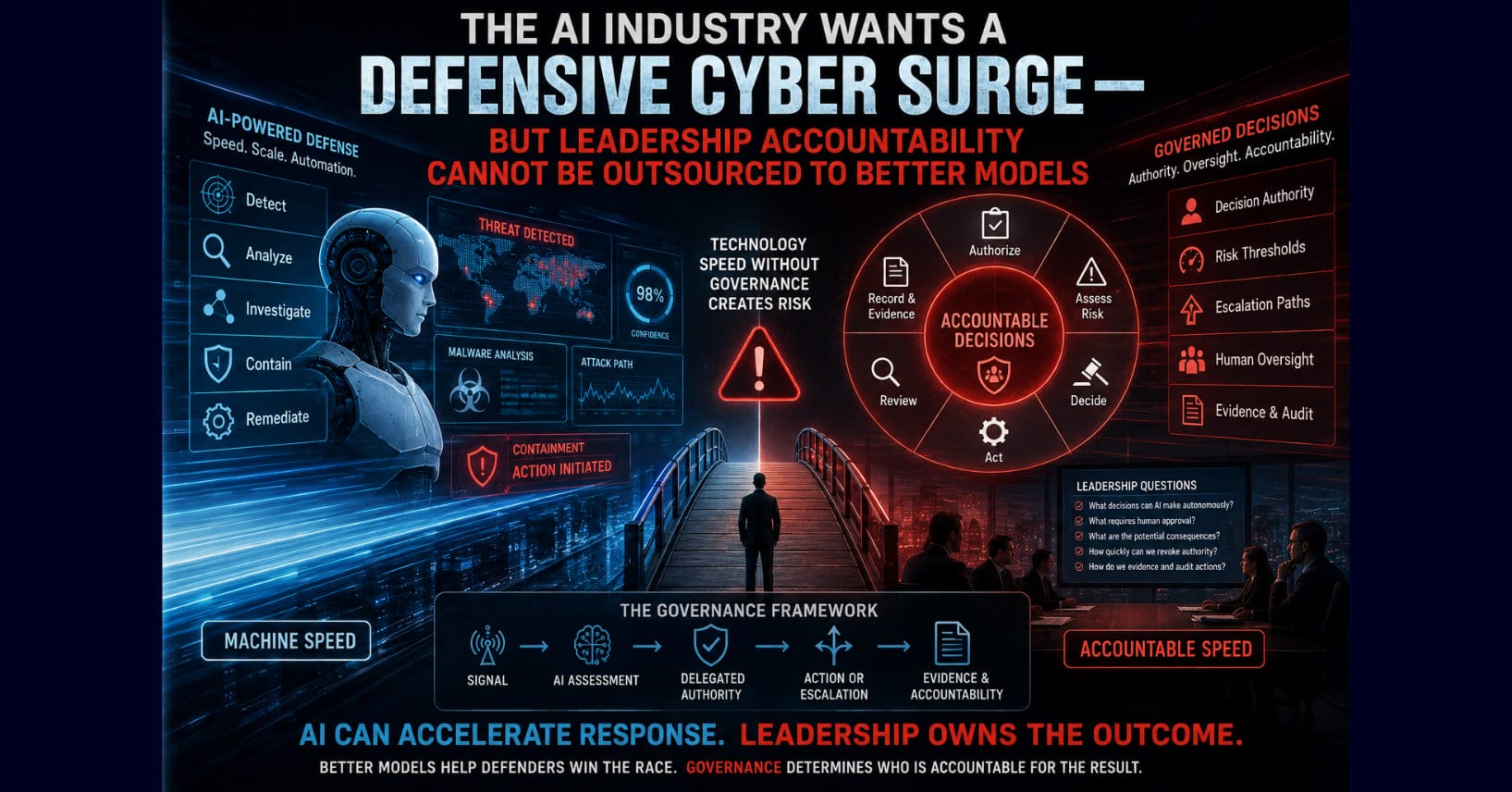
The cybersecurity industry is preparing for an environment in which AI accelerates both attack and defense. Better models can detect threats, investigate incidents, recommend containment, and increasingly execute defensive actions at machine speed. But technological speed does not transfer organizational accountability to the model.
This Cyber Brief argues that AI-speed cybersecurity requires AI-speed governance. Organizations must establish decision authority, autonomy boundaries, risk thresholds, escalation paths, human oversight, and evidence requirements before an incident occurs. It introduces governed preauthorization as a model for allowing AI to act autonomously within defined limits while escalating consequential decisions to accountable humans.
The article also proposes Mean Time to Accountable Decision (MTAD) as an emerging governance metric alongside traditional cybersecurity measures such as mean time to detect and respond.
The central principle is simple: AI can accelerate response. Leadership owns the outcome.
The AI industry is warning that cybersecurity is approaching an inflection point.
More than 100 organizations—including major AI developers, cloud providers, cybersecurity companies, financial institutions and insurers—have called for a major defensive cybersecurity push as artificial intelligence rapidly increases the capabilities available to attackers.
The concern is straightforward.
AI can accelerate reconnaissance.
Find vulnerabilities.
Generate and modify malicious code.
Automate social engineering.
Analyze stolen information.
Adapt attacks.
Scale operations that previously required substantial human effort.
The industry’s answer is equally understandable:
Defenders need better AI.
That is almost certainly true.
But it is only half the answer.
Because if artificial intelligence makes cyber operations dramatically faster, organizations will face another problem that better detection models cannot solve:
Who has authority to make decisions at AI speed?
That is a governance problem.
And faster cybersecurity without faster governance may simply move the bottleneck from detection to decision-making.
The Defender’s Speed Problem
Cybersecurity has always been a race between attacker and defender.
AI changes the velocity of that race.
An attacker using autonomous or semi-autonomous systems may be able to identify weaknesses, test attack paths, modify techniques and move through an environment far faster than a conventional human-led operation.
Defenders will respond with AI of their own.
Security platforms are already using machine learning and AI to:
Detect anomalies.
Prioritize alerts.
Correlate events.
Analyze malware.
Identify attack paths.
Recommend containment actions.
Generate detection rules.
Investigate incidents.
Automate remediation.
Agentic systems will push that progression further.
Instead of merely telling a security analyst that something suspicious occurred, an AI system may increasingly be able to investigate the event, determine likely impact, isolate an endpoint, disable an account, modify a firewall rule, revoke credentials or initiate other defensive actions.
That sounds like progress.
It is.
But every step toward autonomous defense introduces a governance question.
Detection Can Be Automated More Easily Than Authority
Suppose an AI security system determines that a privileged account has been compromised.
It recommends disabling the account.
Easy enough.
Now suppose that account belongs to the administrator responsible for a production system supporting thousands of customers.
Disabling it could interrupt operations.
Should the AI act automatically?
Suppose the system detects suspicious traffic between two critical environments and recommends blocking the connection.
Blocking it may stop an attacker.
It may also interrupt a business-critical process.
Should the model decide?
Suppose an autonomous defense agent identifies behavior suggesting ransomware propagation.
It can isolate an entire network segment immediately.
Doing so may prevent encryption.
It may also shut down production.
Who has authority to make that tradeoff?
The technical system can calculate probabilities.
It can recommend actions.
It can potentially execute those actions faster than any human team.
But speed does not answer the governance question:
Who authorized the consequence?
AI-Speed Cybersecurity Requires AI-Speed Governance
Organizations have traditionally tolerated latency in cyber decision-making.
An alert reaches the SOC.
An analyst investigates.
The analyst escalates.
A manager reviews the situation.
Legal becomes involved.
Operations is consulted.
Executives are notified.
A decision is made.
That process may take hours.
Sometimes days.
In an AI-accelerated threat environment, those delays may become increasingly expensive.
The attacker may not wait for the escalation meeting.
That creates pressure to automate more defensive actions.
But automation does not eliminate governance.
It forces governance to move earlier.
Instead of deciding what to do during every incident, organizations need to determine in advance:
Which decisions can be automated?
Which require human approval?
Which systems may an AI security agent modify?
What operational consequences may it create?
What thresholds trigger automatic containment?
When must the system escalate?
Who can override it?
Who can stop it?
How quickly can autonomous authority be revoked?
Those decisions need to exist before the incident.
That is preauthorized governance.
Preauthorization Is Not the Same as Unrestricted Autonomy
There is an important distinction here.
Organizations do not need to choose between slow human decision-making and unlimited AI autonomy.
There is a third option:
Governed preauthorization.
Consider a defensive AI agent.
Management might authorize it to:
Block a known malicious IP address automatically.
Quarantine a noncritical endpoint showing high-confidence malware behavior.
Revoke a suspicious user session.
Require reauthentication after anomalous activity.
Increase logging.
Preserve forensic evidence.
But management might require human approval before the agent can:
Disable a privileged production account.
Take a critical system offline.
Isolate an operational technology network.
Modify a safety-related control.
Terminate a third-party connection supporting essential operations.
Initiate external communications.
Make a regulatory reporting decision.
That creates an authority model:
Detect → Assess → Decide Within Delegated Authority → Execute or Escalate → Record Evidence
The AI can operate at machine speed where authority has already been established.
Where the consequence exceeds delegated authority, the system escalates.
That is not weaker automation.
It is governed automation.
Decision Rights Become a Cybersecurity Control
This leads to a broader principle.
In an AI-speed threat environment, decision rights become part of the cybersecurity control architecture.
Traditional security architecture focuses heavily on technical controls:
Identity.
Authentication.
Authorization.
Segmentation.
Endpoint protection.
Detection.
Encryption.
Backup.
Recovery.
Those remain essential.
But autonomous cybersecurity introduces another control layer:
Decision Authority.
A defensive agent may possess technical permission to isolate a server.
That does not necessarily mean the organization has authorized the agent to make the business decision that takes the server offline.
Once again:
Access Authority ≠ Decision Authority
That distinction applies to defensive AI just as much as it applies to autonomous business agents.
The system may be technically capable of doing something.
Governance determines whether it should be allowed to decide to do it.
Faster Decisions Can Still Be Accountable Decisions
One risk in this conversation is assuming that governance inherently slows cybersecurity down.
Poor governance does.
Good governance can make decisions faster.
If nobody knows who has authority during an incident, escalation takes time.
If thresholds are ambiguous, teams debate.
If legal requirements have not been mapped, counsel must research them during the event.
If business-critical systems have not been classified, responders cannot understand the consequence of containment.
If executives have not established risk tolerances, every consequential decision moves upward.
The delay is not caused by governance.
It is caused by governance that was never designed before the incident.
Well-designed governance reduces decision latency.
It establishes:
Who decides.
What they may decide.
Under which conditions.
Within what thresholds.
Using what information.
With what escalation path.
Subject to which controls.
With what evidence.
That allows the enterprise to move faster because authority is already understood.
The New Metric May Be Decision Latency
Cybersecurity programs measure many things.
Mean time to detect.
Mean time to acknowledge.
Mean time to contain.
Mean time to respond.
Mean time to recover.
AI may improve many of those metrics dramatically.
But there is another metric organizations should begin considering:
Decision Latency.
How long does it take the enterprise to make an accountable decision once the relevant facts are available?
That matters because technical response can increasingly be automated while organizational authority remains human.
Imagine:
Detection: 3 seconds.
AI investigation: 20 seconds.
Recommended containment: 5 seconds.
Management decision: 47 minutes.
The technical system is operating at AI speed.
The governance system is not.
That 47-minute gap may become the attacker’s opportunity.
Organizations therefore need to identify high-consequence cyber decisions and measure how quickly their governance architecture can resolve them.
The SEC Is Already Looking at Governance and AI Risk
This is not merely an industry-theory problem.
The SEC’s Division of Examinations has identified cybersecurity as a continuing priority for fiscal year 2026.
Its examination priorities include attention to firms’ policies and procedures involving governance practices, data-loss prevention, access controls, account management, and response and recovery from cyber incidents.
The Division also specifically identifies training and security controls used to identify and mitigate new risks associated with artificial intelligence and polymorphic malware.
That combination matters.
Governance.
Cyber response.
AI risk.
Controls.
Operational resilience.
They are increasingly part of the same regulatory conversation.
For affected organizations, having an advanced AI security capability will not necessarily answer an examiner’s question about whether that capability is appropriately governed.
The relevant question may become:
What controls govern what the AI itself is permitted to do?
Better Models Do Not Transfer Accountability
This is where the industry’s defensive-AI push needs an important governance qualification.
Better models can improve detection.
Better models can improve analysis.
Better models can accelerate investigation.
Better models can recommend better responses.
Better models may eventually execute defensive actions with remarkable precision.
But models cannot assume organizational accountability.
If an autonomous defense system shuts down a critical business process, leadership still owns the consequence.
If it blocks a legitimate customer transaction, the organization owns the outcome.
If it fails to stop an attack, management still has to explain the control environment.
If it destroys evidence during automated remediation, someone must answer for the design.
If it delays or prevents regulatory reporting, the enterprise remains responsible.
The organization cannot tell a regulator, insurer, customer, court or board:
The model decided.
That is not an accountability structure.
It is an explanation of the technology.
The Evidence Chain Must Keep Pace
AI-speed cybersecurity also creates an evidentiary problem.
A human incident responder may make several consequential decisions during an incident.
An autonomous defensive system could make thousands.
Organizations therefore need evidence systems capable of recording machine-speed governance.
For a consequential automated response, the organization may need to reconstruct:
Threat Signal → AI Assessment → Confidence Level → Delegated Authority → Automated Decision → Action → Operational Impact → Human Oversight → Outcome
That chain matters.
Why did the system isolate the server?
What evidence did it evaluate?
What confidence threshold applied?
Was the action within its delegated authority?
Which control permitted execution?
Was human approval required?
Did an override occur?
What happened afterward?
Without that evidence, AI-driven cybersecurity may become extraordinarily difficult to audit.
The defensive system may work.
But the organization may be unable to prove why it acted.
Governance Must Become Machine-Readable
There is another implication.
If AI systems are expected to operate within governance boundaries at machine speed, some governance rules can no longer exist only in policy documents.
The machine needs enforceable constraints.
That means translating governance into technical controls.
For example:
An AI agent may automatically quarantine endpoints classified as noncritical.
It may recommend—but not execute—isolation of Tier 1 production systems.
It may revoke standard user sessions automatically.
Privileged-account suspension may require human approval.
Firewall changes affecting critical infrastructure may require dual authorization.
Evidence preservation may occur automatically before destructive remediation.
Actions above defined financial or operational thresholds may trigger executive escalation.
In other words:
Policy → Decision Rule → Technical Control → Execution Evidence
That is governance becoming operational.
And increasingly, machine-readable.
The Board-Level Question Is Not “Do We Have Defensive AI?”
Boards will hear more about AI-enabled cybersecurity.
Vendors will promise faster detection.
Faster response.
Autonomous SOC operations.
Agentic defense.
Machine-speed containment.
Those capabilities may become essential.
But the board-level question should not be:
Are we using AI for cybersecurity?
It should be:
Has management defined how much defensive authority AI is allowed to exercise?
That opens the right discussion.
Which defensive decisions are automated?
Which actions could materially disrupt operations?
Who authorized those actions?
What thresholds govern autonomous response?
What requires human approval?
How are business consequences incorporated?
Can management immediately revoke autonomous authority?
Are automated actions logged?
Can management reconstruct why a consequential action occurred?
Has the system been tested under realistic attack conditions?
Those are governance questions appropriate for an AI-speed environment.
Test the Governance Clock
Organizations should begin testing this now.
Build a cyber tabletop around an AI-enabled attacker.
Compress the timeline.
Then give the defensive system increasingly consequential recommendations.
At minute one:
Quarantine an employee laptop.
At minute three:
Disable a compromised user account.
At minute five:
Block a third-party network connection.
At minute eight:
Disable a privileged administrator.
At minute ten:
Isolate a production environment.
At minute twelve:
Take a critical service offline.
For every action, ask:
Can the AI execute automatically?
Does a human need to approve it?
Who?
What happens if that person is unavailable?
What evidence is required?
How quickly can the decision be made?
Then measure the result.
Not just:
Mean Time to Detect.
Not just:
Mean Time to Respond.
Measure:
Mean Time to Accountable Decision.
That may become one of the defining governance metrics of AI-enabled cybersecurity.
The Governance Takeaway
The AI industry’s call for a defensive cybersecurity surge is directionally correct.
Attackers will use AI.
Defenders will need AI.
Security operations will become faster.
Investigation will become more automated.
Containment decisions will increasingly happen in seconds rather than hours.
But faster technology creates a governance obligation.
Leadership cannot outsource accountability to the model simply because the model can act faster than leadership can meet.
The answer is not to slow the AI down until every action reaches an executive.
The answer is to design governance that can operate at machine speed where appropriate.
That means establishing decision authority before the incident.
Defining autonomy boundaries.
Embedding thresholds into technical controls.
Creating escalation paths.
Preserving evidence.
Measuring decision latency.
And ensuring humans retain authority over consequences that should not be delegated.
The emerging operating model is:
Signal → AI Assessment → Delegated Decision Authority → Automated Action or Human Escalation → Evidence → Accountability
AI can compress detection.
AI can compress analysis.
AI can compress response.
Governance must now compress decision-making without compressing accountability.
Because the future cybersecurity question will not simply be:
How fast can our AI respond?
It will be:
How fast can our organization make an accountable decision?
That is why AI-speed cybersecurity will require AI-speed governance.