AI Governance Series | Article 15 of 20
Governing Intelligence Before It Governs You
Summary: Most organizations publicly commit to ethical AI, but ethical principles alone do not govern AI systems. This article explains why governance transforms ethics from aspirational statements into operational reality through accountability, ownership, measurable controls, oversight, independent assurance, and defensible evidence. Boards should look beyond AI ethics policies and ask how fairness, transparency, privacy, and accountability are actually implemented, monitored, and verified. Organizations earn trust not by publishing ethical commitments, but by demonstrating that those commitments consistently guide decisions under real-world business pressures.
Every organization claims to use AI ethically.
Visit almost any technology company’s website and you’ll find statements about fairness, transparency, accountability, and responsible AI.
Those principles sound reassuring.
But principles alone don’t govern anything.
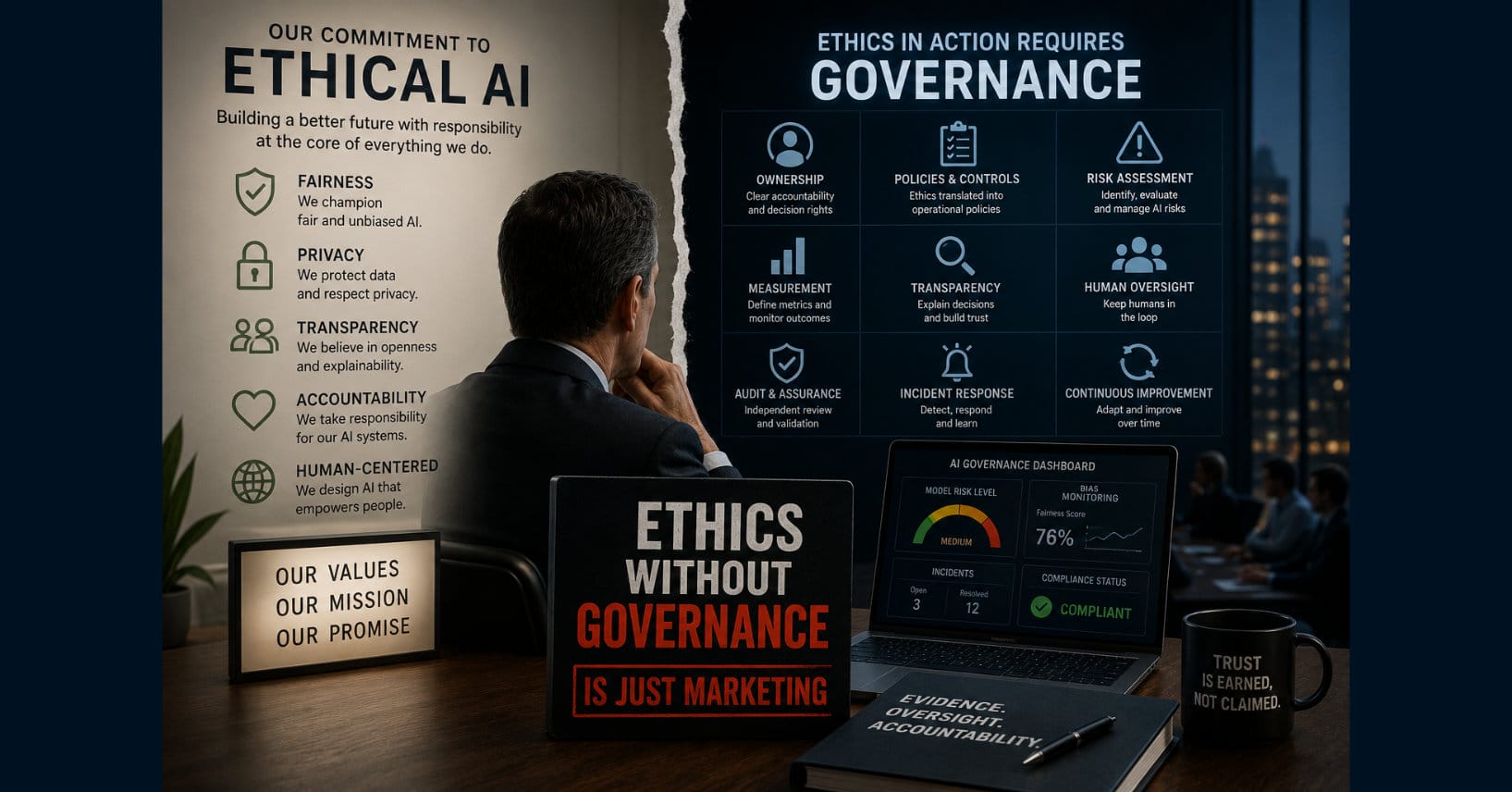
Without governance, ethics becomes little more than marketing.
Ethics Is Easy to Publish
Publishing ethical principles is simple.
Organizations proudly announce commitments such as:
- We will build trustworthy AI.
- We will eliminate bias.
- We will protect privacy.
- We will promote transparency.
- We will respect human rights.
- We will ensure accountability.
These statements are important.
They also raise an obvious question:
How do you know those commitments are actually being followed?
Governance provides the answer.
Good Intentions Do Not Produce Good Outcomes
Most AI failures are not caused by unethical intentions.
They occur because organizations fail to operationalize ethical principles.
A company may genuinely value fairness.
But if no one measures bias, fairness becomes an aspiration rather than a control.
An organization may value transparency.
But if AI decisions cannot be explained, transparency exists only in policy documents.
Ethics without execution produces false confidence.
Governance Makes Ethics Operational
Governance transforms values into measurable practices.
Instead of saying:
“We value fairness.”
Governance asks:
- Who measures fairness?
- How often?
- Against what criteria?
- Who reviews the results?
- What happens when fairness degrades?
- Where is the evidence?
Those questions turn philosophy into management.
Every Ethical Principle Needs an Owner
Ethics often belongs to everyone.
Which means it belongs to no one.
Every ethical commitment requires clear accountability.
Someone must own:
- Bias testing
- Privacy oversight
- Human review
- Regulatory compliance
- Model transparency
- Risk acceptance
- Incident response
- Continuous monitoring
Without ownership, ethical commitments slowly become organizational slogans.
Policies Are Not Proof
Many organizations believe publishing an AI Ethics Policy demonstrates responsible governance.
It demonstrates intent.
It does not demonstrate implementation.
Boards should expect evidence such as:
- Risk assessments
- Model testing results
- Human oversight logs
- Decision documentation
- Independent assurance reports
- Audit findings
- Training records
- Corrective actions
Evidence distinguishes governance from aspiration.
Ethics Must Survive Business Pressure
Ethical principles are easiest to follow when nothing is at stake.
The real test comes when organizations face pressure to:
- Reduce costs
- Increase automation
- Accelerate deployment
- Improve productivity
- Beat competitors
- Meet quarterly targets
Governance ensures ethical commitments remain intact when commercial pressures increase.
Without governance, expediency often wins.
Boards Govern Behavior, Not Values
Boards rarely approve technical architectures.
They oversee organizational behavior.
That includes ensuring ethical principles are supported by:
- Policies
- Decision rights
- Risk management
- Internal controls
- Independent assurance
- Performance metrics
- Escalation procedures
- Evidence
Boards cannot oversee values that cannot be demonstrated.
Trust Requires More Than Ethics Statements
Customers increasingly ask:
Can we trust your AI?
The answer is no longer found in a mission statement.
It is found in governance.
Organizations build trust by demonstrating:
- Consistent oversight
- Transparent decision-making
- Independent validation
- Documented accountability
- Effective incident response
- Continuous improvement
Trust grows from observable behavior—not published promises.
Practical Ethics Is Measurable
Ethics becomes practical when organizations can answer questions such as:
- How do we detect bias?
- Who approves high-risk AI decisions?
- When are models independently reviewed?
- How are incidents investigated?
- What evidence demonstrates compliance?
- How does the board receive assurance?
Organizations that cannot answer these questions do not have operational ethics.
They have ethical aspirations.
Boardroom Takeaway
Ethical principles establish expectations, but governance determines whether those expectations are consistently achieved. Organizations earn trust not by publishing AI ethics statements, but by embedding ethics into decision-making, accountability, oversight, controls, and evidence that demonstrate responsible AI in practice.
Coming Next
Trust Is Becoming the New AI Currency
As AI adoption accelerates, organizations will increasingly compete on trust rather than technology alone. The next article explores why public confidence, transparency, and demonstrable governance are becoming strategic business assets in the age of artificial intelligence.