AI Governance Series | Article 18 of 20
Governing Intelligence Before It Governs You
Summary: Most AI governance failures are not caused by a single catastrophic event but by gradual governance drift. Small exceptions, outdated policies, unclear ownership, delayed reviews, and weakening oversight slowly separate an organization’s actual practices from its intended governance framework. This article explains how governance drift develops, why it often goes unnoticed, and how boards can identify early warning signs before they become crises. By continuously monitoring governance health, validating accountability, maintaining evidence, and strengthening assurance, organizations can prevent minor governance gaps from becoming significant operational, regulatory, and reputational risks.
Most governance failures do not begin with a major incident.
They begin quietly.
A policy is postponed.
An exception is granted.
A review meeting is skipped.
An owner changes roles.
Documentation falls behind.
A model is updated without reassessing risk.
None of these events appear significant on their own.
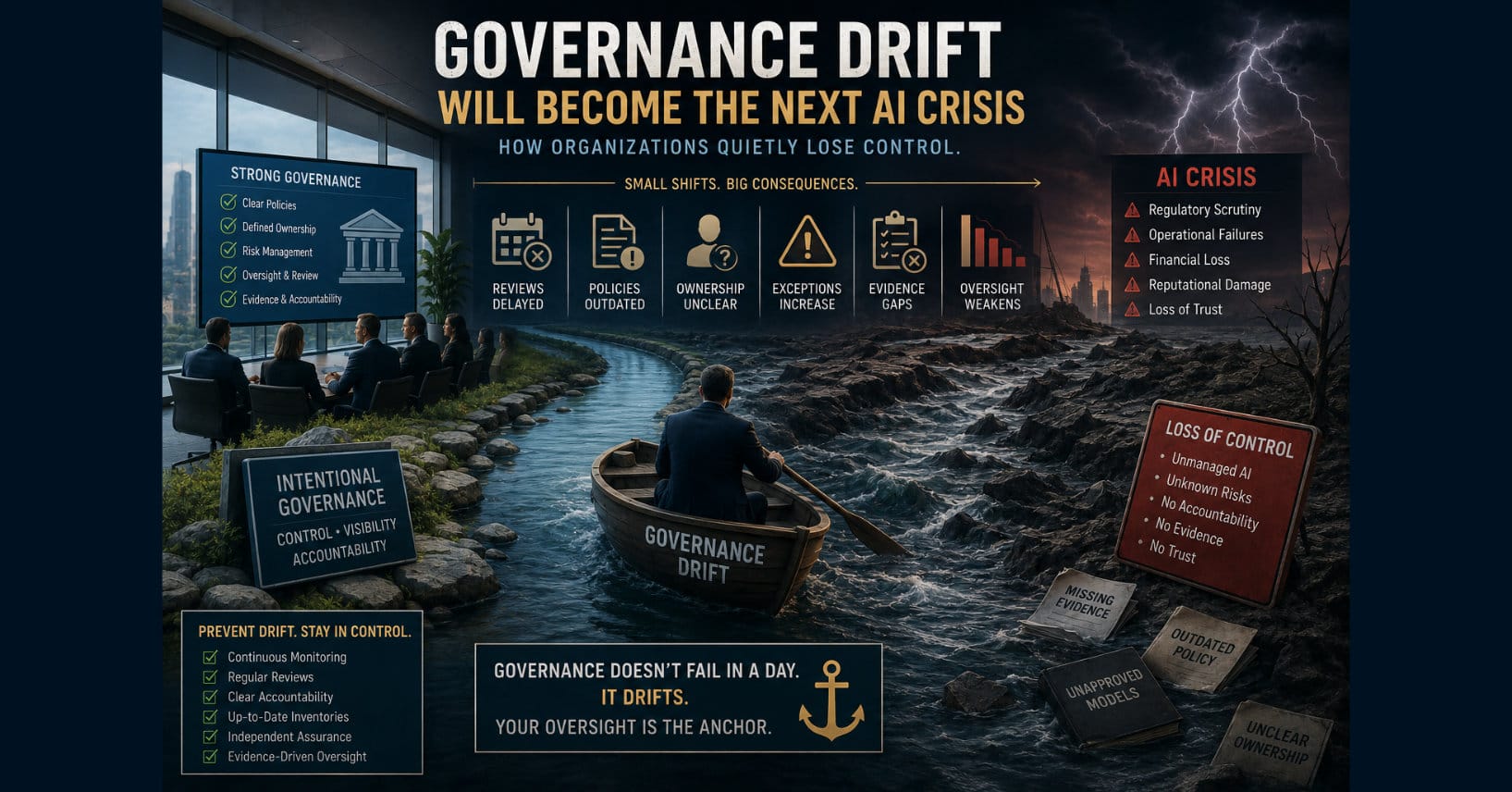
Together, they create governance drift.
Organizations rarely lose control of AI overnight.
They slowly drift away from the governance that once protected them.
What Is Governance Drift?
Governance drift occurs when an organization’s actual practices gradually diverge from its intended governance framework.
Policies still exist.
Committees still meet.
Dashboards still look healthy.
Yet the governance that once drove decisions is no longer driving behavior.
Processes become inconsistent.
Responsibilities become unclear.
Controls become optional.
Oversight becomes reactive.
Eventually, governance exists more on paper than in practice.
AI Accelerates Drift
Artificial intelligence changes faster than almost any other enterprise technology.
Models evolve.
Vendors release new capabilities.
Business units discover new use cases.
Employees experiment with new tools.
Third-party AI services expand.
Governance that is reviewed annually cannot keep pace with change occurring weekly.
Without continual attention, organizations slowly lose visibility into what AI is doing, who owns it, and how decisions are being made.
Drift Is Usually Invisible
Governance drift rarely announces itself.
Instead, organizations begin hearing familiar phrases:
“We’ve always done it this way.”
“We’ll document it later.”
“This model doesn’t really need review.”
“We’re only testing.”
“The vendor handles that.”
“It’s just a temporary exception.”
Each statement sounds reasonable.
Repeated hundreds of times, they quietly redefine governance.
Warning Signs Boards Should Watch
Boards rarely observe governance drift directly.
They see its symptoms.
Those symptoms include:
- Growing numbers of undocumented AI systems.
- Increasing policy exceptions.
- Delayed risk assessments.
- Inconsistent model inventories.
- Missing decision records.
- Declining participation in governance reviews.
- Expanding use of third-party AI without oversight.
- Repeated audit findings.
- Incident investigations that reveal unclear ownership.
None of these alone represents a crisis.
Together, they indicate governance is losing effectiveness.
Governance Debt Accumulates
Technology teams often discuss technical debt.
Organizations should also recognize governance debt.
Governance debt develops whenever oversight activities are delayed, skipped, or treated as optional.
Examples include:
- Unapproved AI deployments.
- Outdated policies.
- Incomplete inventories.
- Missing evidence.
- Unresolved audit findings.
- Undefined accountability.
- Controls that were never implemented.
Like financial debt, governance debt compounds over time.
Eventually, organizations pay interest through increased risk, slower response, regulatory scrutiny, and declining trust.
AI Makes Small Exceptions Expensive
Many governance failures begin as reasonable business decisions.
One project bypasses review to meet a deadline.
One department adopts an external AI platform without informing governance.
One vendor update is accepted without reassessment.
One executive requests an exception.
Each exception appears manageable.
But AI systems are interconnected.
One exception often affects multiple business processes, data sources, and downstream decisions.
Small governance shortcuts can quickly become enterprise-wide exposure.
Preventing Governance Drift
Organizations cannot eliminate change.
They can prevent uncontrolled drift.
That requires governance that continuously monitors itself.
Effective organizations:
- Continuously update AI inventories.
- Revalidate ownership when roles change.
- Review policy exceptions.
- Monitor governance metrics.
- Test controls regularly.
- Perform independent assurance.
- Produce evidence continuously.
- Report governance health—not merely AI performance—to the board.
Governance becomes a living capability rather than an annual compliance exercise.
Boards Should Monitor Governance Health
Most AI dashboards measure operational performance.
Boards should also ask:
Are responsibilities still clear?
Are controls operating as designed?
Are exceptions increasing?
Are governance reviews occurring on schedule?
Can management demonstrate current evidence of oversight?
Has our governance framework evolved as quickly as our AI?
These questions reveal governance health long before incidents occur.
The Best Time to Correct Drift
Organizations often strengthen governance after a crisis.
The best organizations identify drift before a crisis develops.
They recognize that governance is never finished.
It requires continual calibration as technology, regulation, business strategy, and organizational structure evolve.
Good governance is not maintained by writing better policies.
It is maintained by continuously aligning people, processes, oversight, and evidence with the reality of how AI is actually being used.
That is how organizations remain in control.
Boardroom Takeaway
The next major AI governance failure is unlikely to result from a single catastrophic decision. It will more likely emerge from dozens of small exceptions, undocumented changes, blurred responsibilities, and weakening oversight that accumulate over time. Boards that monitor governance health—not just AI performance—will identify governance drift before it becomes an enterprise crisis.
Coming Next
The AI Board of 2030 Will Look Very Different
Artificial intelligence is reshaping the responsibilities of corporate boards. The next article explores how board oversight, governance structures, fiduciary duties, evidence expectations, and executive accountability are likely to evolve over the remainder of the decade—and what today’s directors should be doing now to prepare.