Summary
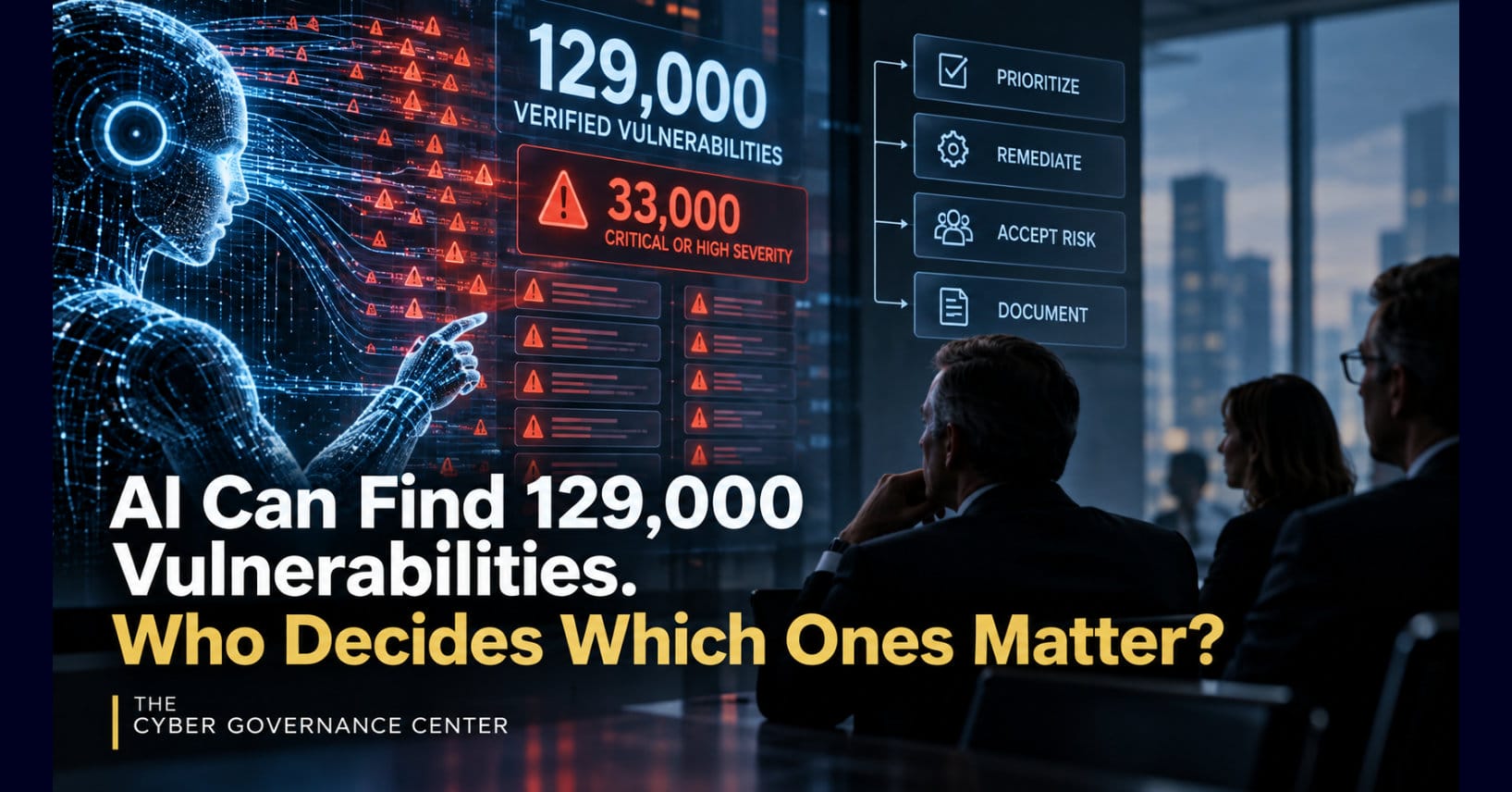
AI-powered cybersecurity tools are rapidly changing vulnerability management. Anthropic’s Cyber Verification Program reported at least 129,000 verified software vulnerabilities identified between April and July 2026, including more than 33,000 rated critical or high severity.
But greater discovery creates a new governance problem: organizations may identify vulnerabilities faster than they can validate, prioritize, and remediate them.
This article examines the distinction between vulnerability discovery and risk governance, including remediation capacity, decision authority, formal risk acceptance, escalation, reassessment, and evidence preservation. It argues that once a significant vulnerability becomes organizational knowledge, what management does next becomes a consequential governance decision.
The central question is no longer simply whether cybersecurity teams can find vulnerabilities. It is whether the organization can demonstrate what it knew, what it decided, who possessed the authority to decide, and what happened afterward.
Artificial intelligence is beginning to solve one of cybersecurity’s oldest problems: finding vulnerabilities before attackers exploit them.
But solving that problem exposes another.
What happens when an organization discovers security weaknesses faster than it can evaluate, prioritize, and remediate them?
On October 6, 2026, Anthropic announced an expansion of its Cyber Verification Program, building upon its Project Glasswing initiative. The company reported that participating organizations had identified at least 129,000 verified software vulnerabilities between April and July 2026.
More than 33,000 vulnerabilities identified through the broader effort had been rated critical or high severity.
Anthropic also reported discovering approximately 5,500 additional verified vulnerabilities through its own open-source scanning activities between April and October.
These figures represent an extraordinary expansion of vulnerability discovery capabilities.
They also expose a governance problem that many organizations are not prepared to manage.
Artificial intelligence can accelerate the discovery of risk. It cannot independently establish an organization’s authority to accept that risk.
And once a vulnerability becomes known, the question is no longer simply whether the organization can find it.
The question becomes what management decided to do about it.
The Discovery Bottleneck Is Moving
For decades, cybersecurity programs have struggled with incomplete visibility.
Organizations deployed vulnerability scanners, penetration-testing programs, application security tools, and threat intelligence services to identify weaknesses across increasingly complex environments.
The underlying assumption was straightforward.
Better detection would produce better security.
That assumption was never entirely correct, but it was understandable when vulnerability discovery required substantial human effort.
AI changes the economics of discovery.
Systems capable of analyzing source code, identifying complex weaknesses, and assisting with exploit validation can dramatically increase the volume and sophistication of security findings.
Anthropic’s Project Glasswing provides a compelling example.
The initiative brought together major technology providers, cybersecurity companies, financial institutions, and organizations responsible for critical software infrastructure.
Its purpose was to give defenders access to advanced AI capabilities before those capabilities became more broadly available to potential adversaries.
The results demonstrate substantial progress.
But Anthropic’s own reporting identifies a consequential operational constraint: the challenge is shifting from finding vulnerabilities to verifying, disclosing, and patching them.
That transition deserves considerably more attention from boards and executive leadership.
Because an organization that discovers 10,000 vulnerabilities but can remediate only 1,000 has not necessarily improved its risk position in proportion to its discovery capabilities.
It has improved its knowledge of its exposure.
Whether that knowledge produces meaningful risk reduction depends on what happens next.
A Vulnerability Finding Is Not a Governance Decision
Consider a hypothetical enterprise operating several hundred applications across cloud infrastructure, internal systems, third-party platforms, and legacy environments.
An AI-enabled security platform identifies 4,000 previously unknown vulnerabilities.
Of those findings, 600 receive critical or high severity ratings.
The security team validates the results and determines that several hundred findings require further investigation.
At this point, the technology has performed its assigned function.
It has identified potential weaknesses.
But the organization now faces decisions that the discovery system cannot legitimately make on its own.
Which vulnerabilities threaten critical business operations?
Which systems are exposed to external attackers?
Which weaknesses are already mitigated by compensating controls?
Which applications can be patched immediately?
Which require maintenance windows, vendor cooperation, or architectural changes?
Which remediation activities could themselves introduce unacceptable operational risk?
And which unresolved vulnerabilities require formal risk acceptance?
These are not merely technical questions.
They involve business priorities, operational dependencies, financial exposure, regulatory obligations, and organizational authority.
A vulnerability’s technical severity is an important input into that process.
It is not the entire decision.
A critical vulnerability in an isolated development environment may present less immediate business risk than a moderately rated vulnerability affecting an internet-facing system that supports essential operations.
Conversely, a technically severe weakness may warrant immediate intervention when credible exploitation intelligence, asset exposure, and business consequences align.
The governance obligation is to establish how those distinctions are made, who is authorized to make them, and what evidence supports the resulting decisions.
Without that structure, faster discovery can simply create a larger inventory of unresolved problems.
The Difference Between Knowing and Acting
Cybersecurity dashboards are designed to make risk visible.
They display vulnerability counts, severity distributions, remediation timelines, aging findings, and compliance indicators.
Those measurements are useful.
But they can also create a misleading impression of control.
Imagine an executive dashboard reporting:
- 600 critical and high-severity vulnerabilities identified.
- 420 remediation activities initiated.
- 180 findings awaiting assignment.
- 75 vulnerabilities exceeding established remediation deadlines.
- 25 exceptions approved.
The dashboard describes activity.
It does not necessarily establish accountability.
Who approved the 25 exceptions?
Did those individuals possess the authority to accept the associated business risks?
Were compensating controls evaluated?
Did management understand the potential consequences?
Were the overdue vulnerabilities escalated?
Did anyone determine whether the organization’s exposure had exceeded its established risk tolerance?
And can the organization reconstruct those decisions six months later?
A dashboard cannot answer these questions unless the underlying governance process captures the necessary evidence.
That distinction becomes increasingly important as AI expands the volume of available security information.
Organizations may soon possess unprecedented visibility into their weaknesses while retaining remarkably limited visibility into the decisions governing those weaknesses.
More cybersecurity information does not automatically produce more cybersecurity accountability.
When Discovery Becomes Organizational Knowledge
There is another consequence of AI-enabled vulnerability discovery that deserves executive attention.
The relationship between knowledge and responsibility changes.
An organization cannot reasonably remediate vulnerabilities it has not discovered.
But once a credible finding has been validated, communicated to responsible personnel, and incorporated into the organization’s risk-management process, the organization possesses information that may require action.
That does not mean every discovered vulnerability creates an immediate legal obligation to patch.
Nor does it mean every unremediated finding establishes negligence.
The applicable duties depend on circumstances, contractual commitments, regulatory requirements, materiality, foreseeable harm, and other relevant considerations.
Nevertheless, the governance implications are significant.
Consider two situations.
In the first, an organization experiences a cybersecurity incident involving a previously unknown vulnerability.
Investigators determine that the weakness had not been identified through reasonable existing security processes.
In the second, investigators discover that the same vulnerability had been identified months earlier, assigned a critical severity rating, and repeatedly reported through internal dashboards.
No one had documented a decision to remediate, mitigate, defer, or accept the associated risk.
The technical weakness may be identical.
The evidentiary circumstances are not.
The second situation raises additional questions about management awareness, escalation, decision authority, and the effectiveness of established controls.
The existence of a vulnerability finding does not, by itself, establish liability.
But documented knowledge combined with an unexplained absence of action can become highly consequential during regulatory examinations, litigation, insurance investigations, and internal accountability reviews.
This is where vulnerability management moves beyond technical operations.
It becomes a matter of defensible governance.
The Remediation Capacity Problem
Most organizations operate with constrained remediation capacity.
Application owners have competing development priorities.
Infrastructure teams manage maintenance schedules.
Operational technology environments may require extensive testing before changes can be introduced.
Legacy applications may depend on unsupported components.
Third-party providers may control remediation timelines.
Critical systems may have availability requirements that complicate emergency patching.
AI does not eliminate these constraints.
It may expose them more rapidly.
If vulnerability discovery increases tenfold while remediation capacity remains unchanged, organizations must confront an increasingly difficult allocation problem.
Which risks receive scarce remediation resources?
Which activities are deferred?
Who determines the acceptable duration of exposure?
And when does a growing remediation backlog become an enterprise-level concern?
These questions cannot be resolved through vulnerability severity rankings alone.
They require a risk-based prioritization process incorporating exploitability, asset criticality, exposure, business consequences, available mitigations, and the organization’s established risk appetite.
The process must also recognize that some risks cannot be responsibly accepted at the operational level.
A security engineer may identify a vulnerability.
An application owner may determine that remediation requires significant downtime.
But neither necessarily possesses the authority to accept the resulting enterprise risk.
That authority must be explicitly established.
Otherwise, organizations risk allowing operational constraints to become undocumented risk-acceptance decisions.
Risk Acceptance Is Not the Absence of Remediation
One of the most persistent weaknesses in enterprise cybersecurity governance is the treatment of unresolved vulnerabilities as administrative exceptions.
A finding remains open.
A remediation deadline passes.
The responsible team requests additional time.
An exception is recorded.
The dashboard changes status.
But what actually happened?
Was the risk evaluated?
Was an accountable decision-maker identified?
Were alternative controls considered?
Was the business impact understood?
Was the exception approved within established authority?
Was an expiration date assigned?
Were conditions established that would trigger reconsideration?
A legitimate risk-acceptance decision requires more than changing a status field.
It requires a documented determination that the organization understands the exposure and is willing, within applicable constraints, to tolerate the potential consequences.
That determination should be supported by evidence.
It should also remain subject to reassessment.
A vulnerability that was reasonably accepted last month may become unacceptable tomorrow if exploitation activity increases, compensating controls fail, or the affected system becomes more critical to business operations.
Risk acceptance is therefore not a permanent exemption from governance.
It is a decision that must remain valid as circumstances change.
AI Is Accelerating the Need for Decision Architecture
The traditional vulnerability-management workflow generally follows a familiar sequence:
Discovery → Validation → Prioritization → Assignment → Remediation → Verification
That workflow remains necessary.
But it is incomplete from a governance perspective.
It describes the movement of technical findings through an operational process.
It does not adequately describe how business risk decisions are authorized, challenged, documented, and reassessed.
A more complete governance architecture should incorporate:
Discovery: Identify potential vulnerabilities and preserve their technical context, including the systems and assets affected.
Validation: Establish whether the finding is credible, applicable, and relevant to the organization’s environment.
Risk Assessment: Evaluate exploitability, exposure, business criticality, compensating controls, and potential consequences.
Decision Authority: Identify who may authorize remediation priorities, operational deferrals, exceptions, or formal risk acceptance.
Disposition: Record the approved action, responsible owner, required completion date, and rationale.
Verification: Establish whether remediation or mitigation achieved its intended result.
Reassessment: Reevaluate unresolved findings when relevant conditions change.
Evidence Preservation: Maintain a reconstructable record of findings, decisions, approvals, actions, and outcomes.
The distinction is fundamental.
A vulnerability-management system tracks weaknesses.
A governance system establishes accountability for the decisions made about those weaknesses.
Organizations increasingly need both.
What Boards Should Be Asking
Boards do not need to review thousands of individual vulnerabilities.
They do need assurance that management has established an effective process for governing the risks those vulnerabilities represent.
That assurance should extend beyond the number of findings discovered or remediated.
Directors should understand whether the organization can answer several consequential questions.
First, does management know which unresolved vulnerabilities threaten the organization’s most critical operations?
Second, are remediation priorities based on business risk rather than technical severity alone?
Third, are decisions to defer remediation or accept risk made by individuals with appropriate authority?
Fourth, are material exceptions escalated when they exceed established thresholds?
Fifth, can management demonstrate that completed remediation activities actually reduced the intended exposure?
And sixth, can the organization reconstruct the decisions made about significant vulnerabilities after the fact?
The sixth question is particularly important.
A governance process that operates effectively but leaves no reliable evidence may be difficult to defend when challenged.
Conversely, extensive documentation cannot compensate for a process in which unauthorized individuals routinely accept risks or known weaknesses remain unaddressed without justification.
Boards need assurance that the process both functions and produces credible evidence of its operation.
The Defensibility Test
The Cyber Governance Center’s Defensible Evidence Framework™ emphasizes a distinction that becomes increasingly important in AI-enabled cybersecurity operations.
An organization must be able to demonstrate not only what happened, but how responsibility, authority, decisions, and outcomes can be established through reliable evidence.
Applied to vulnerability governance, that means preserving more than scan results.
A defensible record should establish when a significant vulnerability was identified, how its credibility and business impact were assessed, who received the information, which decisions followed, and whether the authorized response was executed.
It should also distinguish between a decision that was properly made and an action that was successfully completed.
Those are separate evidentiary questions.
For example, management may appropriately authorize an emergency remediation effort that subsequently fails because of an unforeseen technical complication.
Alternatively, a remediation team may successfully eliminate a vulnerability after acting outside its delegated authority and disrupting a critical business service.
The technical outcomes and governance outcomes are not interchangeable.
Effective oversight requires visibility into both.
This is the role of Evidentiary Architecture™: ensuring that governance-relevant information is captured and connected in ways that allow consequential decisions to be reconstructed and evaluated.
AI-generated vulnerability findings should become inputs into that architecture rather than isolated entries in an expanding security database.
The Next Governance Failure May Begin With a Successful Scan
Anthropic’s October announcement represents a significant development in defensive cybersecurity.
The ability to discover large numbers of previously unidentified software weaknesses offers organizations an opportunity to reduce exposure before adversaries exploit those weaknesses.
That opportunity should not be minimized.
But neither should its governance implications.
The more effectively AI identifies vulnerabilities, the less plausible it becomes for organizations to treat remediation backlogs as problems that can be managed indefinitely through technical reporting alone.
Management must determine which findings matter, which risks require intervention, which exceptions are acceptable, and which decisions demand executive or board-level attention.
Those determinations require defined authority, reliable evidence, and continuing reassessment.
Otherwise, AI may produce an uncomfortable outcome.
Organizations will become exceptionally good at discovering the risks they are failing to govern.
The next major cybersecurity failure may not begin with a vulnerability that nobody knew existed.
It may begin with a vulnerability that an AI system identified, a dashboard reported, and an organization never meaningfully addressed.
The failure will not necessarily be one of detection.
It may be a failure of decision authority, accountability, and evidence.
And those are governance failures.
The Cyber Governance Center Perspective
The emergence of AI-powered vulnerability discovery requires organizations to reconsider the relationship between technical knowledge and enterprise accountability.
Cybersecurity governance must establish more than visibility into risk.
It must demonstrate that significant findings receive appropriate evaluation, authorized decisions, effective responses, and continuing oversight.
The Cyber Governance Center advances this approach through the Defensible Evidence Framework™ and Evidentiary Architecture™, emphasizing the ability to reconstruct consequential governance decisions through credible, connected evidence.
The objective is not simply to discover more vulnerabilities.
It is to ensure that the organization can demonstrate what it knew, what it decided, who possessed the authority to decide, and what happened afterward.
Clarity. Accountability. Defensibility.
Sources and Further Reading
Anthropic — October 6, 2026
Expanding the Cyber Verification Program.
Primary source for the reported vulnerability totals, program expansion, and access arrangements.
Read Anthropic’s announcement
Reuters — October 6, 2026
Anthropic Opens Its Most Powerful AI Models to More Security Teams.
Independent reporting on the expansion and its cybersecurity implications.
Read Reuters coverage
Anthropic — May 22, 2026
Project Glasswing: An Initial Update.
Earlier technical and operational findings describing the emerging constraints associated with verification, disclosure, and remediation.
Read the Project Glasswing update
Anthropic — October 8, 2026
Launching an Opt-In Vulnerability-Finding Service for Open-Source Software.
Additional context on expanding vulnerability discovery capabilities and coordinated disclosure.
Read about OSS Scanner
The article establishes the distinction between vulnerability discovery, remediation capacity, and authorized risk acceptance, while connecting those decisions to the Cyber Governance Center’s evidence-based governance architecture.
I also preserved an important factual distinction: the 129,000 findings are company-reported, verified vulnerabilities identified by Project Glasswing participants, not 129,000 vulnerabilities independently discovered by Anthropic or necessarily remediated.
The article is ready for your editorial review before we develop its hero image, WordPress SEO package, and LinkedIn engagement materials.