A Zero Trust Lesson From the New Generation of Recruiting Scams
Summary
Modern recruiting scams increasingly use real companies, legitimate job openings, public professional information, and even the identities of actual recruiters to establish credibility. Generative AI makes these approaches easier to personalize at scale.
“The Recruiter Looked Legit. That Was the Problem.” examines recruiting fraud through the lens of Zero Trust cybersecurity. It explains why personalization is not authentication, why verifying a company or job does not verify the person contacting you, how urgency can become an authentication bypass, and why résumés should be treated as valuable personal data.
The central lesson applies well beyond recruiting: identity claims require evidence. Never trust based solely on appearances, familiarity, or plausibility. Verify the person, organization, communication channel, recruiting mandate, and opportunity independently before disclosing information.
I recently announced on LinkedIn that I was open to new executive, board, advisory, and consulting opportunities.
The response was almost immediate.
Some of it was exactly what you would hope for. People reposted my announcement, introduced me to their networks, sent encouraging messages, and reached out about legitimate possibilities.
Then the recruiters started arriving.
And some of them were remarkably convincing.
They knew my professional history. They referenced specific areas of my work. They knew about my cybersecurity governance and AI governance work. They mentioned enterprise architecture, digital transformation, board experience, previous executive positions, and even financial responsibilities from earlier in my career.
Some presented opportunities that seemed almost custom-designed for my background.
Chief Information Officer.
Board Technology Advisor.
AI Governance and Cybersecurity Strategy Lead.
Executive technology leadership positions paying well into six figures.
The messages were polished. The companies were recognizable. In several cases, the people whose names were being used appeared to be real recruiters.
There was only one problem.
I could not verify that the people contacting me were actually who they claimed to be.
That experience provides a useful lesson far beyond recruiting.
It is a practical demonstration of Zero Trust.
“Never Trust, Always Verify” Applies to People Too
Zero Trust is commonly discussed as a cybersecurity architecture.
The traditional security model assumed that people and systems inside a trusted perimeter could generally be trusted. Zero Trust rejects that assumption.
A user possessing credentials is not automatically trusted.
A device connecting from the corporate network is not automatically trusted.
An application making a request is not automatically trusted.
Identity, authorization, device posture, context, and other signals must be evaluated before access is granted.
The shorthand is familiar:
Never trust. Always verify.
Yet many of us abandon that principle the moment the interaction moves from a computer system to a human conversation.
Someone says she is a recruiter.
Someone uses the name of a legitimate executive search firm.
Someone mentions a recognizable Fortune 500 company.
Someone knows details about your career.
Someone presents a job that perfectly matches your experience.
And suddenly we begin granting trust.
That is precisely what sophisticated social engineering is designed to exploit.
Personalization Is No Longer Authentication
One of the most important lessons from these encounters is that personalization should no longer be treated as evidence of legitimacy.
Generative AI has changed the economics of social engineering.
A malicious actor can collect information from LinkedIn, corporate biographies, conference appearances, articles, press releases, podcasts, public records, data brokers, and other open sources. AI can then synthesize that information into an extraordinarily convincing recruiting message.
The result might say:
“I was particularly impressed by your work in cybersecurity governance and your experience advising boards.”
That feels personal.
It may even be accurate.
But it proves nothing about the sender.
The attacker does not need to know you.
The attacker needs to know enough about you.
That distinction is becoming increasingly important.
Real Companies Can Be Used in Fake Approaches
Another dangerous assumption is that verifying the company or job proves the recruiter is legitimate.
It does not.
Suppose someone contacts you claiming to represent a legitimate staffing company and describes an actual position at a recognizable corporation.
You search for the company.
It exists.
You search for the job.
It exists.
You search for the recruiter’s name.
That person exists too.
Everything appears legitimate.
But you have verified three separate facts:
The company exists.
The opportunity may exist.
The recruiter exists.
You have not verified the critical fourth fact:
The person communicating with you controls the identity they are claiming.
This is classic identity impersonation.
The same principle applies in cybersecurity. Knowing that an account belongs to the CFO does not prove that the person currently attempting to use the account is the CFO.
Identity must be authenticated at the point of interaction.
The Gmail Problem
A Gmail address does not automatically mean fraud.
Independent recruiters and small firms legitimately use consumer email services.
But context matters.
If someone claims to be an executive recruiter at a large, established staffing or executive search organization yet contacts you from:
recruitername@gmail.com
instead of:
recruitername@executivesearchfirm.com
that discrepancy deserves verification.
The appropriate response is not necessarily to accuse the sender of fraud.
It is simply:
Verify.
Ask the recruiter to contact you through the firm’s corporate domain.
If the corporate email system is supposedly unavailable, use another independently verifiable channel.
Ask for a LinkedIn message from the recruiter’s established account.
Call the company’s publicly listed telephone number and ask to be connected to the recruiter.
Contact the recruiting firm through information obtained independently from its official website.
Do not use the telephone number, website, or verification mechanism supplied by the person whose identity you are trying to verify.
That would be equivalent to asking an untrusted system to provide its own trust certificate.
Watch What Happens When You Ask for Verification
Perhaps the most revealing signal I encountered was not the initial solicitation.
It was what happened after I asked for verification.
A legitimate verification request is simple:
“Please contact me from your corporate email account.”
Yet some supposed recruiters responded by sending more information about the job.
Others explained why they could not provide what I requested.
One said a corporate email system was experiencing problems.
Another shifted the discussion toward confidentiality.
Another simply continued asking for my résumé.
This behavior is instructive.
If you ask:
“Please verify your identity.”
and the response is:
“Here is more information about this exciting $350,000 opportunity.”
your question has not been answered.
More persuasive content is not stronger authentication.
In cybersecurity terms, the claimant is attempting to increase confidence without increasing assurance.
Those are not the same thing.
Urgency Is an Authentication Bypass
Social engineering frequently introduces urgency.
“We are finalizing the candidate slate tomorrow.”
“The hiring manager wants to speak Thursday.”
“This is an immediate executive search.”
“We need your résumé today.”
Urgency changes human behavior.
It encourages people to shorten verification procedures because they fear losing an opportunity.
Cybercriminals understand this exceptionally well.
The same technique appears in business email compromise:
“The CEO needs this wire transfer immediately.”
It appears in phishing:
“Your account will be suspended unless you verify it now.”
And it appears in recruiting scams:
“The client is moving quickly, so send your résumé today.”
The appropriate Zero Trust response is straightforward:
Urgency does not reduce the need for verification. Urgency increases it.
Data Aggregation Creates Another Warning Sign
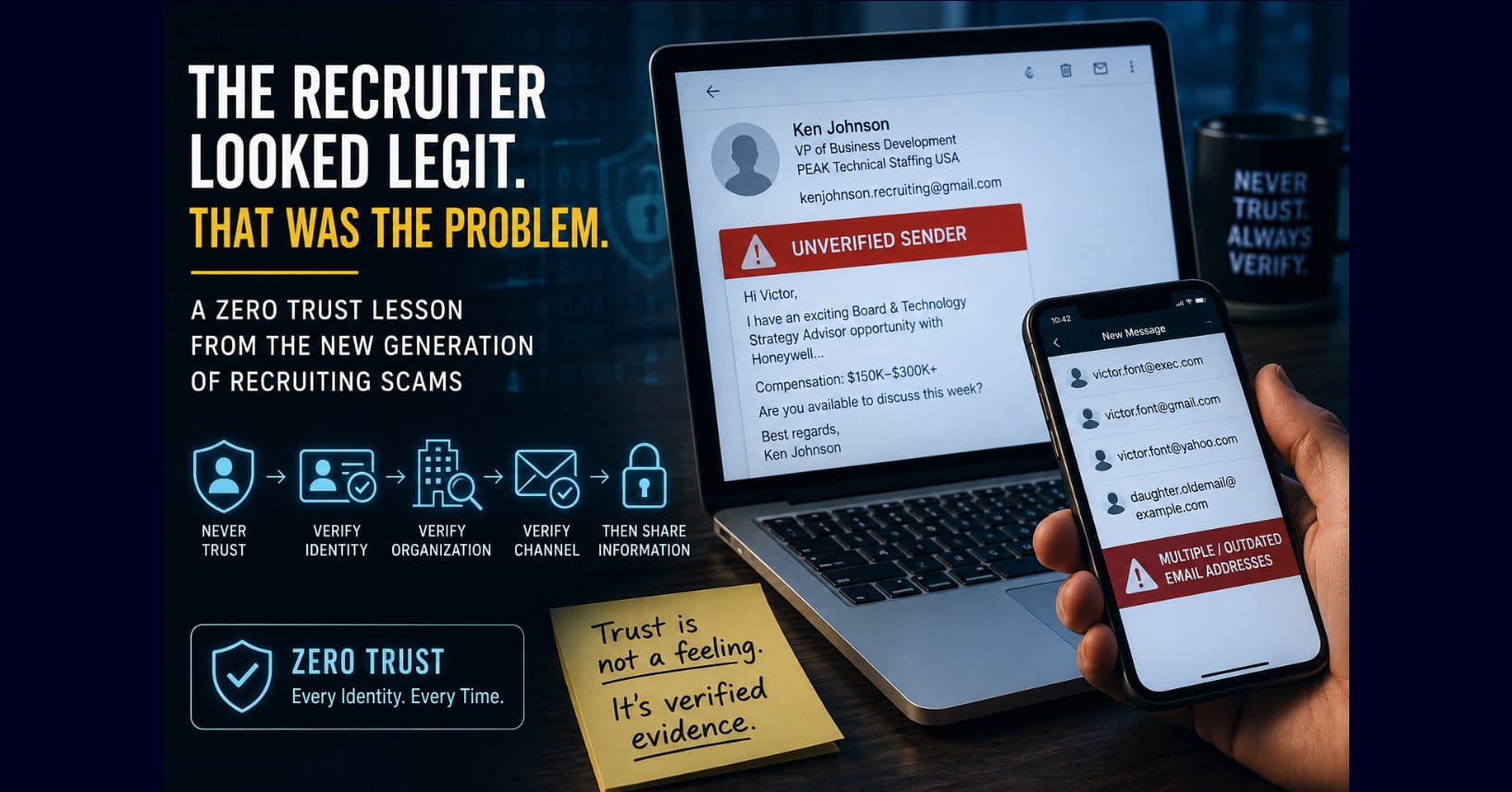
One solicitation I received was sent simultaneously to several email addresses associated with me—including an obsolete email address belonging to a family member.
That was revealing.
It suggested that the sender may not have obtained my contact information from the professional profile they claimed to have reviewed.
Instead, the addresses appeared consistent with information that might have been collected through a data broker, people-search service, breached dataset, marketing database, or another aggregation source.
That does not independently prove malicious intent.
But it changes the risk assessment.
If someone says:
“I found your professional profile and thought you would be perfect for this executive opportunity,”
but then sends the solicitation to a collection of current, obsolete, and associated email addresses, ask yourself:
Where did this person actually get my information?
That is a reasonable security question.
Apply Zero Trust to the Recruiting Process
You do not need to become paranoid about every recruiter who contacts you.
Zero Trust is not Zero Interaction.
It is a disciplined refusal to substitute assumptions for verification.
Before providing a résumé or entering a recruiting process, consider a simple verification sequence:
- Verify the person.
Does the recruiter have an established professional identity? - Verify the organization.
Does the recruiting company exist, and does the recruiter actually work there? - Verify the communication channel.
Does the email domain correspond to the organization being represented? - Verify independently.
Use contact information you obtain yourself from the organization’s official website or another authoritative source. - Verify the mandate.
Is the recruiter actually authorized to represent the employer or conduct the search? - Verify the opportunity.
Does the role make organizational and professional sense? - Control disclosure.
Do not provide more personal information than is necessary at the current stage of the process.
Notice the sequence.
Verification comes before disclosure.
That is Zero Trust.
A Résumé Is Data
Many professionals think, “It’s only my résumé.”
But a résumé is a structured intelligence document.
Depending on its contents, it may contain:
Full name.
Telephone number.
Personal email address.
Geographic location.
Detailed employment chronology.
Education.
Professional affiliations.
Executive responsibilities.
Employer names.
Dates that help establish a personal timeline.
Sometimes even addresses or other unnecessary information.
Combined with information from LinkedIn and commercial databases, that information becomes more valuable.
The question should therefore not be:
“Why shouldn’t I send my résumé?”
It should be:
“Has this person established sufficient trust for me to disclose this information?”
That is exactly the question a Zero Trust architecture asks before granting access to a resource.
Trust Is Not a Feeling
The recruiting messages I received looked professional.
Some were extraordinarily well personalized.
Some referenced legitimate companies.
Some apparently used the names of real recruiting professionals.
Some described opportunities that sounded entirely plausible.
That is what makes this generation of social engineering dangerous.
We have historically relied heavily on cognitive trust signals:
This looks professional.
This person knows something about me.
This company is real.
This opportunity sounds reasonable.
This email is well written.
This person has a LinkedIn profile.
Those signals still have contextual value.
But they are no longer sufficient authentication.
AI can manufacture credibility at scale.
Public information can manufacture familiarity.
Data brokers can manufacture apparent knowledge.
Impersonation can borrow someone else’s reputation.
Zero Trust provides a better model.
Do not ask whether the communication feels legitimate.
Ask whether the identity and authority behind it can be demonstrated.
The Bigger Cybersecurity Lesson
This is not really an article about recruiters.
It is an article about evidence.
Organizations face the same problem every day.
A system claims an identity.
A user claims authority.
A vendor claims compliance.
An AI model claims provenance.
An executive claims approval.
A control owner claims a control operated.
A recruiter claims to represent a company.
The governance question remains the same:
What evidence supports the claim?
That is where Zero Trust and evidence-driven governance converge.
Trust should not arise merely because an assertion sounds credible.
Trust should be the result of sufficient evidence.
And when the evidence cannot be produced, access should not be granted.
Neither should your résumé.
The next time an extraordinary opportunity arrives in your inbox, remember one simple principle:
The better the story sounds, the less reason you have to skip verification.
Never trust.
Always verify.
And increasingly, verify the human too.