Evidence-Driven Cybersecurity Governance Series—Article 18
Cybersecurity governance is entering a new era where accountability is measured by evidence rather than assurances. Although regulators, insurers, investors, and courts approach organizations from different perspectives, they increasingly seek answers to the same fundamental questions: Did leadership understand the risks? Were informed decisions made? Was management held accountable? Can those actions be demonstrated through credible evidence? The common denominator across these expectations is no longer technical excellence alone—it is defensible governance.
This article explores the convergence of stakeholder expectations and explains why evidence is becoming the defining characteristic of mature cybersecurity governance. Readers will discover how evidence-driven governance strengthens regulatory readiness, improves insurance confidence, builds investor trust, and supports legal defensibility. As organizations prepare for the next generation of governance expectations, those that intentionally produce credible, connected, and trustworthy evidence will be best positioned to demonstrate responsible leadership and earn stakeholder confidence.
Why regulators, insurers, investors, and courts are all asking the same question.
The future of cyber governance will not be defined by who claims to govern well. It will be defined by who can prove it.
Cybersecurity governance is changing.
Not because technology has changed.
Because expectations have changed.
Boards are expected to exercise greater oversight.
Executives are expected to demonstrate greater accountability.
Organizations are expected to produce greater transparency.
Across industries, one trend is becoming increasingly clear.
Every major stakeholder is moving toward the same destination.
Evidence.
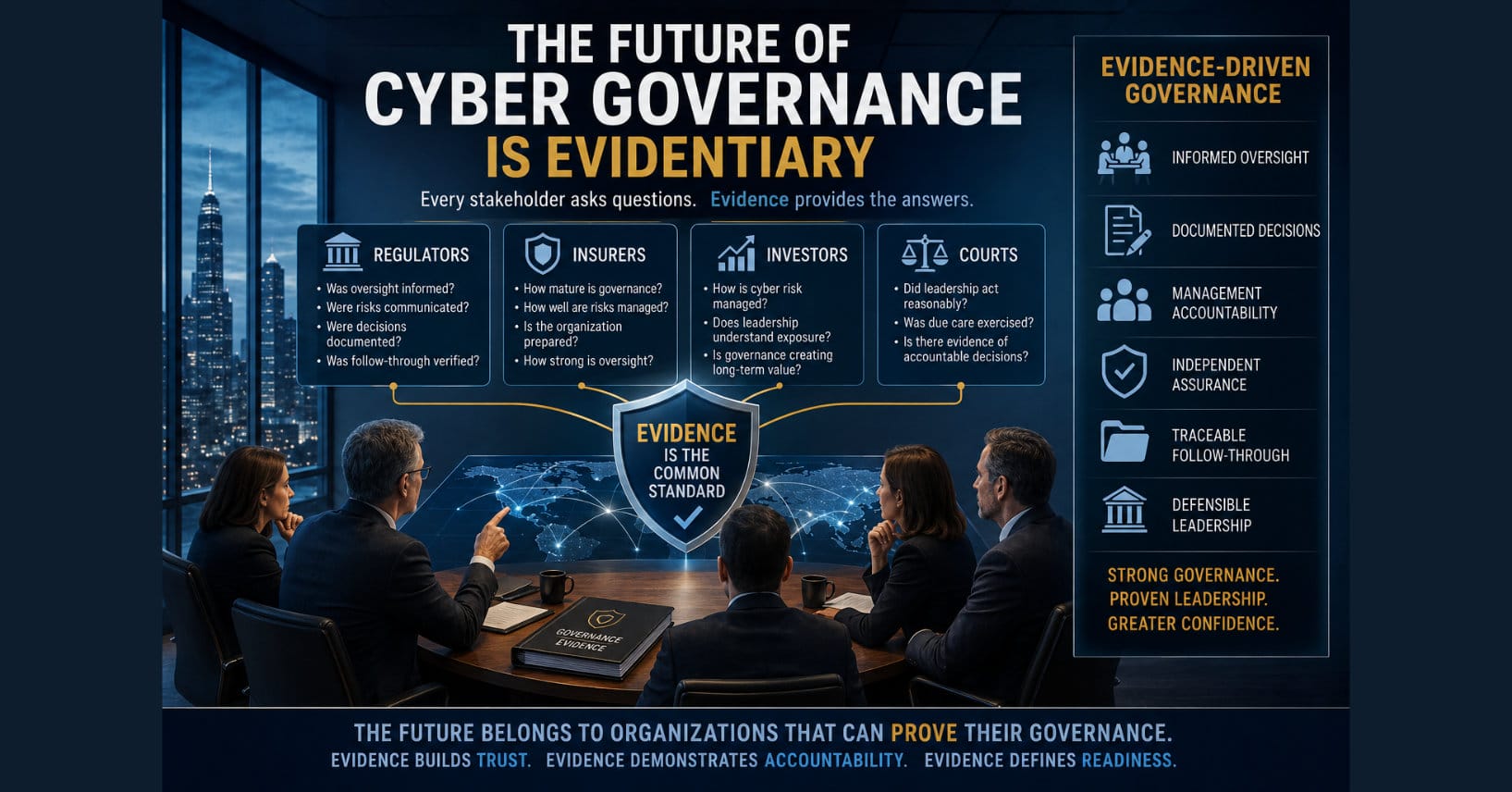
Regulators Want Demonstrable Oversight
Regulatory expectations continue to evolve.
Reporting requirements become more detailed.
Governance expectations become more explicit.
Oversight responsibilities become more clearly defined.
Regulators increasingly look beyond whether controls existed.
They want to understand how leadership exercised oversight.
How risks were communicated.
How decisions were made.
How management was directed.
How outcomes were verified.
Those questions require evidence.
Not assumptions.
Insurers Are Evaluating Governance
Cyber insurance has evolved dramatically.
Insurers no longer evaluate only technical controls.
They increasingly examine governance maturity.
Risk management.
Executive involvement.
Incident preparedness.
Independent assurance.
Organizations that demonstrate disciplined governance often present lower uncertainty.
Lower uncertainty leads to better underwriting decisions.
Evidence strengthens confidence.
Confidence influences insurability.
Investors Are Watching Leadership
Cybersecurity has become a governance issue for investors.
Institutional investors increasingly recognize that cyber risk affects enterprise value.
Boards are expected to understand material cyber risks.
Executives are expected to oversee resilience.
Leadership is expected to allocate appropriate resources.
Following major incidents, investors often ask:
Did leadership govern responsibly?
The answer is rarely found in financial statements.
It is found in governance evidence.
Courts Evaluate Reasonableness
When cyber incidents lead to litigation, courts seldom evaluate technical perfection.
They evaluate reasonableness.
Did leadership act responsibly?
Were known risks discussed?
Did directors exercise informed judgment?
Was management appropriately supervised?
Did governance reflect due care?
Evidence allows organizations to answer those questions with facts instead of explanations.
The Convergence Is Already Happening
Viewed independently, these trends appear unrelated.
Regulation.
Insurance.
Investment.
Litigation.
In reality, they are converging.
Each asks different questions.
Each reaches the same destination.
Evidence.
That convergence should reshape how organizations think about governance.
Governance Becomes a Strategic Asset
Organizations often view governance as an obligation.
Evidence-driven organizations view it differently.
Governance becomes a strategic asset.
It strengthens decision-making.
Improves accountability.
Builds stakeholder confidence.
Supports regulatory readiness.
Enhances organizational resilience.
Most importantly, it creates trust.
Trust is difficult to earn.
Evidence helps preserve it.
Preparing for the Next Decade
The next generation of cybersecurity governance will likely be measured differently.
Not only by technical maturity.
Not only by compliance.
Not only by audit performance.
But by an organization’s ability to demonstrate informed leadership through credible evidence.
Boards that recognize this shift today will be better prepared for tomorrow’s expectations.
The New Standard
For decades, organizations invested heavily in security technologies.
That investment remains essential.
The next competitive advantage, however, may not come from another security platform.
It may come from governance that consistently produces defensible evidence.
Because technology explains how organizations protect information.
Evidence explains how leaders fulfilled their responsibilities.
Looking Ahead
The future of cyber governance is not merely more regulation.
It is not merely stronger controls.
It is not merely better reporting.
It is governance that can be demonstrated.
Governance that survives investigation.
Governance that earns stakeholder confidence.
Governance that strengthens executive decision-making before a crisis occurs.
Governance that produces evidence naturally, continuously, and intentionally.
That is the future.
And for many organizations, it has already begun.
From the Framework
This article is adapted from The Defensible Evidence Framework™ White Paper, which explores how organizations can create defensible governance evidence naturally through disciplined oversight rather than attempting to reconstruct it after a crisis.
The complete white paper is available in the Publications section of my LinkedIn profile.
Coming Next
Article 19: Why Defensible Evidence Matters Before the Incident
Most organizations begin thinking about evidence after something goes wrong. That’s too late. In the next article, we’ll explore why defensible evidence must be created before an incident occurs, how preparation shapes investigation outcomes, and why organizations that build evidence into everyday governance are better positioned to withstand regulatory scrutiny, litigation, insurance reviews, and board accountability long before the first alert is triggered.