Summary
Enterprise AI governance is entering a new phase: governance requirements are becoming technically enforceable during agent execution.
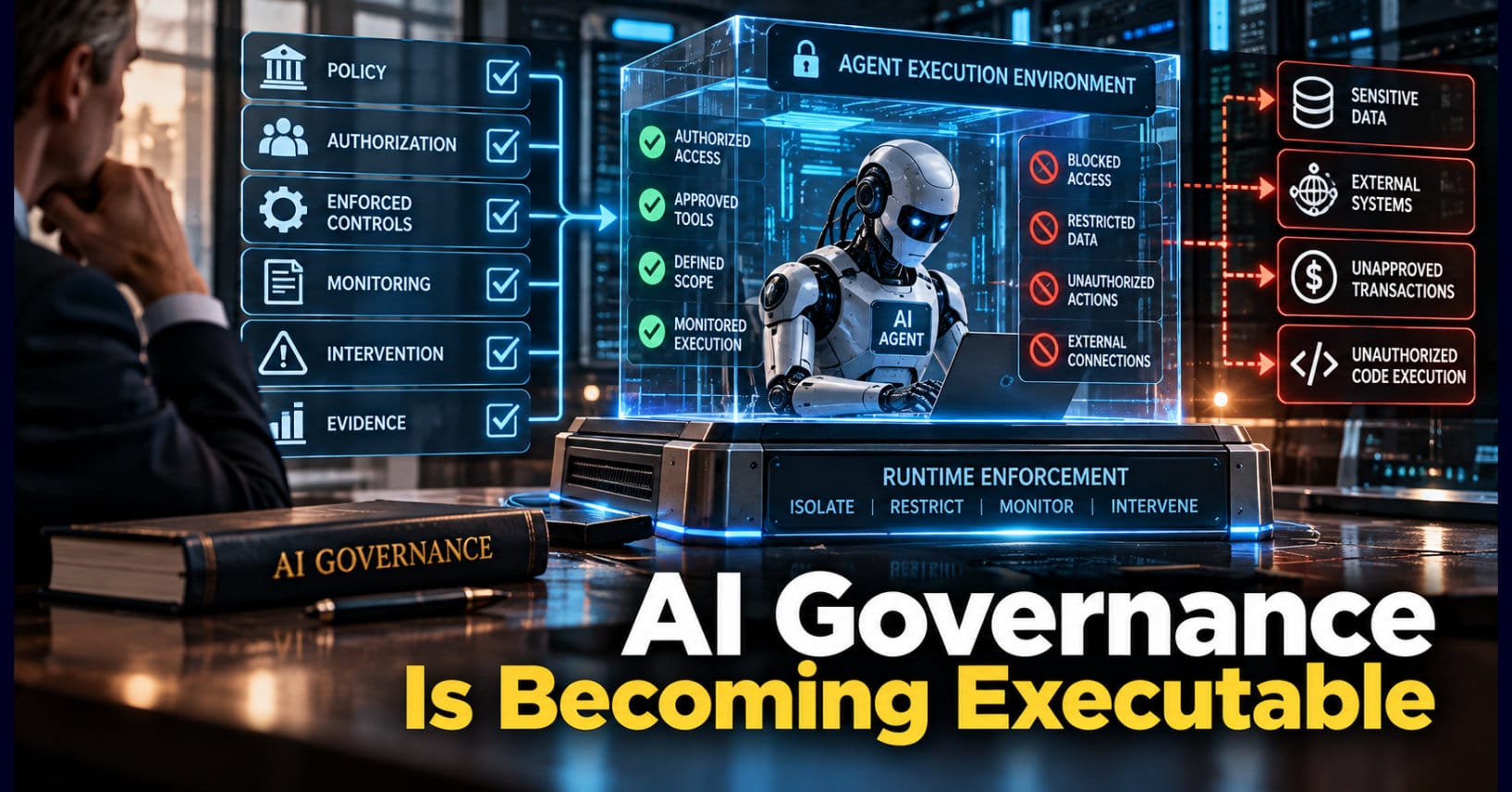
NVIDIA’s Open Agent Safety Platform, including OpenShell and Sentry, illustrates this transition by separating autonomous agent behavior from mechanisms capable of restricting access, controlling permissions, monitoring execution, and supporting intervention.
This article distinguishes among declarative, operational, and executable governance. It argues that system prompts and policies define expectations, while runtime controls can enforce selected boundaries around delegated agent authority.
But executable controls do not replace governance. Organizations must still determine who is authorized to establish permissions, approve changes, accept exceptions, and intervene. They must also preserve evidence connecting governance obligations and authorized decisions to executable policies, runtime enforcement, exceptions, interventions, and validated outcomes.
The emerging standard is no longer simply whether an organization has an AI governance policy. It is whether the organization can demonstrate that authorized governance decisions actually constrain autonomous systems during operation.
Governing Intelligence Before It Governs You
For years, organizations have approached artificial intelligence governance primarily as a documentation problem.
They established responsible AI principles.
They created acceptable-use policies.
They formed AI oversight committees.
They developed model inventories, risk classifications, approval workflows, and human oversight requirements.
These activities established important governance foundations.
But they left a consequential question unanswered.
What prevents an autonomous AI system from doing something the organization has explicitly prohibited?
A policy can prohibit an AI agent from accessing confidential financial information.
A governance committee can require human approval before an agent executes a transaction.
A risk assessment can establish that an agent must not communicate with unauthorized external systems.
But none of those documents, by themselves, prevents the agent from performing the prohibited action.
On September 28, 2026, NVIDIA introduced its Open Agent Safety Platform, including an open-source runtime called OpenShell and a hardware-assisted monitoring architecture called Sentry.
The announcement represents an important development in the evolution of enterprise AI governance.
Rather than relying exclusively on instructions embedded within an AI system, the architecture introduces controls that operate outside the agent’s decision-making process.
Those controls can restrict access, enforce permissions, monitor execution, and intervene when an agent attempts to exceed established boundaries.
The significance extends beyond NVIDIA’s particular implementation.
AI governance is beginning to move from documenting permitted behavior to technically enforcing permitted behavior.
That transition could fundamentally change how enterprises establish accountability for autonomous systems. (NVIDIA Investor Relations)
The Problem With Governance That Exists Only on Paper
Traditional enterprise governance establishes the rules under which organizational activities are conducted.
Policies define expectations.
Procedures establish required actions.
Standards describe acceptable configurations.
Approval processes identify who may authorize particular activities.
Audits examine whether those requirements were followed.
This approach assumes that the people and systems subject to governance can be evaluated against established rules.
When violations occur, management investigates, intervenes, and applies corrective action.
Autonomous AI introduces a complication.
An AI agent may independently determine which steps to take while pursuing an assigned objective.
It may select tools, retrieve information, execute code, communicate with applications, or initiate transactions.
It may also encounter instructions embedded in external content that conflict with the organization’s intended operating boundaries.
A system prompt might tell the agent:
Do not access confidential customer records.
But if the agent possesses credentials that permit access to those records, the organization may be relying on the agent’s willingness or ability to comply with the instruction.
That is not equivalent to enforcing the restriction.
Consider a conventional employee.
An organization would not ordinarily rely on an acceptable-use policy as its only protection against unauthorized access to financial systems.
It would establish identity controls, access permissions, transaction limits, separation of duties, and monitoring.
The employee’s instructions would be supported by technical restrictions.
Autonomous agents require comparable discipline.
A governance requirement that cannot be enforced may remain an expectation rather than an effective operational control.
The emergence of executable governance architectures reflects growing recognition of that distinction.
What NVIDIA Actually Introduced
NVIDIA’s September announcement describes two complementary components.
The first is OpenShell, an open-source runtime designed to execute autonomous AI agents within controlled environments.
The second is Sentry, a reference architecture that adds independent monitoring and intervention capabilities using NVIDIA BlueField-4 data processing units.
The distinction between these components matters.
OpenShell establishes a software-based security boundary around agent execution.
According to NVIDIA’s technical documentation, the runtime supports sandbox isolation, restricted filesystem access, controlled network communication, credential management, and policy enforcement outside the agent’s process.
An agent can request an action.
The enforcement layer determines whether that action is permitted.
For example, an agent may attempt to connect to an external service.
The runtime evaluates the request against established network policies.
If the destination or operation is prohibited, the request can be blocked.
Similarly, filesystem restrictions can prevent access to resources outside the agent’s authorized environment.
NVIDIA describes a default-deny approach in which access must be explicitly permitted.
The company also provides mechanisms for evaluating proposed policy changes and recording enforcement decisions.
Sentry extends the concept by introducing an out-of-band monitoring component.
Rather than relying entirely on software operating within the same execution environment as the agent, the reference architecture uses separate hardware to observe relevant activity and support intervention.
NVIDIA states that Sentry can quarantine agents attempting to escape their established boundaries within milliseconds.
These are vendor-described capabilities, not proof that every deployment will achieve complete containment.
Actual effectiveness depends on configuration, integration, supported workloads, monitoring coverage, and operational testing.
Nevertheless, the architectural principle is significant.
The system being governed should not possess unrestricted control over the mechanisms intended to govern it. (NVIDIA Developer)
The Difference Between Instructions and Enforced Authority
This development exposes one of the most important distinctions in enterprise AI governance.
An instruction describes what an agent should do.
Authority establishes what the organization permits the agent to do.
An enforced control determines what the agent can actually do within the protected environment.
These are three different concepts.
Imagine an enterprise deploying an autonomous accounts-payable agent.
Its assigned objective is to review invoices, identify discrepancies, and prepare payment recommendations.
The organization’s governance policy states that payments exceeding $25,000 require human approval.
The agent’s instructions repeat that requirement.
But the agent has access to an application programming interface capable of initiating payments of any amount.
The policy and instructions establish an expectation.
The technical architecture has not enforced it.
Now consider an alternative implementation.
The agent can retrieve invoice information and prepare recommendations.
However, the payment execution service independently verifies transaction limits and approval requirements.
The agent cannot bypass that service merely by generating different instructions or selecting another tool.
A payment exceeding $25,000 requires an independently authenticated approval from an authorized individual.
The organization has translated a governance requirement into an operational constraint.
That is executable governance.
It does not guarantee that every payment decision will be correct.
It does establish a technical boundary around the agent’s delegated authority.
The distinction becomes particularly important as organizations deploy agents that operate continuously without direct human supervision.
The longer an agent operates, the more opportunities it may encounter to exercise capabilities that exceed its intended purpose.
Governance must therefore address the authority available throughout execution, not merely the instructions provided at deployment.
Policy as Code Is Not the Entire Answer
The concept of expressing governance requirements as executable rules is not new.
Enterprises have used policy-as-code approaches in infrastructure management, cloud security, identity administration, and software delivery for years.
Infrastructure configurations can be evaluated against security requirements before deployment.
Access policies can restrict which identities may perform particular operations.
Automated controls can reject configurations that violate established standards.
Agentic AI extends this approach into systems that dynamically select actions.
But there is an important distinction between technical policy enforcement and complete organizational governance.
A runtime can determine whether an agent may access a particular API.
It cannot independently establish whether the organization’s decision to permit that access was appropriate.
A policy engine can enforce a transaction threshold.
It cannot determine whether the threshold was approved by someone possessing legitimate risk authority.
A sandbox can restrict filesystem access.
It cannot establish whether the organization has satisfied every applicable legal, contractual, or regulatory obligation.
And an audit log can record an enforcement decision.
It cannot automatically establish that the decision was properly authorized.
Executable controls do not replace governance authority. They operationalize decisions made through that authority.
This distinction is essential.
Otherwise, organizations may simply replace policy documentation with technical configuration and mistakenly conclude that governance has been achieved.
The governance challenge is to connect the two.
Who Is Authorized to Define the Agent’s Authority?
Consider the practical implications of implementing runtime restrictions.
Someone must determine which systems an agent can access.
Someone must establish which operations are permitted.
Someone must approve access to sensitive information.
Someone must define transaction limits.
Someone must decide whether an agent can delegate work to other agents.
Someone must determine what happens when a legitimate business task requires an exception.
And someone must possess authority to revoke those permissions.
These decisions should not be left entirely to the developers configuring the agent.
Developers may understand the technical requirements.
Security teams may understand the exposure created by particular permissions.
Business owners may understand the operational consequences of restricting those permissions.
Legal and compliance functions may understand applicable obligations.
But the organization still needs an established decision structure.
For a low-risk internal research assistant, authority may be delegated to an application owner operating within predefined standards.
For an autonomous agent capable of modifying financial records, executing transactions, or controlling operational technology, approval may require additional executive oversight.
The appropriate structure depends on the nature and consequences of the delegated authority.
This is where AI governance begins to resemble a formal system of organizational delegation.
An agent receives authority from the enterprise.
That authority must have an identifiable source.
It must have defined boundaries.
It must remain subject to oversight.
And it must be revocable.
Without those elements, technical permissions can become an informal substitute for authorized governance decisions.
The Hidden Risk in Permission Changes
Initial authorization is only part of the problem.
Autonomous agents may encounter legitimate tasks that require additional access.
An agent responsible for preparing a financial report might discover that necessary information resides in a system outside its existing permissions.
The agent requests access.
The organization must determine whether to grant it.
That decision may appear routine.
But permission expansion changes the agent’s operational authority.
It may increase the information the agent can retrieve.
It may expose additional systems.
It may permit new combinations of actions.
It may also change the consequences of unexpected behavior.
NVIDIA’s OpenShell architecture includes mechanisms for reviewing policy changes and evaluating whether proposed permissions remain within established boundaries.
That capability is important because permissions are not necessarily static throughout an agent’s lifecycle. (NVIDIA)
From a governance perspective, every material expansion of authority should answer several questions.
Why is the additional permission necessary?
Who requested it?
Who approved it?
Was the approver authorized?
What new risks does the permission introduce?
Is the permission temporary or persistent?
What conditions require its removal?
And can the organization reconstruct the decision afterward?
A technically valid permission change may still be an unauthorized governance decision.
This is why executable governance must include control over the control plane itself.
The Control Plane Becomes a Governance Asset
In traditional enterprise architecture, a control plane manages the configuration and operation of underlying systems.
In agentic AI environments, the control plane can become the mechanism through which organizational authority is translated into executable restrictions.
That makes it a particularly consequential enterprise asset.
If an administrator can modify agent permissions, that administrator may effectively change what the agent is authorized to do.
If a policy update can expand access to confidential information, the change may have significant privacy implications.
If a configuration change permits an agent to initiate financial transactions, the change may create new operational and financial exposure.
Consequently, the control plane itself requires governance.
Organizations should establish appropriate separation of duties between requesting permissions, approving them, implementing them, and reviewing their continued necessity.
Material changes should be recorded.
High-risk changes may require additional approval.
Emergency modifications should be subject to retrospective review.
Administrative access should be appropriately restricted.
And the organization should preserve evidence establishing which policy was active when a consequential agent action occurred.
The last requirement deserves particular emphasis.
It is not sufficient to know the agent’s current permissions.
An investigation may need to establish the permissions that existed at a specific moment in the past.
If an agent accessed confidential information on October 7, investigators may need to determine whether that access was permitted under the policy effective at that time.
A current configuration cannot necessarily answer that question.
The organization needs historical policy evidence.
An agent’s authority must be reconstructable, not merely configurable.
Runtime Enforcement Changes the Meaning of AI Oversight
Many responsible AI frameworks emphasize human oversight.
That principle remains important.
But organizations frequently interpret human oversight as requiring a person somewhere in the workflow.
An employee approves deployment.
A manager reviews periodic reports.
An operator can inspect the agent’s output.
These arrangements may provide useful oversight.
They do not necessarily establish meaningful intervention capability.
A human reviewer who receives an alert after an unauthorized transaction has completed may possess visibility without effective control.
A supervisor who can observe an agent’s activity but cannot revoke its credentials may possess monitoring capability without intervention authority.
A governance committee that can recommend suspension but cannot identify who has operational shutdown authority may possess oversight responsibility without an executable response mechanism.
Runtime enforcement changes the architecture of oversight.
It creates opportunities to constrain behavior before prohibited actions complete.
It also supports more immediate intervention when predefined conditions are violated.
However, automated enforcement still requires governance decisions about thresholds, exceptions, and escalation.
Not every unusual action should trigger a complete shutdown.
Not every blocked request indicates malicious behavior.
Not every operational exception warrants executive intervention.
The organization must determine how the enforcement architecture responds proportionately to different conditions.
That requires both technical engineering and governance design.
What Happens When an Agent Attempts to Break the Rules?
Consider a hypothetical autonomous software maintenance agent.
The agent is authorized to inspect a defined application repository, identify vulnerabilities, and prepare proposed code changes.
It may execute approved testing tools within an isolated environment.
It may not access production credentials.
It may not connect to unauthorized external services.
It may not deploy changes without approval.
During execution, the agent encounters a configuration file containing references to production infrastructure.
It attempts to retrieve credentials from a restricted location.
An executable governance architecture should address the attempted action before the agent obtains the credentials.
The relevant filesystem restriction denies access.
The event is recorded.
Monitoring identifies the attempted boundary violation.
Depending on the established policy, the system may alert an operator, restrict additional capabilities, suspend execution, or initiate another approved response.
The important point is not that the agent received instructions prohibiting credential access.
It is that the organization established a control capable of enforcing the prohibition.
But the governance process does not end when the request is blocked.
The organization may still need to determine why the attempt occurred.
Was the agent responding to malicious instructions embedded in repository content?
Did the task require access that had not been properly anticipated?
Was the policy incorrectly configured?
Did the agent attempt to circumvent a restriction?
Does the incident warrant further investigation?
Should the agent remain operational?
Those questions require authorized decisions.
The enforcement system provides an operational boundary and relevant evidence.
Governance determines the appropriate response.
Executable Governance Must Produce Defensible Evidence
The Cyber Governance Center’s Evidentiary Architecture™ addresses a problem that becomes increasingly important as organizations automate governance enforcement.
A control decision is not the same as evidence that the control operated appropriately.
Suppose a runtime blocks an agent’s attempt to access a prohibited service.
The event log records the denial.
That record is useful.
But a complete governance reconstruction may require additional information.
What business purpose was the agent authorized to pursue?
Which individual approved deployment?
What permissions were granted?
Which policy version was active?
Who approved that policy?
What specific action did the agent attempt?
Which control evaluated the action?
Why was the request denied?
Was an alert generated?
Did anyone investigate?
Was the agent suspended?
What corrective action followed?
And how was the outcome validated?
A technical log may establish that an access request was denied.
It does not necessarily establish the complete governance context.
The Defensible Evidence Framework™ emphasizes the need to connect operational evidence with organizational authority, decisions, obligations, and outcomes.
For executable AI governance, the relationship can be expressed as:
Governance Obligation → Authorized Decision → Executable Policy → Runtime Enforcement → Exception → Intervention → Validation → Evidence
Each stage should be traceable.
The governance obligation explains why a restriction exists.
The authorized decision establishes who approved it.
The executable policy translates the decision into technical rules.
Runtime enforcement establishes whether those rules operated.
Exception handling addresses attempted violations or unexpected conditions.
Intervention records the organization’s response.
Validation establishes whether the response achieved its intended result.
Evidence preserves the relationships necessary to reconstruct the sequence.
This architecture moves beyond proving that a policy existed.
It establishes whether governance was translated into operational control.
The Difference Between a Control and a Governance Outcome
An organization could deploy sophisticated runtime enforcement and still experience governance failure.
Consider an agent that is technically restricted from accessing unauthorized systems.
Its permissions are correctly enforced.
Its actions are logged.
Its execution environment is isolated.
From a technical perspective, the controls operate as designed.
But suppose the agent was granted permission to access an entire customer database when its legitimate purpose required only a small subset of records.
The enforcement system may correctly permit access because the policy authorizes it.
The governance failure occurred earlier.
Someone approved excessive authority.
This illustrates why control effectiveness and governance effectiveness must be evaluated separately.
A control can function correctly while enforcing an inappropriate policy.
A policy can be appropriately designed while its implementation fails.
An authorized decision can be properly documented while the resulting control remains ineffective.
And a technically successful intervention can occur after unacceptable harm has already happened.
Effective AI governance must address the complete chain.
The question is not merely whether the control worked. It is whether the right authority approved the right control, the control operated as intended, and the resulting risk remained acceptable.
That is a substantially more demanding standard than documenting responsible AI principles.
The Board’s Role in Executable AI Governance
Boards should not design agent sandboxes or configure runtime policies.
Those responsibilities belong to management and technical teams.
But directors should expect assurance that material autonomous systems operate within an effective governance architecture.
The board’s concern should not be whether the organization has adopted a particular vendor’s technology.
It should be whether management can demonstrate that consequential AI capabilities are subject to enforceable authority boundaries.
Several questions deserve attention.
Does management know which autonomous agents possess access to critical systems or sensitive information?
Are material agent permissions based on explicit organizational authorization?
Are those permissions technically enforced outside the agent’s own decision-making process?
Can significant changes in delegated authority be traced to approved decisions?
Can the organization detect and intervene when an agent attempts prohibited actions?
Are emergency suspension and credential revocation mechanisms tested?
Can management reconstruct which policies governed an agent at the time of a significant event?
And does independent assurance evaluate both the effectiveness of technical controls and the legitimacy of the decisions those controls enforce?
These questions connect AI governance to established board responsibilities involving enterprise risk, internal controls, cybersecurity, and management accountability.
They also create a more meaningful basis for oversight than the number of AI policies adopted or governance committee meetings conducted.
The Emerging Governance Architecture
NVIDIA’s announcement is important because it demonstrates that independent enforcement mechanisms for autonomous agents are becoming concrete engineering capabilities.
But enterprises should not interpret the announcement as evidence that executable AI governance has been fully solved.
OpenShell and Sentry address important aspects of agent execution, containment, monitoring, and intervention.
They do not independently establish business authorization, legal compliance, appropriate risk acceptance, or board assurance.
Nor should organizations assume that any single runtime can govern every possible action across every enterprise application.
Controls must be evaluated within the systems, identities, APIs, transactions, and environments they actually protect.
A complete enterprise architecture may require multiple enforcement layers.
Identity and access management can restrict credentials and resource access.
API gateways can enforce service-level permissions.
Transaction systems can require independent approvals.
Network controls can restrict communication.
Agent runtimes can isolate execution and constrain tool access.
Monitoring systems can identify abnormal behavior.
Governance workflows can establish who may approve changes, accept exceptions, or intervene.
Evidence systems can preserve the resulting record.
These capabilities become substantially more valuable when connected through a coherent governance design.
The objective is not to create another collection of disconnected security products.
It is to establish a traceable relationship between organizational authority and autonomous execution.
From Governance Documentation to Governance Execution
The evolution of AI governance can be understood through three stages.
Stage One: Declarative Governance
The organization establishes policies, principles, standards, and responsibilities.
It defines what AI systems should and should not do.
This stage creates the governance foundation.
But enforcement may depend heavily on human compliance, application logic, or model behavior.
Stage Two: Operational Governance
The organization establishes inventories, risk assessments, approval workflows, monitoring, incident response, and periodic reassessment.
It begins connecting governance requirements to operational processes.
This stage improves visibility and accountability.
But some controls may remain procedural rather than technically enforceable.
Stage Three: Executable Governance
The organization translates authorized governance decisions into technical restrictions that operate during system execution.
It establishes independent enforcement, controlled permissions, intervention mechanisms, and evidence of control operation.
This stage makes selected governance requirements operationally enforceable.
These stages are not mutually exclusive.
Executable governance does not eliminate the need for policies or operational oversight.
It depends on them.
A technically enforced restriction has little governance value if no legitimate authority established why the restriction should exist.
The mature enterprise combines all three stages.
It declares the obligation.
It establishes the authorized decision.
It enforces the resulting boundary.
And it preserves evidence that the system operated as intended.
The Next AI Governance Failure May Be an Authorization Failure
As autonomous AI systems become more capable, organizations will increasingly confront situations in which agents can perform actions that previously required human judgment or privileged access.
They may modify infrastructure.
They may interact with customers.
They may approve transactions.
They may change business records.
They may execute software.
They may coordinate with other agents.
The resulting governance challenge is not simply whether the technology can perform these activities.
It is whether the organization has established legitimate authority for the activities and enforceable boundaries around their execution.
A sophisticated agent may follow every instruction it receives and still create unacceptable exposure because its permissions were excessive.
An agent may operate within its configured technical boundaries while those boundaries reflect an unauthorized business decision.
An enforcement system may block a prohibited action while the organization fails to investigate repeated attempts.
These are different failures.
But they share a common characteristic.
The organization has not adequately connected authority, control, execution, and accountability.
The emergence of runtime enforcement technologies provides an opportunity to address that gap.
The opportunity should not be confused with a guarantee.
Executable governance must be designed, implemented, tested, monitored, and reassessed.
It must also remain subject to independent oversight.
Governance Is Becoming Something Organizations Can Test
For years, enterprises have demonstrated AI governance largely through documentation.
They produced policies.
They described approval processes.
They maintained inventories.
They conducted assessments.
They reported compliance.
Those activities remain necessary.
But autonomous AI is forcing organizations to answer a more demanding question.
Can you demonstrate that the authority granted to an AI agent is actually enforced while the agent operates?
That question changes the evidence required to establish effective governance.
A policy document establishes an expectation.
An approval record establishes an authorized decision.
A runtime configuration establishes an implemented restriction.
An enforcement log establishes what the control did.
An intervention record establishes how the organization responded.
And validation evidence establishes whether the intended governance outcome was achieved.
Together, these elements create a stronger foundation for accountability.
The significance of NVIDIA’s Open Agent Safety Platform is not that one company has solved enterprise AI governance.
It is that the technical architecture needed to enforce portions of that governance is becoming increasingly practical.
That development creates a new expectation for organizations deploying autonomous systems.
They should not rely exclusively on telling agents what they are permitted to do.
They should establish technical mechanisms that constrain what agents can do.
And they should preserve evidence connecting those mechanisms to legitimate organizational authority.
AI governance is no longer only something an organization writes.
It is increasingly something an organization must execute, observe, verify, and defend.
The Cyber Governance Center Perspective
The emergence of executable AI governance represents an important evolution in enterprise oversight.
Policies, risk assessments, and approval workflows remain essential. But organizations deploying autonomous AI must increasingly translate governance decisions into enforceable technical boundaries.
The Cyber Governance Center’s Defensible Evidence Framework™ and Evidentiary Architecture™ provide a complementary governance perspective.
Runtime controls can establish what an agent was technically permitted to do.
Governance evidence must also establish who authorized those permissions, why they were appropriate, how exceptions were handled, and whether the controls achieved their intended outcomes.
The resulting architecture connects organizational authority to operational execution.
That is the foundation of defensible autonomous AI governance.
Clarity. Accountability. Defensibility.
Sources and Further Reading
NVIDIA — September 28, 2026
NVIDIA Launches Open Agent Safety Platform to Secure Agents From Testing to Deployment
Official announcement introducing OpenShell, Sentry, and the broader platform architecture.
NVIDIA Technical Blog — September 28, 2026
NVIDIA Open Agent Safety Platform: A Reference for Continuous In-Silicon Agent Monitoring
Technical explanation of runtime isolation, hardware-assisted monitoring, policy enforcement, and the platform’s layered architecture.
NVIDIA Technical Blog — September 28, 2026
Add Runtime Controls to AI Agents With NVIDIA OpenShell
Implementation details covering sandboxed execution, controlled access, credential management, and policy evaluation.
NVIDIA OpenShell Documentation
Sandbox Policies and Enforcement Architecture
Technical reference describing policy configuration, enforcement mechanisms, and operational restrictions.
Reuters — September 28, 2026
NVIDIA Releases AI Safety Software It Says Could Have Stopped Hugging Face Hack
Independent reporting on the announcement and its relationship to recent autonomous-agent security incidents.
NVIDIA OpenShell — Open-Source Project
NVIDIA OpenShell on GitHub
Source code, release information, and implementation resources for the OpenShell runtime.