
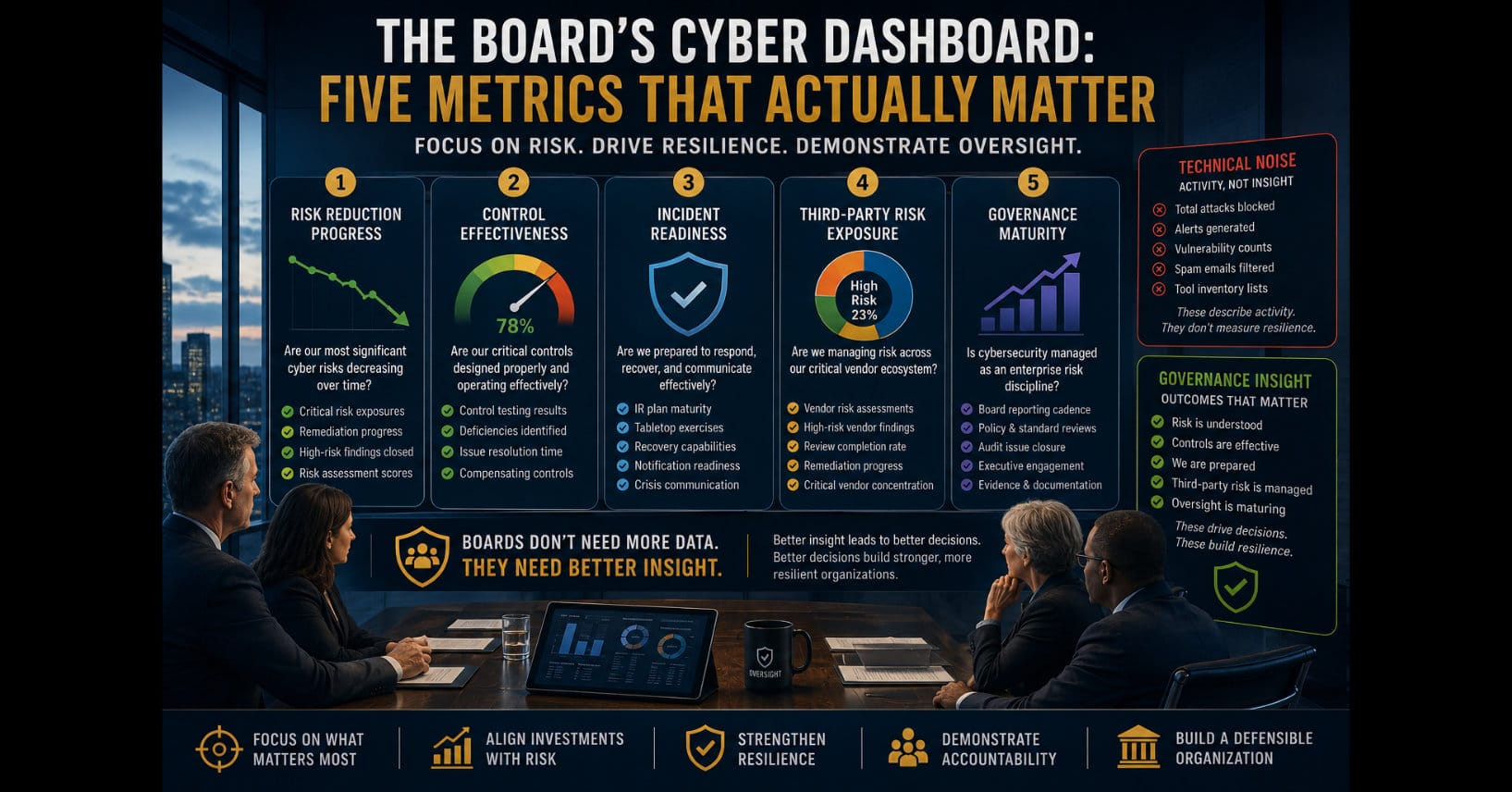
The piece argues that cybersecurity dashboards often overwhelm boards with technical data that does not answer whether the organization is becoming more resilient. It distinguishes operational metrics from governance metrics and says boards need outcomes, trends, and risk exposure rather than raw activity counts.
It highlights five board-level metrics: risk reduction progress, control effectiveness, incident readiness, third-party risk exposure, and governance maturity. The post concludes that effective dashboards support decision-making, accountability, and oversight of enterprise risk.
Cybersecurity dashboards are everywhere.
Executives receive them. Boards review them. Security teams build them.
Yet many dashboards fail to answer the most important question:
“Is the organization becoming more resilient?”
Instead, they overwhelm leadership with technical statistics that may be operationally useful but provide little governance value.
The result is a common problem.
Organizations collect vast amounts of cybersecurity data while gaining very little insight.
Effective governance requires a different approach.
Boards do not need more data.
They need better metrics.
The Problem with Technical Metrics
Many cybersecurity reports focus on measurements such as:
- Malware detections
- Vulnerability counts
- Blocked attacks
- Spam messages filtered
- Security alerts generated
These metrics may be useful for operational management.
They are often less useful for governance oversight.
For example, an increase in detected attacks may indicate worsening threats.
It may also indicate improving detection capabilities.
A higher vulnerability count may signal increased risk.
It may also reflect improved scanning coverage.
Without context, technical metrics frequently create confusion rather than clarity.
Boards should focus on outcomes, trends, and risk exposure.
Metric #1: Risk Reduction Progress
The first question boards should ask is straightforward:
“Are our most significant cyber risks becoming less significant over time?”
This metric focuses on organizational priorities rather than technical activities.
Examples include:
- Reduction in critical risk exposures
- Completion of remediation initiatives
- Closure of high-risk findings
- Improvement in risk assessment scores
Risk reduction demonstrates that cybersecurity investments are producing measurable governance outcomes.
Metric #2: Control Effectiveness
Controls matter.
However, boards should focus less on whether controls exist and more on whether they work.
Key questions include:
- How are critical controls tested?
- How often are they evaluated?
- What deficiencies have been identified?
- How quickly are issues corrected?
Organizations frequently discover that documented controls and effective controls are not the same thing.
Control effectiveness provides insight into actual resilience.
Metric #3: Incident Readiness
Organizations spend significant resources attempting to prevent incidents.
Governance also requires preparedness.
Boards should understand:
- Incident response maturity
- Tabletop exercise frequency
- Recovery capabilities
- Notification readiness
- Crisis communication preparedness
The relevant question is not whether an incident will occur.
The relevant question is whether the organization is prepared when it does.
Metric #4: Third-Party Risk Exposure
Modern organizations depend heavily on vendors, cloud providers, software platforms, and service providers.
As discussed in our previous article, accountability remains with the organization.
Boards should monitor:
- Critical vendor concentration
- Third-party risk assessments
- Vendor review completion rates
- High-risk vendor findings
- Third-party remediation progress
Third-party risk has become one of the largest concentrations of enterprise cyber risk.
It deserves visibility at the governance level.
Metric #5: Governance Maturity
This is perhaps the most important metric of all.
Governance maturity measures whether cybersecurity is being managed as an enterprise risk discipline.
Indicators may include:
- Board reporting frequency
- Risk review cadence
- Policy review completion
- Audit issue closure
- Evidence retention practices
- Executive participation
Governance maturity provides insight into whether cybersecurity oversight is sustainable, repeatable, and defensible.
What Boards Should Stop Measuring
Some metrics are useful operationally but often misleading at the board level.
Examples include:
- Total attack volume
- Number of alerts generated
- Raw vulnerability counts
- Number of blocked emails
- Security tool inventories
These measurements describe activity.
They do not necessarily describe resilience.
Governance should focus on outcomes rather than operational noise.
The Purpose of a Dashboard
A board dashboard should support decision-making.
It should answer questions such as:
- Where is risk increasing?
- Where is risk decreasing?
- Which investments are effective?
- Which risks require attention?
- Where does accountability reside?
If a dashboard cannot help leadership answer these questions, it may be reporting information without providing insight.
The Governance Perspective
The most effective cybersecurity dashboards are not technical scorecards.
They are governance instruments.
They help leadership understand risk, evaluate oversight, allocate resources, and exercise accountability.
Good dashboards do more than describe what happened.
They reveal what matters.
Because boards are not responsible for monitoring every alert, patch, or vulnerability.
They are responsible for overseeing risk.
And the metrics they receive should help them fulfill that responsibility.
That is what makes a metric meaningful.
Not that it can be measured.
But that it can inform a decision.