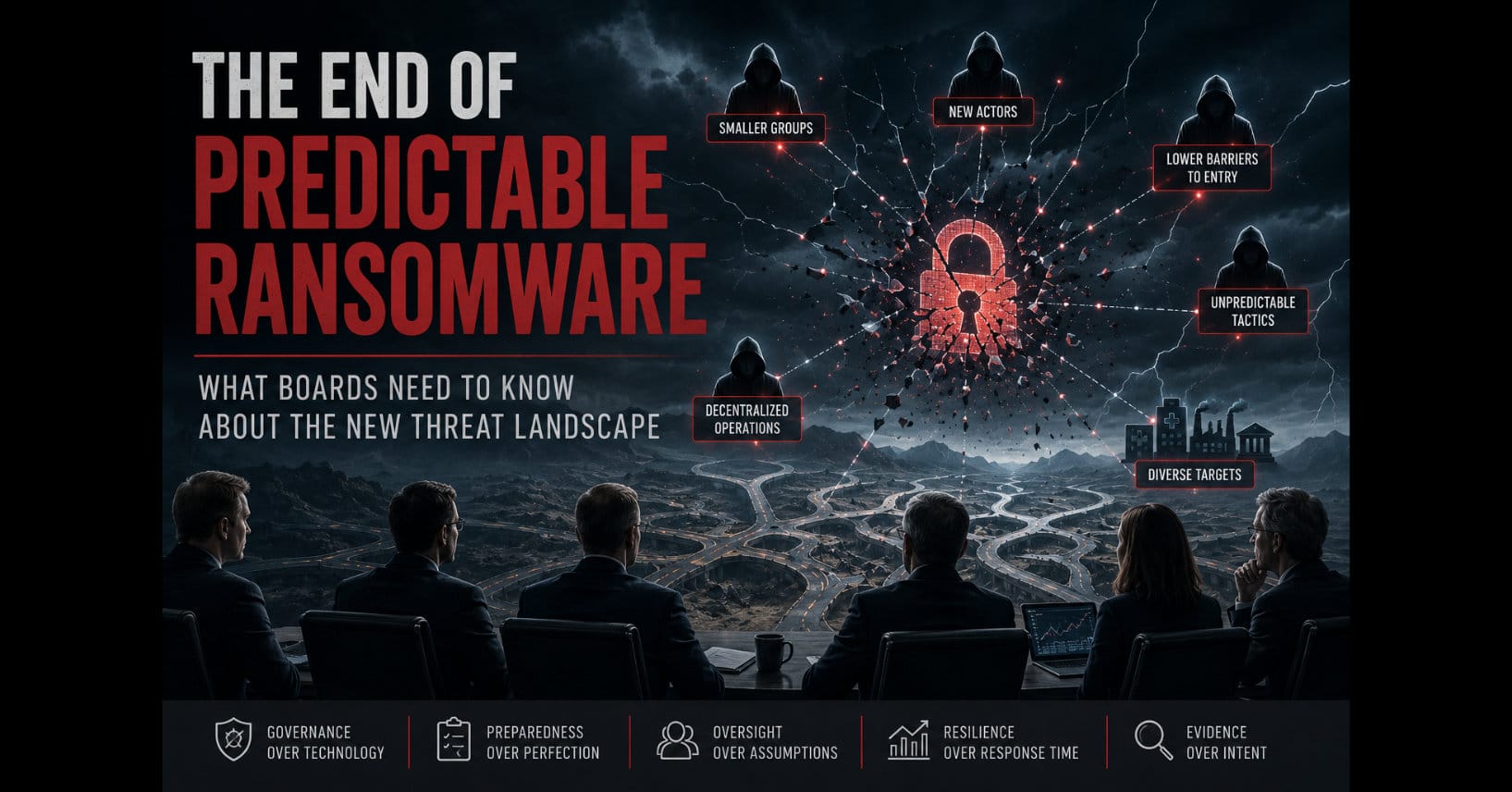
Ransomware is becoming more fragmented and less predictable as major criminal groups are disrupted and splinter into smaller operations. The result is a more uncertain threat environment that makes attacks harder to track and defend against.
The piece argues that ransomware is now primarily a governance issue. Boards are urged to focus on resilience, third-party risk, and evidence of preparedness, including testing, oversight, and recovery planning, rather than relying on prevention alone.
For years, ransomware followed a relatively predictable pattern.
Large criminal organizations operated like businesses. They developed malware, maintained affiliate networks, negotiated payments, and targeted organizations using repeatable tactics. While the attacks were disruptive, security teams, insurers, and law enforcement developed a reasonable understanding of how these groups operated.
That predictability is beginning to disappear.
Recent law enforcement assessments suggest that ransomware activity is becoming increasingly fragmented. Major ransomware syndicates continue to face disruption through arrests, sanctions, infrastructure takedowns, and international cooperation. Yet rather than reducing the threat, these actions may be contributing to a more decentralized and less predictable ecosystem.
For boards and executive leaders, this shift changes the governance conversation.
The question is no longer whether ransomware groups are growing stronger.
The question is whether organizations are prepared for a threat landscape that is becoming more chaotic.
The Myth of Ransomware Decline
Board members occasionally ask whether ransomware risk is decreasing because several high-profile criminal groups have been dismantled or disrupted.
It is a reasonable question.
Unfortunately, it may be the wrong one.
History shows that when large criminal enterprises are disrupted, their members rarely disappear. They often splinter into smaller groups, form new alliances, or create independent operations.
The result is a fragmented threat environment where attackers may be less sophisticated individually but collectively become harder to track, predict, and defend against.
Smaller groups frequently have lower barriers to entry, fewer operational constraints, and less concern about maintaining a criminal “brand.”
This makes threat intelligence more difficult and attack patterns less predictable.
Organizations should not mistake fragmentation for reduced risk.
In many cases, fragmentation increases uncertainty.
Why Governance Matters More Than Technology
Many discussions about ransomware focus on technical controls.
Organizations evaluate endpoint protection, email filtering, backup systems, network segmentation, and detection technologies.
These controls remain essential.
However, ransomware has increasingly become a governance challenge rather than a purely technical challenge.
Most ransomware events create executive-level consequences:
- Operational disruption
- Financial loss
- Regulatory scrutiny
- Legal exposure
- Reputation damage
- Customer impact
- Board accountability
The decisions that determine organizational resilience often occur long before an attack begins.
Questions such as:
- Have executives participated in tabletop exercises?
- Has incident response authority been clearly defined?
- Are recovery priorities documented?
- Has the board reviewed business continuity capabilities?
- Are third-party dependencies understood?
- Can leadership demonstrate oversight of cyber risk?
These are governance questions.
Technology may stop attacks.
Governance determines how organizations respond when technology fails.
The Rise of the Resilience Board
Historically, many boards viewed cybersecurity primarily as a prevention function.
Success was often measured by the absence of incidents.
That perspective is becoming outdated.
Modern boards are increasingly recognizing that resilience may be more important than prevention.
No organization can guarantee immunity from ransomware.
The objective is not perfection.
The objective is resilience.
A resilience-focused board asks different questions:
- How quickly can operations be restored?
- What critical services must be recovered first?
- What evidence demonstrates readiness?
- How often are response plans tested?
- What lessons were learned from prior incidents?
- How is recovery capability measured?
These discussions shift attention from technical controls to organizational preparedness.
Preparedness is where governance creates value.
The Evidence Problem
One of the most significant developments in cybersecurity governance is the growing demand for evidence.
Regulators, insurers, auditors, and litigators increasingly want proof that organizations exercised reasonable oversight.
Following a ransomware incident, organizations may be asked to demonstrate:
- Risk assessments
- Board briefings
- Executive reviews
- Tabletop exercise participation
- Recovery testing results
- Vendor oversight activities
- Incident response planning
Organizations that cannot produce evidence often struggle to demonstrate due care, regardless of the investments they made in technology.
This creates an important distinction.
Having controls is valuable.
Being able to prove that those controls were governed, tested, and reviewed is even more valuable.
The difference is defensibility.
Third-Party Risk Becomes More Dangerous
Fragmentation also creates new challenges in the third-party ecosystem.
Smaller ransomware groups frequently target vendors, service providers, managed service providers, software supply chains, and other trusted relationships.
Organizations increasingly inherit risk through their partners.
Boards should ensure management can answer fundamental questions:
- Which third parties have access to critical systems?
- How is third-party cyber risk assessed?
- What contractual requirements exist?
- How are vendors monitored?
- What contingency plans exist if a critical provider is compromised?
A fragmented threat landscape increases the likelihood that attacks originate through indirect pathways.
Governance must extend beyond organizational boundaries.
Defensibility in an Unpredictable World
The future ransomware challenge is not simply one of stronger malware or larger criminal organizations.
It is one of unpredictability.
Threat actors are becoming more diverse.
Attack methods are becoming less standardized.
Risk is becoming more distributed.
In this environment, the organizations most likely to succeed will not necessarily be those with the most technology.
They will be the organizations with the strongest governance.
Strong governance creates clarity.
Clarity creates accountability.
Accountability creates resilience.
And resilience creates defensibility.
The Bottom Line
The era of predictable ransomware may be ending.
As threat actors fragment into smaller and less predictable groups, organizations must shift their focus from prevention alone to resilience, accountability, and governance.
Boards should not ask whether ransomware is becoming less dangerous.
They should ask whether their organization can demonstrate preparedness, recover from disruption, and provide evidence that leadership exercised informed oversight.
Because when the next ransomware event occurs, the most important question may not be how the attackers gained access.
It may be whether leadership can prove they were ready.