Traditional asset inventories no longer provide the visibility boards need to govern cyber risk. Today’s organizations depend on AI platforms, SaaS applications, cloud services, third-party vendors, APIs, privileged identities, and sensitive data repositories that often exist outside traditional IT asset management.
This article argues that boards should require a governance inventory that identifies critical digital assets, ownership, business dependencies, and associated risks. Such an inventory becomes the foundation for informed oversight, regulatory readiness, and defensible governance.
Executive Brief
Over the past several years, organizations have learned the importance of knowing what software they run. Software Bills of Materials (SBOMs) have become a standard tool for understanding software supply chain risk. A similar transformation is now beginning for cryptography.
As organizations prepare for the transition to post-quantum cryptography, they face a fundamental question:
Where is today’s cryptography actually being used?
Without that answer, no migration plan can succeed.
The next critical cybersecurity inventory is the Cryptographic Bill of Materials (CBOM).
The Business Reality
Every modern enterprise depends on cryptography.
It protects customer information, authenticates users, secures VPN connections, encrypts databases, validates software updates, signs digital certificates, and enables secure communications between systems.
The challenge is that most organizations have accumulated decades of cryptographic implementations across thousands of applications, cloud services, embedded devices, APIs, third-party products, and legacy systems.
Very few organizations have a complete inventory.
That becomes a significant problem when preparing for the post-quantum era.
Unlike routine software upgrades, migrating cryptographic algorithms requires understanding every place vulnerable algorithms are embedded. Organizations cannot replace encryption they cannot locate.
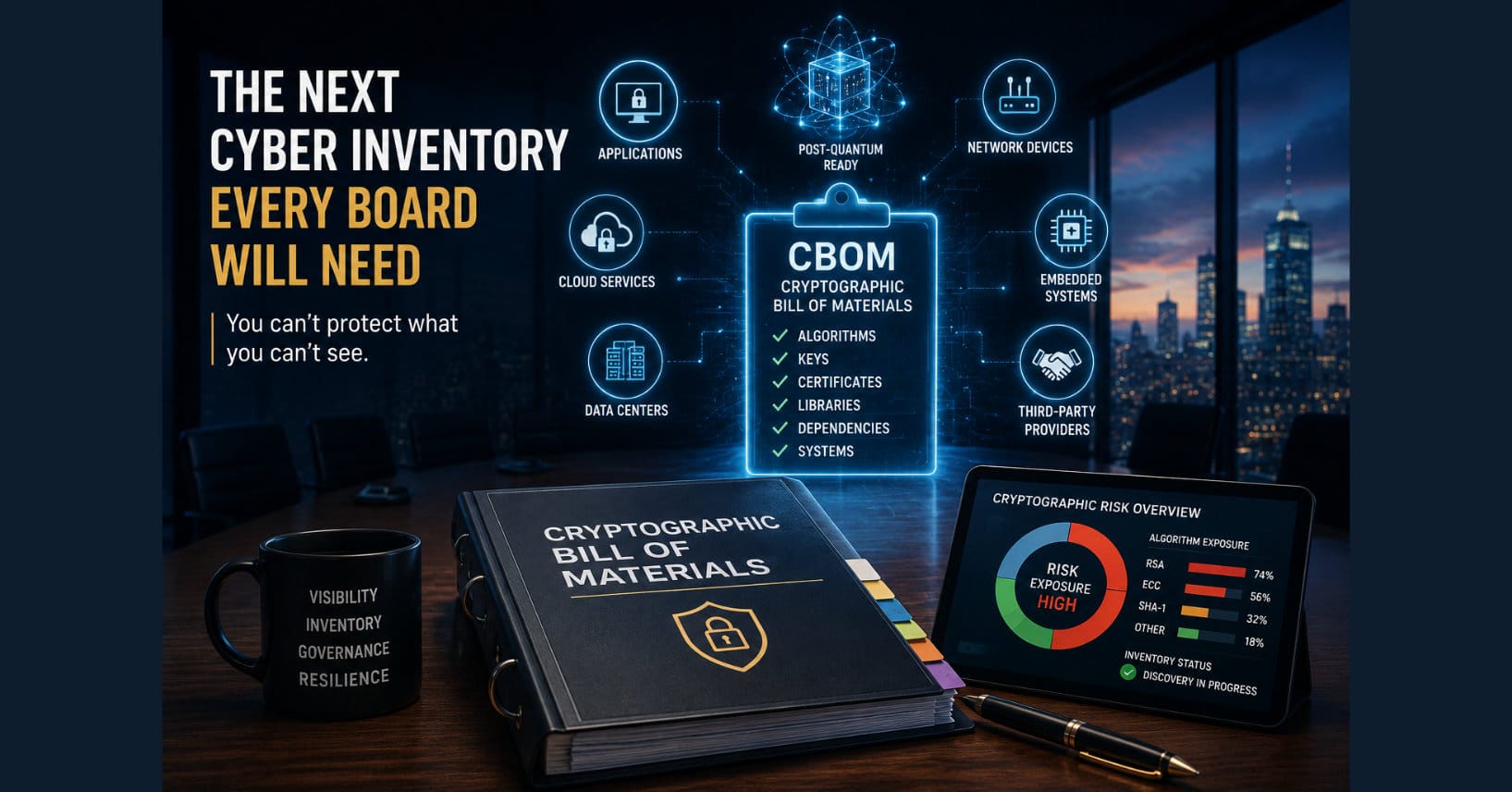
A Cryptographic Bill of Materials (CBOM) provides that visibility by documenting the algorithms, keys, certificates, cryptographic libraries, and dependencies used throughout the enterprise.
Just as an SBOM provides transparency into software components, a CBOM provides transparency into an organization’s cryptographic landscape.
For many enterprises, creating this inventory will be the longest phase of their quantum readiness journey.
What Leadership Often Misses
Leadership teams often assume post-quantum migration begins by selecting new cryptographic algorithms.
In reality, it begins with discovery.
Before management can estimate costs, prioritize systems, or develop migration schedules, they must answer basic questions:
- Which applications still rely on RSA or Elliptic Curve Cryptography?
- Which vendors have already adopted quantum-resistant standards?
- Which systems contain long-lived confidential information?
- Which business processes would be disrupted by cryptographic changes?
- Which third-party providers represent the greatest exposure?
Without a comprehensive inventory, those questions become estimates rather than evidence.
And governance decisions should never rely on estimates when evidence is attainable.
Questions Every Executive Should Ask
- Do we have a complete inventory of our enterprise cryptography?
- Can we identify where quantum-vulnerable algorithms are currently in use?
- Which business systems present the greatest migration complexity?
- Have our strategic technology vendors published their post-quantum roadmaps?
- How will we measure progress throughout a multi-year cryptographic migration?
Governance Takeaway
Boards do not need to understand the mathematics behind quantum-resistant encryption.
They do need confidence that management understands the organization’s cryptographic exposure.
A Cryptographic Bill of Materials transforms quantum readiness from speculation into measurable governance. It provides the visibility necessary to prioritize investments, demonstrate due diligence, and guide one of the most significant cybersecurity transitions organizations will undertake over the coming decade.
The first step toward quantum readiness is not replacing cryptography.
It is knowing where it exists.