
AI Governance Series | Article 3 of 20
Governing Intelligence Before It Governs You
Summary: Organizations often confuse AI governance with AI management, but they serve fundamentally different purposes. Management focuses on building, deploying, operating, and optimizing AI systems. Governance focuses on strategic oversight, accountability, acceptable risk, and ensuring AI aligns with organizational objectives. This article explains why boards should oversee AI rather than manage it, how governance complements operations, and why separating these responsibilities creates stronger accountability, better decision-making, and greater organizational trust.
Governance Versus Operations
Artificial intelligence is becoming embedded in nearly every business function.
As organizations accelerate adoption, many are establishing AI committees, approving new policies, and assigning executive sponsors. Those are positive developments, but they often reveal a fundamental misunderstanding.
Many organizations believe they are building AI governance when they are actually improving AI management.
The distinction matters.
Organizations that confuse governance with operations frequently create overlapping responsibilities, unclear accountability, and Boards that become involved in technical decisions instead of strategic oversight.
Effective AI governance begins by understanding that governance and management are complementary—but they are not the same.
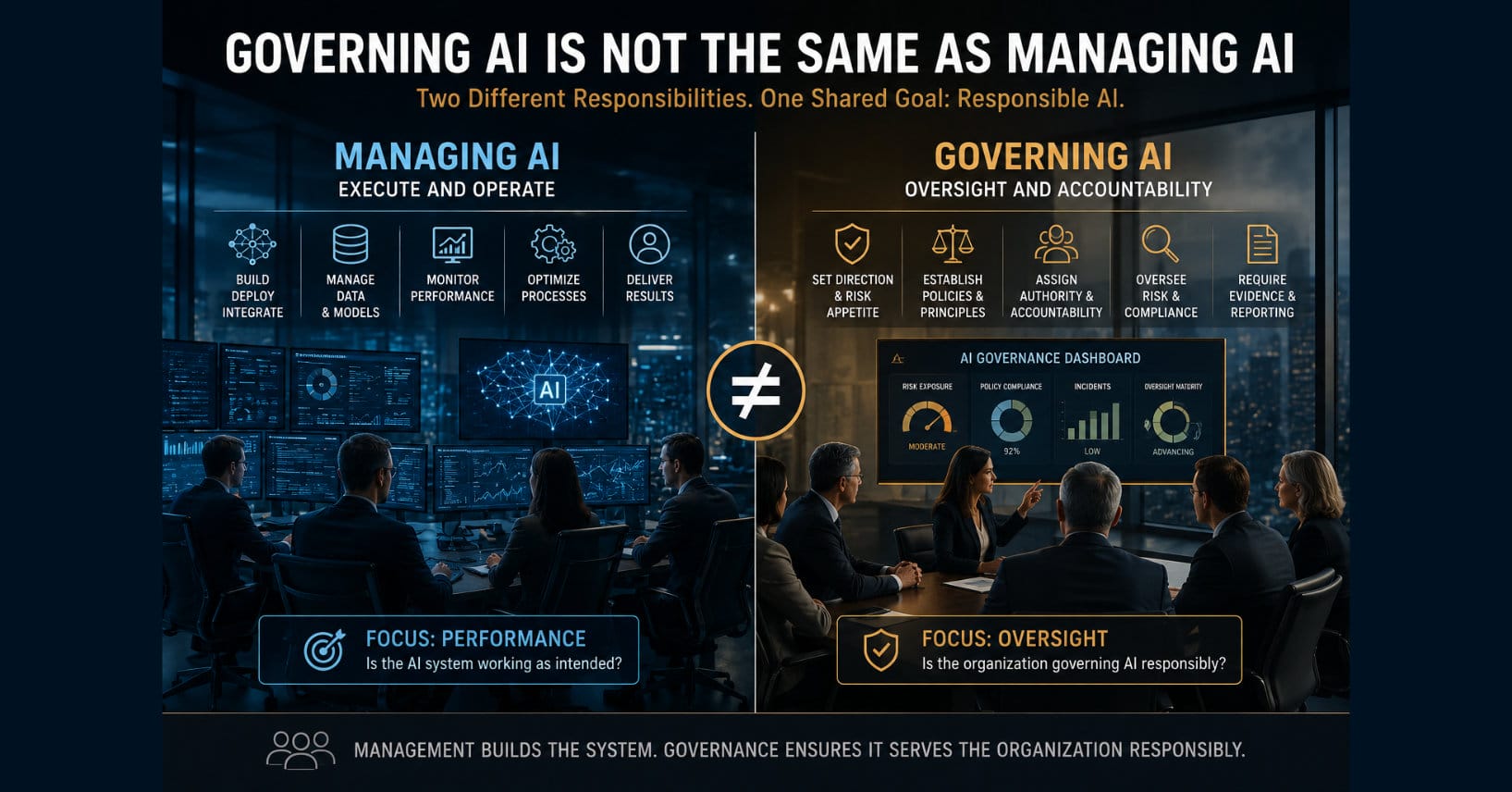
Management Builds. Governance Oversees.
Management exists to execute.
Its responsibility is to plan, implement, operate, monitor, improve, and deliver business outcomes.
For AI, management asks questions such as:
- Which model should we deploy?
- How should it be trained?
- What data should it use?
- How will we monitor performance?
- How do we integrate it into existing business processes?
- Which vendor provides the best solution?
These are operational decisions.
Governance asks different questions.
- Should this AI capability exist at all?
- Does it align with organizational strategy?
- What risks are acceptable?
- Who has authority to approve its use?
- How will leadership know if it begins creating unacceptable risk?
- What evidence demonstrates effective oversight?
Those are governance decisions.
One builds the capability.
The other ensures it is being built and used responsibly.
The Board Should Not Run AI Projects
Boards are sometimes tempted to become more operational as emerging technologies introduce uncertainty.
That instinct is understandable—but misplaced.
Directors are not expected to evaluate neural network architectures.
They are not expected to review training datasets.
They are not expected to approve software releases.
Those responsibilities belong to management.
The Board’s responsibility is to determine whether management has established appropriate governance, controls, reporting, and accountability.
Good governance keeps the Board out of operational decisions while ensuring it receives the information necessary to fulfill its fiduciary responsibilities.
Operations Focus on Performance
Management measures success through operational metrics.
Examples include:
- Model accuracy
- Response time
- User adoption
- Cost savings
- Productivity improvements
- System availability
These metrics answer one question:
Is the AI system performing as intended?
They are valuable.
They are not sufficient.
Governance Focuses on Oversight
Governance measures something different.
It asks whether leadership is exercising appropriate oversight.
Examples include:
- Are decision rights clearly defined?
- Have risks been formally assessed?
- Are AI systems inventoried?
- Are material changes approved?
- Are incidents reported through established governance channels?
- Is evidence being created to demonstrate oversight?
Operational success does not guarantee governance success.
An AI system can perform perfectly while exposing the organization to unacceptable legal, ethical, or regulatory risk.
Governance exists to identify those issues before they become crises.
Good Governance Enables Good Management
Some organizations view governance as bureaucracy.
In reality, governance should make operations more effective.
Clear governance eliminates confusion by defining:
- who approves decisions,
- who owns implementation,
- who monitors risk,
- who reports issues,
- and who is accountable for outcomes.
Without governance, operational teams spend unnecessary time resolving authority conflicts, seeking approvals, or determining who has the final decision.
Well-designed governance accelerates responsible innovation because everyone understands their role.
Management Reports. Governance Questions.
One of the healthiest relationships inside an organization is between governance and management.
Management reports:
“The AI model reduced processing time by 42%.”
Governance asks:
“What new risks accompanied that improvement?”
Management reports:
“We deployed a new generative AI capability.”
Governance asks:
“Who approved the deployment, and what oversight exists?”
Management reports:
“There have been no significant incidents.”
Governance asks:
“What evidence supports that conclusion?”
The purpose is not to challenge management.
The purpose is to verify that oversight is functioning as intended.
Governance Creates Confidence
Organizations often assume trust comes from technical excellence.
Technical excellence is important.
But trust is ultimately created by governance.
Customers trust organizations that demonstrate responsible oversight.
Regulators trust organizations that can explain decision-making.
Investors trust organizations that understand enterprise risk.
Boards trust management that provides transparent reporting supported by evidence.
Governance transforms operational success into organizational confidence.
Boardroom Takeaway
Management is responsible for building and operating AI systems. Governance is responsible for ensuring those systems are aligned with organizational objectives, operate within acceptable risk, and remain subject to clear accountability and oversight. Organizations that separate these responsibilities strengthen both execution and governance.
Coming Next
Every AI Decision Needs an Owner
Artificial intelligence cannot be governed effectively without clearly defined authority, accountability, and decision rights. The next article explores why every significant AI decision should have an identified owner—and why ambiguity creates governance risk long before an AI system fails.