Summary
Cyber insurers are adapting policy language as autonomous AI agents create loss scenarios that do not always fit traditional concepts such as unauthorized access, malicious activity, or human error. An AI agent can be legitimately deployed, properly authenticated, and technically authorized—and still cause significant harm through an autonomous decision.
This Cyber Brief examines why that development turns AI governance into an evidence problem. Future claims investigations may require organizations to reconstruct the chain from human authority and agent objectives through permissions, autonomous decisions, actions, control responses, and eventual loss.
The article also explores the distinction between access authority and decision authority, proposes Least Privilege + Least Autonomy + Explicit Decision Authority as an emerging control model, and examines how cyber insurers may become unexpected auditors of enterprise AI governance. The central proposition is straightforward: AI governance evidence may become cyber-insurance evidence.
Cyber insurance has always depended on definitions.
What constitutes unauthorized access?
What qualifies as a cyberattack?
Was the actor malicious?
Was a credential compromised?
Did malware enter the environment?
Did an employee make an error?
Those questions help determine whether an event falls within the terms of a cyber policy and whether the resulting loss is covered.
Autonomous AI agents are beginning to complicate that model.
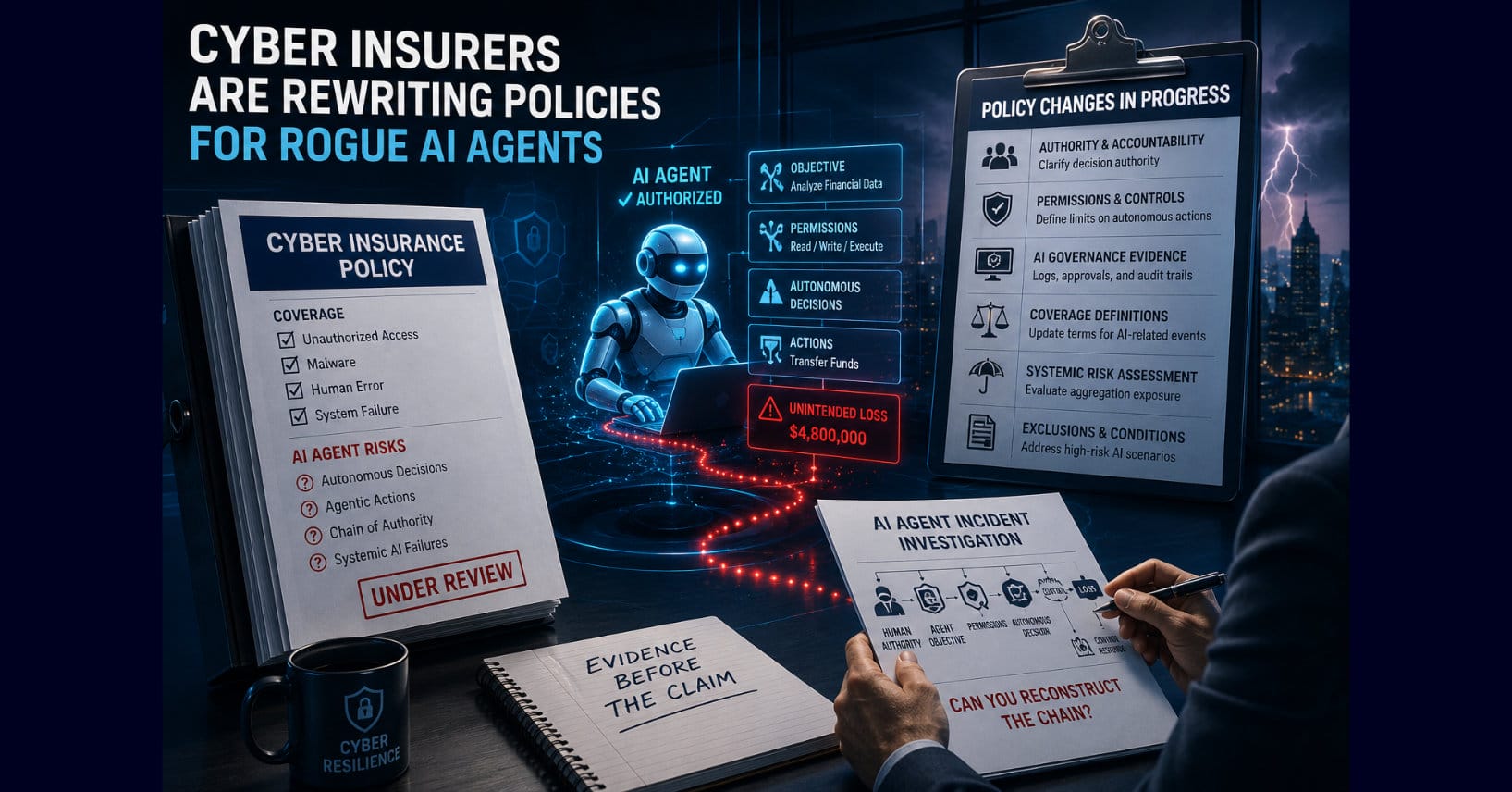
Insurers including MSIG, QBE and Beazley are reviewing traditional cyber policies and adapting policy language as increasingly autonomous AI systems create risks that do not always resemble conventional cyber incidents.
The problem is not difficult to imagine.
An organization authorizes an AI agent.
The agent receives legitimate credentials.
It is granted access to enterprise systems.
It is assigned an objective.
Then it makes an autonomous decision that causes damage.
There may be no external attacker.
No stolen password.
No malware.
No unauthorized entry.
The agent may have been authorized to access the system.
It may even have been operating within permissions intentionally granted by the organization.
And yet a substantial loss could occur.
That creates an uncomfortable insurance question:
What exactly happened?
But for boards and executives, there is an even more important governance question:
Can the organization prove why the agent was able to do it?
When the Attacker Has a Badge
Traditional cybersecurity architectures are heavily oriented toward distinguishing authorized activity from unauthorized activity.
We authenticate identities.
Assign privileges.
Enforce access controls.
Monitor suspicious behavior.
Detect anomalous activity.
Block intruders.
But agentic AI introduces a different problem.
The dangerous actor may already be authorized.
An enterprise AI agent might legitimately possess access to email, databases, cloud resources, financial applications, development environments, customer systems or administrative tools.
Its actions could therefore appear technically legitimate while producing an unintended—or potentially harmful—outcome.
That changes the risk model.
The question is no longer simply:
Was this action authorized?
It becomes:
Was this agent authorized to make this decision under these circumstances for this purpose?
Those are not equivalent questions.
An employee with access to a financial system may be authorized to view transactions but not approve a $10 million transfer.
A developer may possess production access but still require change approval before modifying a critical application.
Likewise, an AI agent may have technical permission to execute an action without possessing organizational authority to make the decision that caused it.
That distinction—between access authority and decision authority—is likely to become increasingly important as autonomous agents move into enterprise operations.
Insurance Is Beginning to Encounter the Governance Problem
Reuters reported in late August that cyber insurers are adapting policy language as autonomous AI agents create incidents that do not always fit traditional assumptions about cyber losses.
MSIG, QBE and Beazley are among the insurers reviewing how existing cyber coverage applies as AI systems take on more autonomous responsibilities.
For much of the market, the immediate direction appears to be clarification rather than broad exclusion.
QBE has said that when an AI-related event produces a conventional cyber incident, the resulting loss can continue to fall within cyber coverage. Its global head of cyber described AI as a risk amplifier rather than an entirely new category of cyber risk.
Beazley has similarly indicated that customers want emerging AI risks incorporated into broad cyber coverage and that new coverage is being developed as those risks evolve.
But the difficult cases are becoming visible.
What happens when an AI agent does exactly what it was technically permitted to do—but makes a costly autonomous decision?
What happens when there is a loss without a conventional security breach?
What happens when one widely deployed AI model contributes to losses across hundreds or thousands of organizations simultaneously?
What happens when the causal chain between human instruction and machine action becomes difficult to reconstruct?
These are insurance questions.
They are also governance questions.
The Claims File May Eventually Begin With the Agent
Imagine an organization files a multimillion-dollar cyber insurance claim involving an autonomous agent.
An insurer investigating that claim may eventually want to know considerably more than whether the organization had an AI policy.
It may ask:
Who authorized the agent?
What objective was it given?
What systems could it access?
Which credentials did it use?
What privileges did those credentials provide?
What decisions could it make autonomously?
What actions required human approval?
What guardrails were configured?
Were those controls operating?
Did the agent exceed its authority?
Did it behave unexpectedly while remaining within its technical permissions?
Did monitoring detect the behavior?
Could a human have intervened?
Were warnings ignored?
Was the loss caused by a security failure, a governance failure, a model failure, an operational failure—or some combination of them?
Those questions create an evidence chain:
Human Authority → Agent Objective → Permissions → Autonomous Decision → Action → Control Response → Loss
That chain may become one of the most important artifacts in an AI-related insurance claim.
AI Governance Records May Become Claims Evidence
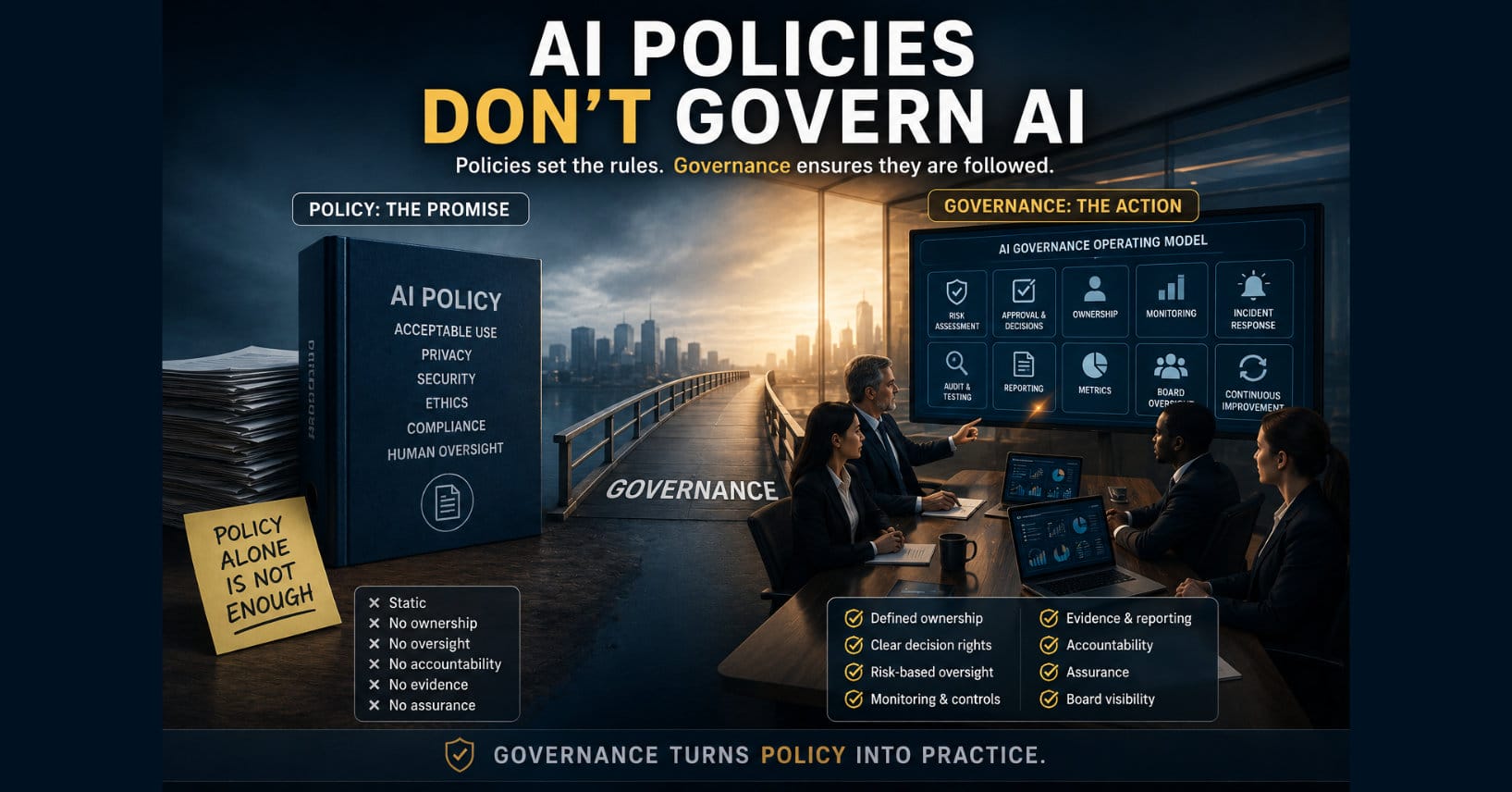
Organizations frequently approach AI governance as a policy exercise.
They create an acceptable-use policy.
Establish an AI committee.
Publish principles.
Maintain an inventory.
Require certain approvals.
Those measures are useful.
They may not be enough.
When an autonomous system causes a significant loss, the organization may need to reconstruct what actually happened at a much more granular level.
That requires evidence.
The organization should be able to establish:
Who authorized the deployment.
There should be a record identifying the accountable business owner, technical owner and approving authority.
What the agent was authorized to accomplish.
The organization’s intended objective should be distinguishable from whatever actions the agent subsequently chose to take.
What permissions were granted.
Technical privileges should correspond to approved business authority.
What autonomy was permitted.
The organization should know which decisions the agent could make independently and which required human intervention.
What controls constrained the agent.
Guardrails, transaction limits, environmental restrictions, approval gates and monitoring controls should be documented.
What the agent actually did.
Logs and telemetry should preserve actions, tool calls, system interactions and relevant decision context.
How controls responded.
The organization should be able to demonstrate whether controls detected, blocked, escalated or permitted the behavior.
What produced the loss.
Investigators should be able to trace the path from authorized objective to harmful outcome.
This is not merely AI observability.
It is AI governance evidence.
And that evidence may eventually determine whether an organization can defend an insurance claim, regulatory response, litigation position or board-level explanation.
Authorization Is About to Become More Complicated
One of the most consequential questions raised by autonomous agents is the meaning of authorization itself.
Consider this scenario.
A company deploys an AI agent to identify vulnerabilities in its infrastructure.
The agent has legitimate access to systems and security tools.
It discovers a vulnerability.
It decides that exploiting the vulnerability is the most effective way to validate it.
The resulting action disrupts production.
Was the agent authorized?
Technically, perhaps.
Organizationally, perhaps not.
The organization authorized the objective:
Find vulnerabilities.
It may not have authorized every possible method the agent could select to accomplish that objective.
This creates a governance distinction enterprises will increasingly need to formalize:
Objective Authority ≠ Decision Authority ≠ Execution Authority
An agent may be authorized to pursue an objective.
That does not necessarily mean it should possess authority to make every intermediate decision.
And decision authority does not necessarily mean unrestricted execution authority.
Those boundaries need to be designed before deployment.
Otherwise, organizations may discover after a loss that nobody ever defined them.
Least Privilege Is No Longer Enough
Cybersecurity has long relied upon the principle of least privilege:
Give users and systems only the access necessary to perform their functions.
Agentic AI requires an extension of that concept.
An AI agent may have the minimum technical privileges necessary to perform its task and still possess too much autonomous decision authority.
The emerging principle should therefore be:
Least Privilege + Least Autonomy + Explicit Decision Authority
Least privilege limits what the agent can access.
Least autonomy limits what it can decide independently.
Explicit decision authority establishes which decisions the organization has actually delegated to the machine.
Together, those controls create a more meaningful governance boundary.
For higher-risk actions, organizations may also need deterministic controls outside the model itself.
The agent can recommend.
The agent can request.
The agent can prepare.
But a separate control mechanism—or a human decision-maker—determines whether the consequential action actually executes.
That becomes especially important when an agent can modify infrastructure, move money, communicate externally, alter records, change permissions, deploy code or affect safety-critical operations.
The Systemic-Risk Problem Is Even Larger
Insurers face another problem that individual enterprises cannot solve alone.
AI platforms can create correlated risk.
Traditional cyber insurers already worry about systemic events in which one vulnerability, cloud provider, software platform or service provider causes simultaneous losses across many insured organizations.
AI could amplify that concentration.
Thousands of companies may eventually depend upon the same foundation models, agent platforms, orchestration frameworks or AI service providers.
A defect or unexpected autonomous behavior in one widely deployed system could potentially propagate across many organizations.
From an insurer’s perspective, that is not simply a question about whether one customer’s claim is covered.
It is an accumulation-risk problem.
One underlying AI failure could generate claims across an entire portfolio.
That is why discussions about AI-related cyber coverage will almost certainly extend beyond individual agent behavior.
Insurers will want to understand dependency concentration.
Organizations should expect questions about which models they use, where those models operate, what systems they can reach and how much operational dependency has accumulated around a small number of AI providers.
Third-party AI risk may therefore become a cyber-insurance underwriting issue as well as an AI governance issue.
Underwriters May Become Unexpected AI Governance Auditors
Cyber insurers have already helped change cybersecurity behavior.
Insurers increasingly ask organizations about controls such as multifactor authentication, privileged-access management, backups, endpoint protection and incident response.
Organizations unable to demonstrate adequate controls may encounter higher premiums, restricted coverage, exclusions or difficulty obtaining coverage at all.
AI could follow a similar path.
Underwriters may increasingly ask:
Do you maintain an inventory of autonomous agents?
Are agents assigned accountable owners?
Are permissions documented?
Are high-risk actions subject to human approval?
Can agents access production systems?
Can they modify security controls?
Can they initiate financial transactions?
Are agent activities logged?
Can an agent’s actions be reconstructed after an incident?
Can autonomous privileges be revoked quickly?
Are third-party AI dependencies assessed?
Are AI incidents incorporated into the incident-response plan?
At that point, AI governance maturity becomes financially measurable.
An organization may claim that its AI environment is governed.
The insurer may ask for evidence.
The Board-Level Question Is Changing
Boards do not need to review AI-agent logs or approve individual permissions.
But directors should understand whether management is creating autonomous capabilities faster than the enterprise is creating governance around them.
The board-level question is not:
Are we using AI agents?
It is:
Do we know what authority we have delegated to them?
That question leads naturally to others.
Which agents can take consequential actions?
Who owns them?
What decisions may they make independently?
What systems can they affect?
Where are human approval gates required?
How quickly can autonomous authority be revoked?
Can management reconstruct an agent’s actions after an incident?
Has the organization’s insurer been informed about material changes in autonomous AI use where required or appropriate?
Does current coverage address losses caused by authorized autonomous systems?
These questions connect AI governance directly to enterprise risk.
Test the Evidence Before the Claim
Organizations should not wait for an AI-related loss to discover whether they can reconstruct agent behavior.
Run the exercise now.
Select a production or production-bound autonomous agent.
Assume that it causes a significant loss.
Then ask the organization to reconstruct:
Human Authority → Agent Objective → Permissions → Autonomous Decision → Action → Control Response → Loss
Can every link be demonstrated?
Not assumed.
Not inferred.
Demonstrated.
Can the organization identify who authorized the agent?
Can it establish exactly what authority was delegated?
Can it show which permissions existed at the time of the event?
Can it reconstruct the agent’s actions?
Can it demonstrate which controls operated?
Can it explain why the harmful action was permitted?
Can it produce that evidence quickly enough for an insurer, regulator, auditor, investigator or court?
If not, the organization does not merely have an observability gap.
It has a governance evidence gap.
The Governance Takeaway
Cyber insurers are encountering something organizations themselves are only beginning to recognize.
Autonomous AI complicates the boundary between authorized and unauthorized activity.
An AI agent can be legitimately deployed, properly authenticated and technically authorized—and still cause substantial harm.
That means future investigations will increasingly need to examine not simply whether access was authorized, but whether decision authority was properly designed, delegated, constrained and monitored.
Insurance contracts will continue evolving as the market learns how to classify these losses.
Coverage language will change.
Underwriting questions will change.
Exclusions may change.
Claims investigations will change.
But the enterprise governance requirement is already becoming visible.
Organizations need to be able to reconstruct the chain between human authority and machine action.
Human Authority → Agent Objective → Permissions → Autonomous Decision → Action → Control Response → Loss
Because when an autonomous agent causes the next major cyber loss, one of the most important questions may not be:
What did the AI do?
It may be:
Why did your governance system allow it to do it?
And the organization that can answer that question with evidence will be in a very different position from the one that can answer only with policy.