
AI Governance Series | Article 16 of 20
Governing Intelligence Before It Governs You
Summary: Artificial intelligence is changing how organizations build and maintain public confidence. Trust is no longer established through brand messaging alone but through demonstrable governance, accountability, transparency, and evidence. This article explains why boards must treat trust as a strategic governance objective, overseeing AI ethics, risk management, incident response, assurance, and continuous improvement. Organizations that consistently demonstrate responsible AI practices will strengthen customer confidence, satisfy regulators, attract investors, and accelerate AI adoption. In the AI economy, trust is becoming a measurable business asset and one of the few competitive advantages that cannot be easily copied.
Organizations once competed on product quality.
Then they competed on customer experience.
Today, they increasingly compete on trust.
Artificial intelligence is accelerating that shift.
As AI systems make more decisions, generate more content, and influence more business processes, customers, employees, investors, regulators, and partners are asking a different question.
Can we trust your AI?
The organizations that answer that question with evidence—not promises—will have a significant competitive advantage.
Trust Is Becoming a Business Asset
Trust has always been valuable.
Now it is becoming measurable.
Organizations with trusted AI are more likely to:
- Retain customers.
- Attract business partners.
- Earn investor confidence.
- Reduce regulatory scrutiny.
- Accelerate AI adoption.
- Strengthen their brand.
Conversely, organizations that lose public confidence often discover that rebuilding trust is far more expensive than building governance in the first place.
Trust is no longer a public relations objective.
It is a governance objective.
AI Failures Damage More Than Systems
When an AI system produces biased decisions, leaks sensitive information, or generates inaccurate recommendations, the technology is rarely what people remember.
They remember the organization.
Customers don’t blame the algorithm.
They blame the company that deployed it.
Investors don’t question the model.
They question leadership.
Regulators don’t investigate software.
They investigate governance.
Technology failures quickly become trust failures.
Trust Cannot Be Claimed
Many organizations tell stakeholders they are trustworthy.
Trust does not work that way.
Trust is granted by others.
It is earned through consistent behavior over time.
Organizations earn trust by demonstrating:
- Accountability
- Transparency
- Reliable oversight
- Ethical decision-making
- Effective incident response
- Continuous improvement
Governance creates those behaviors.
Marketing merely describes them.
Transparency Builds Confidence
People do not expect AI to be perfect.
They expect organizations to be honest.
When AI makes mistakes, stakeholders want to know:
- What happened?
- Who was responsible?
- How was the issue discovered?
- What actions were taken?
- What prevents it from happening again?
Organizations that answer these questions openly preserve confidence.
Organizations that avoid them create suspicion.
Transparency protects trust.
Trust Depends on Evidence
Public confidence increasingly depends upon what organizations can demonstrate.
Can they show:
- Independent AI assessments?
- Governance reviews?
- Risk acceptance decisions?
- Human oversight?
- Audit findings?
- Corrective actions?
- Board reporting?
- Continuous monitoring?
Evidence transforms trust from reputation into proof.
Boards Are Becoming Guardians of Trust
Boards have traditionally overseen financial integrity and organizational strategy.
AI expands that responsibility.
Boards must now oversee whether AI strengthens—or weakens—organizational trust.
That requires regular reporting on:
- AI governance maturity
- Ethical performance
- Regulatory compliance
- Incident trends
- Third-party AI oversight
- Assurance activities
- Public confidence indicators
Trust deserves the same level of oversight as financial performance.
Trust Accelerates Innovation
Some leaders worry governance slows innovation.
The opposite is increasingly true.
Organizations trusted by customers, regulators, and employees can adopt AI more quickly because stakeholders have confidence in the safeguards surrounding its use.
Governance reduces uncertainty.
Reduced uncertainty increases adoption.
Trust becomes an accelerator rather than a constraint.
Reputation Is Built Before the Crisis
Organizations often attempt to protect trust after something goes wrong.
By then, much of the damage has already occurred.
Trust is built long before the first incident.
Every governance review…
Every documented decision…
Every independent assessment…
Every corrective action…
Every transparent communication…
Strengthens organizational credibility before it is tested.
The strongest reputations are built through years of consistent governance—not days of crisis management.
Trust Is the New Competitive Advantage
Organizations often ask how AI can create competitive advantage.
Faster models.
Smarter automation.
Lower costs.
Greater efficiency.
Those benefits matter.
But they can all be copied.
Trust is much harder to replicate.
Competitors can purchase similar AI platforms.
They cannot quickly reproduce years of accountable leadership, transparent governance, and demonstrable oversight.
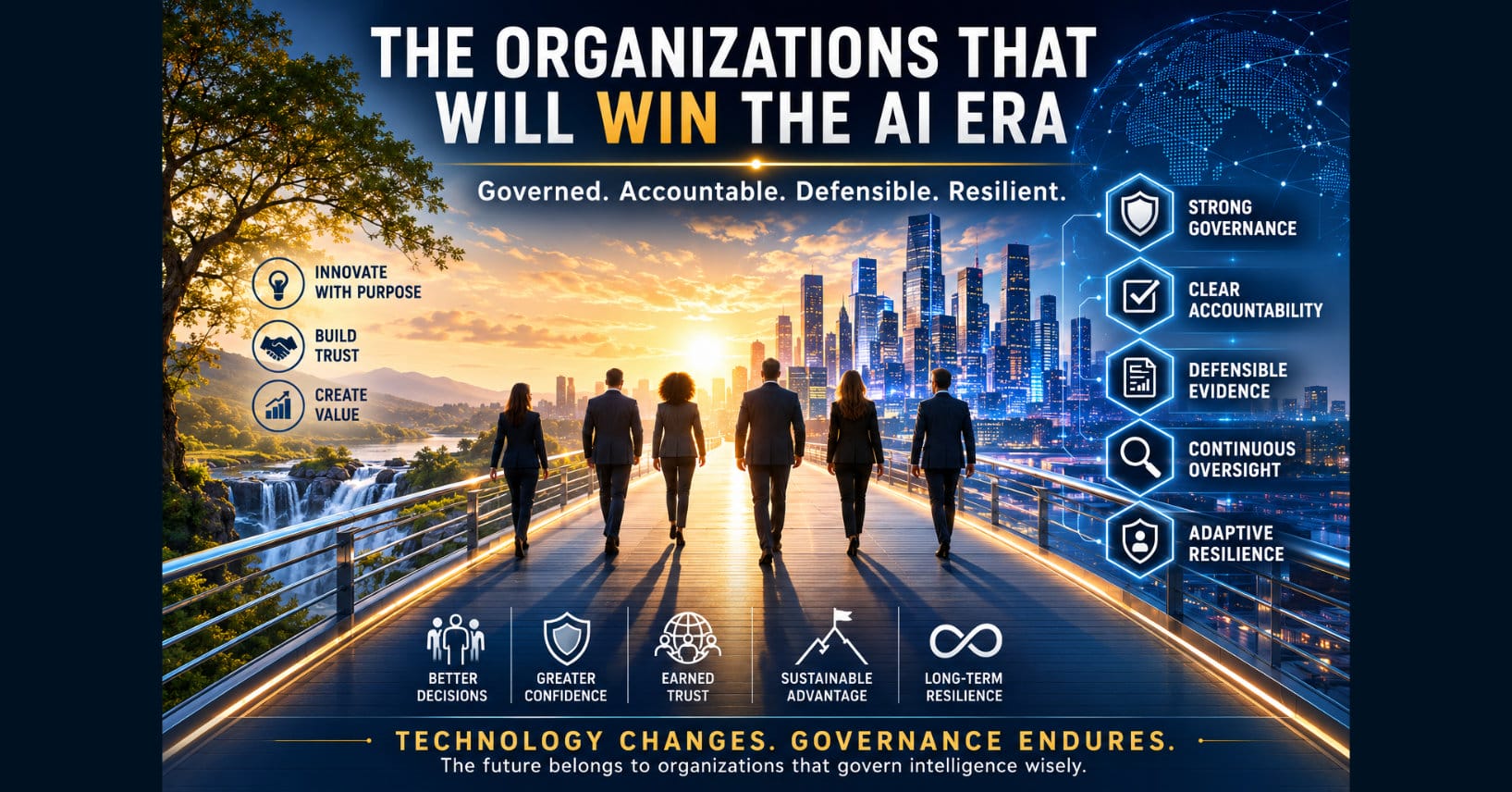
In the AI economy, trust may become the most valuable asset an organization owns.
Boardroom Takeaway
Artificial intelligence is changing how organizations earn and maintain public confidence. Trust is no longer built through brand messaging alone. It is built through governance that consistently demonstrates accountability, transparency, oversight, and evidence. Organizations that treat trust as a strategic governance objective—not a communications objective—will be best positioned to lead in the AI era.
Coming Next
AI Maturity Is Not About Better Models
Many organizations measure AI maturity by the sophistication of their technology. The next article explains why true AI maturity is measured by governance capability—how effectively an organization oversees, manages risk, assures accountability, and produces defensible evidence as AI adoption expands.