Summary:
The FBI’s removal of a contractor following a missed critical security patch exposes a governance issue larger than patch management. This article examines the distinction between executing a cybersecurity control and governing it, including risk ownership, independent verification, escalation, third-party accountability, assurance, and evidence. A mature governance system should detect when critical actions do not occur before an individual failure becomes an enterprise failure.
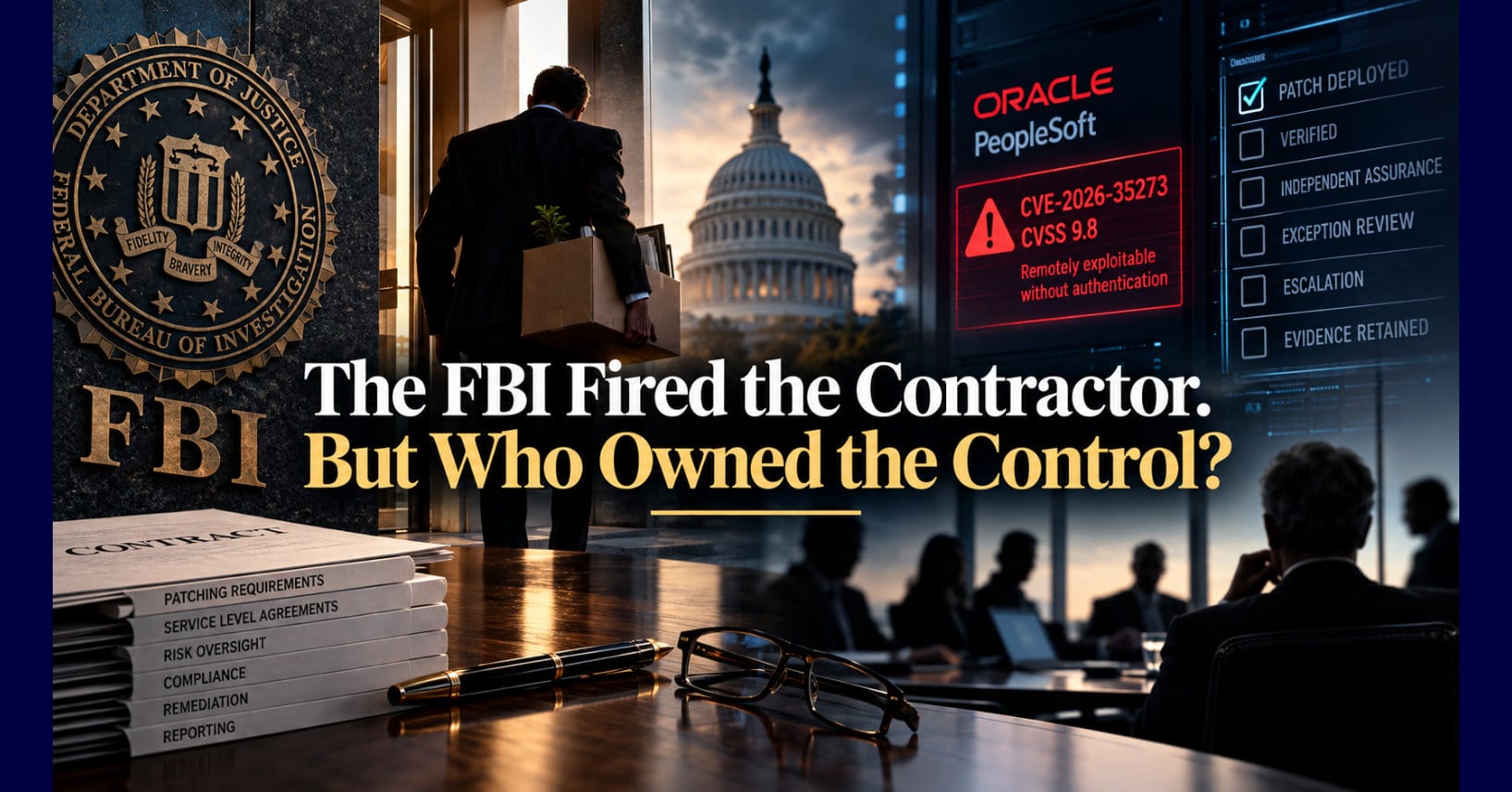
The FBI removed a contractor after determining that a failure to install a critical security patch contributed to a data breach that exposed sensitive information about thousands of FBI personnel.
According to Reuters, sources identified the contractor as associated with Accenture and the affected platform as Oracle PeopleSoft. The compromised information reportedly included home addresses, medical information, and descriptions of sensitive counterintelligence roles. (Reuters)
At first glance, this looks like a patch-management failure.
A critical vulnerability existed. A patch was available. Someone responsible for applying it apparently failed to do so. Attackers exploited the exposure. The contractor was removed.
But from a governance perspective, that explanation is incomplete.
Firing the person who failed to install the patch may answer who failed to perform the task.
It does not answer who owned the risk.
And that is the much more important question.
A Critical Control Should Not Depend on One Person
The vulnerability associated with the broader PeopleSoft campaign, CVE-2026-35273, was not obscure.
Oracle issued a security alert on June 10, 2026, affecting PeopleSoft Enterprise PeopleTools versions 8.61 and 8.62. Oracle rated the vulnerability CVSS 9.8 and warned that it could be exploited remotely without authentication, potentially resulting in remote code execution and takeover of the affected system. Oracle recommended immediate action. (Oracle)
Oracle subsequently incorporated fixes for the vulnerability into its June Critical Security Patch Update and again urged customers to apply security patches without delay. (Oracle)
That makes this incident especially useful as a governance case study.
The central question is not whether critical vulnerabilities should be patched.
Everyone already knows that.
The governance question is what should happen between the moment an organization learns that a critical vulnerability exists and the moment someone can prove that the vulnerability has actually been remediated.
That is an entirely different problem.
A Patch Is a Task. Patch Governance Is a System.
Installing a patch is an operational activity.
Governance determines the system surrounding that activity.
Someone must receive the vulnerability notification.
Someone must determine whether affected technology exists within the environment.
Someone must identify which systems are exposed.
Someone must classify the risk.
Someone must establish the remediation deadline.
Someone must assign responsibility for performing the remediation.
Someone must verify that the remediation occurred.
Someone must determine what happens if it does not.
And someone must retain evidence demonstrating that the process worked.
That creates a governance chain:
Vulnerability identified → affected assets identified → risk classified → remediation required → execution assigned → remediation completed → implementation verified → exceptions escalated → risk disposition documented → evidence retained.
The chain does not end when a ticket says “complete.”
It ends when the organization has sufficient evidence to demonstrate that the risk was actually addressed.
If any link in that chain depends entirely on one individual doing what they were told, the organization does not have a mature governance control.
It has a dependency.
Who Was Supposed to Know the Patch Hadn’t Been Installed?
This is the question that matters most.
We do not yet know enough about the FBI’s internal processes, its contractual arrangements, or the exact division of responsibilities to conclude which governance mechanisms failed.
But that uncertainty does not prevent us from asking the questions every organization should ask about its own environment.
If a critical vulnerability has a defined remediation deadline and the deadline passes, what happens?
Does an alert fire?
Does a vulnerability dashboard show the exposure as overdue?
Does the system owner receive an escalation?
Does cybersecurity challenge the status?
Does a risk owner have to accept the continuing exposure?
Does executive management see unresolved critical vulnerabilities?
At some threshold, does the board or an appropriate board committee see them?
Most importantly:
What evidence is required before the vulnerability can be considered closed?
If the answer is simply that the person responsible for patching the system marked the work complete, there may be no meaningful separation between execution and assurance.
The person performing a control should not always be the only source of evidence that the control worked.
Outsourcing Execution Does Not Outsource Accountability
The reported involvement of a contractor makes the case even more important.
Organizations routinely outsource infrastructure management, application support, security operations, cloud administration, vulnerability remediation, and other technology functions.
They cannot outsource accountability for the resulting risk.
A contract can require a provider to patch critical vulnerabilities within a specified period.
A service-level agreement can define remediation targets.
A statement of work can assign responsibility.
Those documents matter.
But contracts are not controls.
A contractual obligation does not prove that the required action occurred.
The customer organization still needs a mechanism for determining whether the provider performed the obligation, whether the remediation was effective, whether exceptions remain, and whether unresolved risk requires escalation.
This distinction becomes particularly important when the third party operates systems containing sensitive organizational information.
The infrastructure may be managed by someone else.
The consequences are not.
Where Were the Other Lines of Defense?
The incident also raises an important question about the traditional three-lines governance model.
The first line executes and manages risk. That can include employees, operational technology teams, managed service providers, and contractors responsible for maintaining systems.
But mature governance does not stop there.
The second line establishes risk expectations, monitors compliance, challenges unresolved exposure, and escalates when required.
Independent assurance provides another layer of validation that controls and governance mechanisms are actually functioning as intended.
Those layers exist for a reason.
Human beings make mistakes.
Contractors miss tasks.
Employees misunderstand instructions.
Maintenance windows are postponed.
Automated processes fail.
Tickets are closed prematurely.
Assets disappear from inventories.
Dashboards contain incorrect information.
None of those possibilities should surprise anyone responsible for cybersecurity governance.
A well-governed system assumes people and processes will occasionally fail.
Governance exists partly to prevent an individual failure from becoming an enterprise failure.
If one person can fail to install a critical patch and no other mechanism detects the continuing exposure, the problem is larger than the person who missed the patch.
Assurance Is Not the Same as Reassurance
There is another distinction boards and executives need to understand.
Management may report:
“Critical vulnerabilities are patched.”
A service provider may report:
“Remediation is complete.”
A dashboard may even display:
“100% compliance.”
Those statements are reassurance.
Assurance asks for something different:
Show me the evidence.
For a critical vulnerability, that might include asset inventories demonstrating which systems were evaluated, deployment records showing where the patch was installed, configuration or version evidence confirming the affected components were updated, vulnerability scans demonstrating the exposure is no longer detectable, documented exceptions for systems that could not be remediated, and approval from the person authorized to accept any remaining risk.
The precise evidence will vary by technology and environment.
The governance principle does not.
A control is not defensible merely because someone says it was performed.
The organization should be able to reconstruct what happened.
The Closed Ticket Problem
This is where many governance systems create a dangerous illusion.
Organizations often measure work instead of outcomes.
How many vulnerabilities were discovered?
How many tickets were created?
How many patches were deployed?
How quickly were tickets closed?
Those can be useful operational metrics.
But they do not necessarily answer the governance question.
Suppose a critical vulnerability generates 100 remediation tasks.
Ninety-nine are successfully completed.
One is marked complete but the patch was never installed.
The dashboard may show 100% completion while the organization remains exposed.
The operational process looks successful.
The governance outcome is a failure.
That is why evidence matters.
Closing the ticket should not be synonymous with closing the risk.
Third-Party Risk Is Still Your Risk
The FBI case reinforces another governance principle that organizations continue to learn the hard way:
Your cybersecurity governance boundary does not stop where your organizational chart ends.
Third parties operate systems.
Cloud providers store data.
Consultants administer platforms.
Software vendors supply critical components.
Managed service providers perform controls.
Business partners exchange information.
Every one of those relationships can extend the organization’s risk environment.
The more critical the service or sensitive the information, the stronger the governance expectations should become.
That means third-party cybersecurity governance cannot end with a vendor questionnaire completed during procurement.
It requires continuing visibility into whether critical obligations are being performed.
A provider may be responsible for remediation.
The organization still needs to know whether remediation occurred.
Terminating the Contractor Does Not Close the Governance Question
Removing a contractor who failed to perform an assigned responsibility may be entirely appropriate.
But personnel accountability and governance accountability are not the same thing.
One asks:
Who failed to perform the task?
The other asks:
Why was the organization capable of remaining exposed after the task was not performed?
That second question leads somewhere different.
Was there an independent verification mechanism?
Was there an overdue-remediation escalation?
Was the system owner notified?
Was the unresolved vulnerability visible to cybersecurity leadership?
Was residual risk formally accepted?
Was the provider’s performance independently monitored?
Did management have evidence that the vulnerability had actually been eliminated?
Those are governance questions.
And they matter because replacing the individual without correcting the system can leave the same failure mechanism intact.
The next person may simply make a different mistake.
What Boards Should Ask
Boards do not need to manage patch deployment.
They should not be reviewing vulnerability tickets or deciding when individual servers receive maintenance.
Their responsibility is oversight.
That means asking whether management has established a system capable of governing critical cyber risk.
For vulnerability management, directors can begin with five questions:
Who owns the risk?
Not who installs the patch. Who is accountable for ensuring the exposure is resolved?
What evidence closes remediation?
Is completion based on a task status, or is there technical evidence demonstrating that the vulnerability is no longer present?
What happens when the deadline passes?
Does unresolved critical exposure automatically escalate, and to whom?
Who independently challenges the first line?
If a contractor or operating team says remediation is complete, who verifies or tests that assertion?
Could management prove the control worked?
If regulators, investigators, auditors, litigators, or the board asked for the evidence tomorrow, could the organization reconstruct what happened?
Those questions move the conversation away from patch management and toward cybersecurity governance.
Design Governance for the Missed Patch
The lesson from the FBI breach is not that organizations need better policies telling people to install critical security patches.
Everyone already knows critical vulnerabilities should be patched.
The deeper lesson is that cybersecurity governance must be designed for the moment when someone does not do what they were supposed to do.
Contractors will miss tasks.
Employees will make mistakes.
Automated processes will fail.
Tickets will be closed incorrectly.
Vendors will misunderstand responsibilities.
Exceptions will occur.
Governance cannot eliminate every human or operational failure.
It can determine whether those failures remain invisible.
That is the difference between assigning responsibility and establishing accountability.
It is the difference between performing a control and assuring a control.
And it is the difference between believing cybersecurity governance is working and being able to prove it.
Firing the person who failed to install the patch may answer who performed the task incorrectly.
It does not answer who governed the risk.
A mature cybersecurity governance system should contain multiple opportunities to discover that a critical action did not occur: ownership, deadlines, monitoring, escalation, verification, assurance, and evidence.
If all of those mechanisms can be bypassed by one missed patch, the failure is larger than the individual who missed it.
So the most important question raised by the FBI breach should not end with:
Who failed to install the patch?
That is where the governance inquiry begins.
Who was supposed to know that they hadn’t?