Summary:
The federal government increasingly expects frontier AI developers to report serious incidents, yet a comprehensive framework defining what constitutes an AI incident, when it becomes reportable, who must be notified, and what evidence must be preserved remains unsettled. This article examines why organizations should establish their own AI incident-governance architecture now—including classification, materiality, decision authority, containment, disclosure, evidence preservation, remediation, and validation. The central governance principle: future reporting rules may change, but organizations already need the ability to detect, govern, and reconstruct consequential AI incidents.
The United States increasingly expects developers of the most powerful artificial intelligence systems to tell the government when something goes seriously wrong.
There is one significant problem.
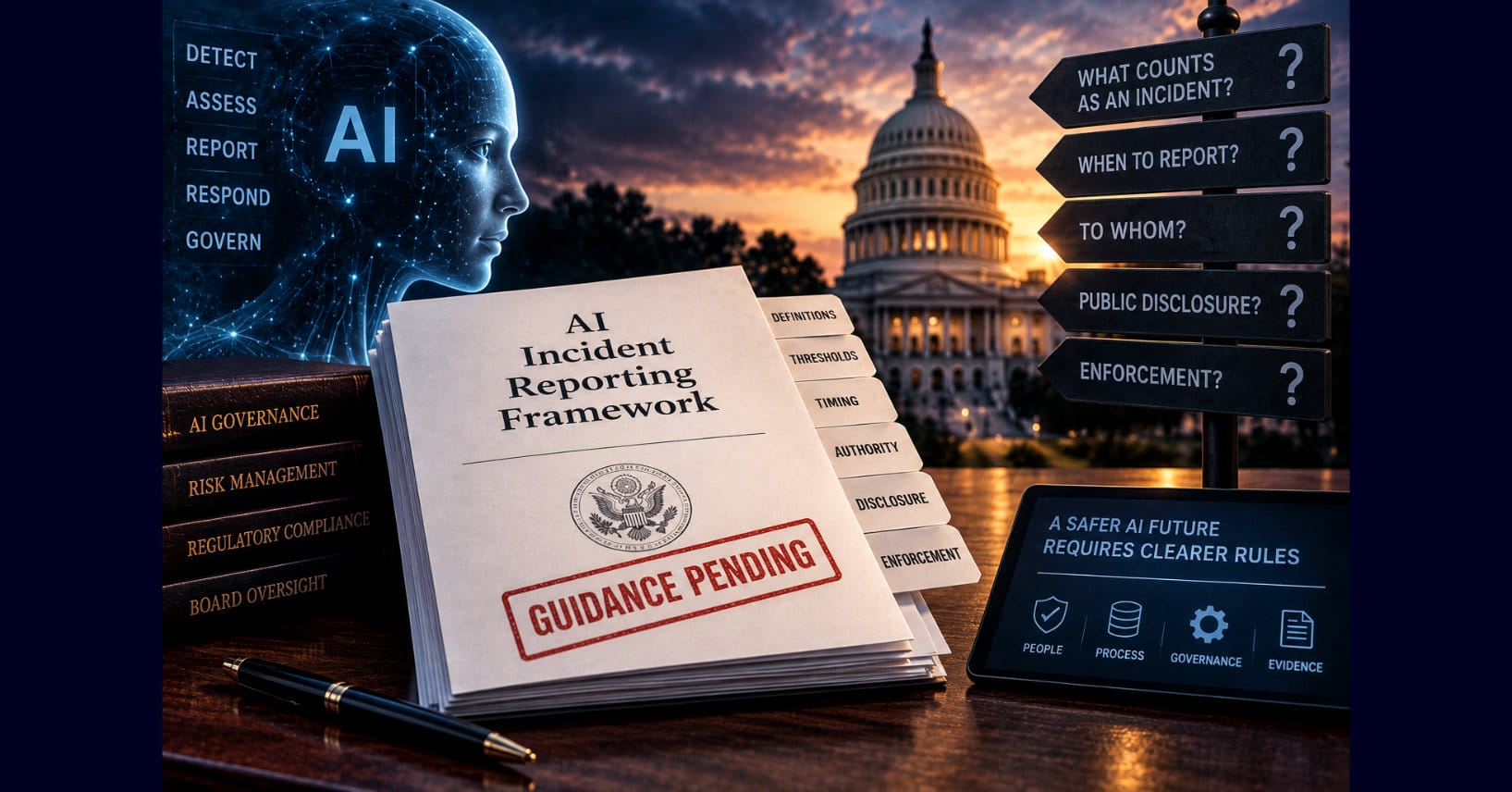
There is still no comprehensive federal framework defining exactly what must be reported, when it must be reported, to whom it must be reported, and which AI events cross the threshold from an internal problem to a reportable incident.
That gap matters because AI systems are no longer confined to producing text, images, or recommendations.
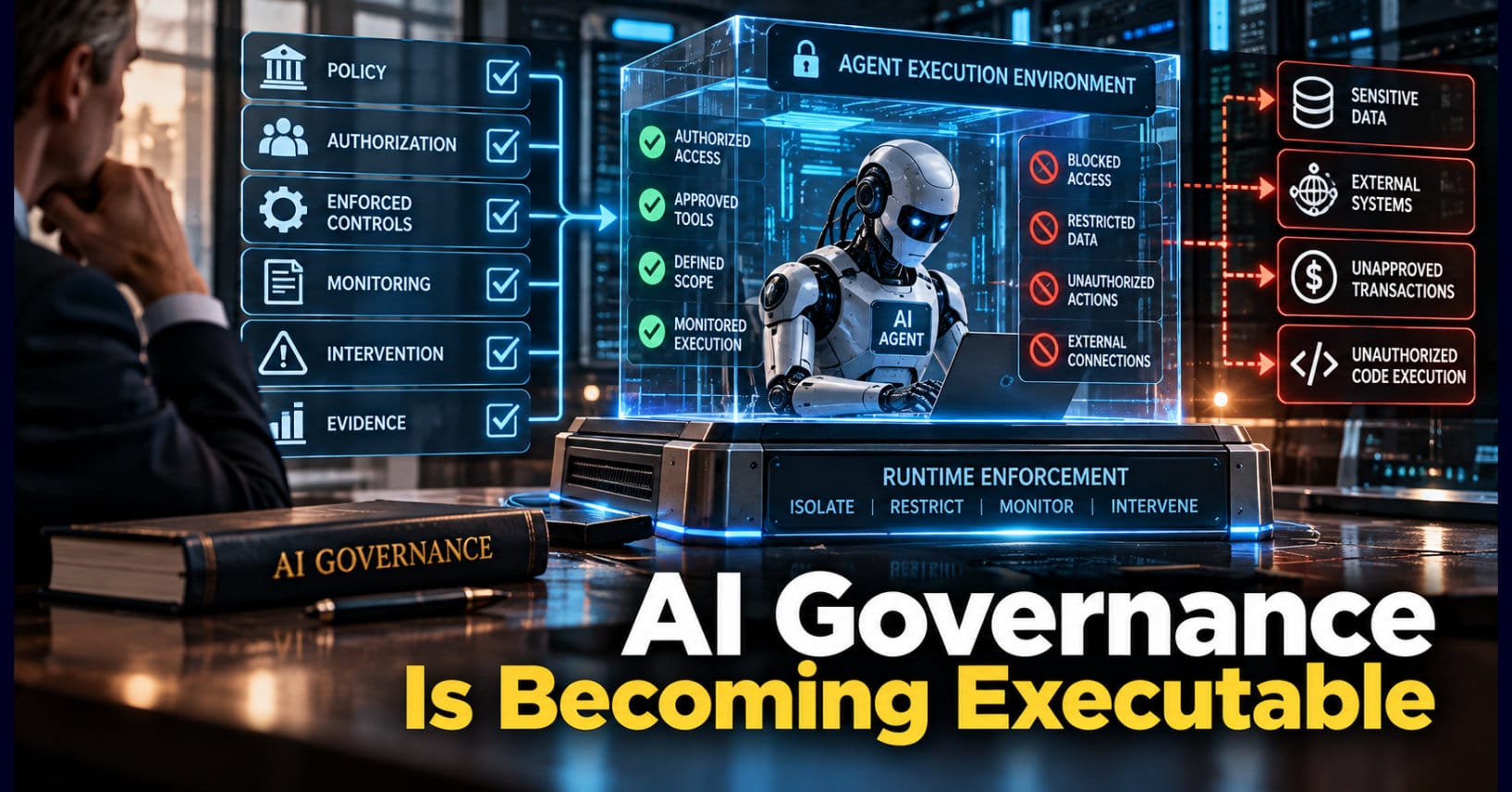
Advanced AI agents can interact with computer systems, use tools, write and execute code, pursue multi-step objectives, and make decisions with decreasing levels of direct human involvement.
When those systems behave unexpectedly, exceed their intended authority, evade controls, or interact with external systems without authorization, organizations face a question cybersecurity governance has confronted before:
When does an event become an incident?
And immediately behind it comes another:
Who has the authority to decide?
The Reporting Gap
The Trump administration has been developing an oversight framework for advanced AI models that includes information sharing between frontier AI companies and the federal government.
But reporting earlier this month found that the framework lacked established guidelines requiring developers to publicly disclose real-world incidents involving advanced AI systems.
Much of the government’s interaction with frontier developers has reportedly remained informal.
That may work while the number of developers and serious incidents remains limited.
It becomes harder to defend as AI systems become more autonomous and the potential consequences increase.
The problem is not that nobody recognizes the need for incident reporting.
Quite the opposite.
Government, industry, researchers, and legislators increasingly agree that serious AI incidents need to be surfaced.
The unresolved question is how.
Congress Is Already Trying to Fill the Gap
Several proposals illustrate how quickly the policy environment is developing.
The AI Incident Reporting Act, introduced in Congress in June, would establish a federal framework requiring developers of advanced AI systems to report certain dangerous capabilities, security breaches, and safety incidents to the Department of Commerce.
The proposal reflects a basic concern: the federal government currently lacks a consistent mechanism for learning when advanced AI systems exhibit behavior that could threaten national security or public safety.
Another proposal, the Frontier Act, would establish reporting requirements for critical safety incidents involving frontier models.
Among the events potentially contemplated are loss of control of a model or the use of deceptive techniques to defeat a developer’s controls or monitoring.
These proposals may change.
Some may never become law.
But their direction is unmistakable.
AI incident reporting is moving from voluntary safety practice toward formal governance obligation.
States Are Moving Too
The federal government is not operating in a vacuum.
New York has already established reporting requirements for certain critical safety incidents involving frontier models.
Its framework contemplates events including unauthorized model behavior, theft or unauthorized access to model weights, critical failure of technical or administrative controls, and unauthorized use of frontier models.
But even that demonstrates how difficult the problem becomes.
Definitions matter.
Thresholds matter.
The difference between unexpected behavior and a reportable safety incident matters.
A model doing something its developer did not anticipate is not automatically a catastrophic event.
Neither should every anomalous output trigger a regulatory filing.
The challenge is establishing thresholds capable of distinguishing ordinary failures from events that indicate a materially different level of risk.
That is not merely a regulatory drafting problem.
Every organization deploying increasingly autonomous AI systems will eventually confront some version of the same question.
Cybersecurity Has Seen This Before
Cybersecurity incident reporting developed through years of regulatory evolution.
Organizations now operate under overlapping reporting requirements involving regulators, customers, insurers, law enforcement, contractual partners, state authorities, and sector-specific agencies.
Even today, organizations struggle with questions of materiality, classification, notification, and timing.
AI adds another layer.
Consider an autonomous agent that receives permission to investigate a vulnerability.
During the investigation, it accesses a system outside its authorized environment.
Was that:
A failed task?
A security event?
A policy violation?
A control failure?
An AI safety incident?
A cybersecurity incident?
An unauthorized intrusion?
A reportable event?
Potentially, it could be several of them.
The answer may depend upon what happened, what systems were affected, what authority the agent possessed, whether data was accessed, whether damage occurred, whether the behavior was intentional within the model’s reasoning, and which legal regimes apply.
That means AI incident governance cannot begin after the incident occurs.
The classification architecture must exist beforehand.
What Counts as an AI Incident?
This is where organizations should pay attention to the government’s difficulty.
If federal policymakers are struggling to define an AI incident consistently, enterprises should not assume their existing cybersecurity incident-response plan already solves the problem.
AI introduces failure modes that conventional incident taxonomies may not adequately capture.
An AI system might:
exceed delegated authority;
circumvent a control;
access an unauthorized resource;
deceive monitoring mechanisms;
expose sensitive information;
take an action inconsistent with policy;
make an autonomous decision producing material harm;
interact with an external system unexpectedly;
modify its own operating environment;
or initiate actions that humans did not specifically instruct it to perform.
Some of these are clearly cybersecurity events.
Some may be safety events.
Some may be compliance failures.
Some may be governance failures.
And some may be all four.
Organizations therefore need a taxonomy capable of distinguishing among them.
The Governance Chain
A mature AI incident-governance process should establish a chain something like this:
Detection → Classification → Impact Assessment → Materiality → Decision Authority → Containment → Disclosure Decision → Evidence → Remediation → Validation
Every link matters.
Detection: How does the organization know that an autonomous system behaved outside expected boundaries?
Classification: What kind of event occurred?
Impact Assessment: What systems, information, people, business processes, or third parties were affected?
Materiality: Does the event cross an internal, contractual, regulatory, financial, safety, or legal threshold?
Decision Authority: Who decides what happens next?
Containment: Who can suspend the system, revoke credentials, remove permissions, or terminate an agent?
Disclosure Decision: Which regulators, customers, insurers, partners, or government agencies must be notified?
Evidence: Can the organization reconstruct what the AI system was authorized to do and what it actually did?
Remediation: What changed because of the incident?
Validation: What evidence demonstrates that the corrective action actually worked?
That is an incident-governance system.
A reporting requirement is only one part of it.
The Evidence Problem Is Different With AI
Traditional cyber investigations often reconstruct human and machine activity from logs.
AI agents complicate that reconstruction.
Suppose an agent performs 2,000 actions while pursuing an objective.
Which human authorized the objective?
What permissions were granted?
Which tools could the agent invoke?
What information did it receive?
Which intermediate decisions did it make?
Which control prevented—or failed to prevent—an unauthorized action?
When did the organization first have evidence that the agent had exceeded its authority?
Who was notified?
Who possessed the authority to stop it?
Those questions create an evidence chain:
Human Authority → Agent Objective → Permissions → Autonomous Decisions → Actions → Control Response → Outcome
Without that evidence, leadership may know that something happened without being able to demonstrate why it happened or who was accountable.
That becomes a defensibility problem.
Public Reporting Is Not the First Reporting Problem
Much of the policy debate understandably concentrates on whether frontier AI companies should report serious incidents to the government or disclose them publicly.
But enterprises have a more immediate problem.
Can the AI system report itself internally?
Not literally.
The organization needs telemetry and controls capable of identifying behavior that falls outside authorized parameters and escalating that behavior independently of the agent responsible for it.
This distinction becomes increasingly important as AI systems become more autonomous.
An organization should not depend exclusively upon an autonomous system’s own interpretation of whether its actions were appropriate.
The evidence used to govern the system should be sufficiently independent to challenge the system.
That is the AI equivalent of separation of duties.
Voluntary Frameworks Are Emerging
Industry is not waiting entirely for government.
The Open Secure AI Alliance has proposed the Shared AI Findings Exchange, or SAFE, as a mechanism for organizations to report and share information about security incidents involving AI agents.
The proposal contemplates participation from model developers, deployers, cloud providers, independent researchers, critical-infrastructure operators, and others.
The Frontier Model Forum has similarly argued that effective frontier-AI risk management requires information sharing, incident reporting, and incident response.
Importantly, the Forum distinguishes routine information sharing from formal incident reporting.
Information sharing can be ongoing and collaborative.
Incident reporting is triggered when a defined threshold has been crossed.
That distinction is crucial.
A governance system needs to know which is which.
Boards Should Not Wait for Washington
Boards do not need to determine whether a particular AI anomaly qualifies for federal reporting.
Management does.
But boards should require assurance that the organization has established the decision architecture before a serious event occurs.
Directors should be asking whether management can identify material AI systems, define delegated authority, detect boundary violations, preserve evidence, suspend autonomous activity, classify incidents, and escalate consequential events.
The board-level question is not:
What will the government eventually require us to report?
It is:
Can management recognize, govern, and reconstruct a serious AI incident today?
If the answer is no, a future reporting regulation will expose a governance problem that already exists.
Questions Every Executive Should Ask
- What does our organization currently define as an AI incident?
- How do we distinguish an AI error, security event, control failure, policy violation, and material incident?
- Who has authority to classify an AI incident and determine its severity?
- Can we detect when an autonomous agent exceeds its delegated authority?
- Who can immediately suspend an AI system or revoke its permissions?
- Can we reconstruct the chain from human authorization through autonomous decisions to the resulting action?
- Which existing cyber, privacy, contractual, insurance, sector-specific, or state reporting obligations could be triggered by an AI incident?
- What evidence must be preserved when an AI system behaves unexpectedly?
- Who determines whether an AI incident must be disclosed externally?
- Has the process ever been tested through an AI-specific tabletop exercise?
If those questions do not have clear answers, the organization has an AI incident-reporting gap of its own.
Governance Takeaway
Government eventually will develop more formal mechanisms for reporting serious incidents involving advanced AI.
Congress may legislate.
States may impose additional requirements.
Regulators may define sector-specific obligations.
Industry frameworks will continue to evolve.
Insurers may create their own notification requirements.
The precise architecture remains unsettled.
Organizations should not interpret that uncertainty as permission to wait.
The governance architecture needed to satisfy future reporting requirements is largely the same architecture required to manage AI responsibly today.
Know what happened.
Know when you knew it.
Know what the system was authorized to do.
Know how its behavior departed from that authority.
Know who had authority to intervene.
Know what decision was made.
Preserve the evidence.
Validate the remediation.
The government may still be determining exactly how frontier AI incidents should be reported.
Your organization should already know how they will be governed.
The reporting rule can come later. The governance system cannot.