
Cyber Governance Center | Breaking Cybersecurity Analysis
Summary
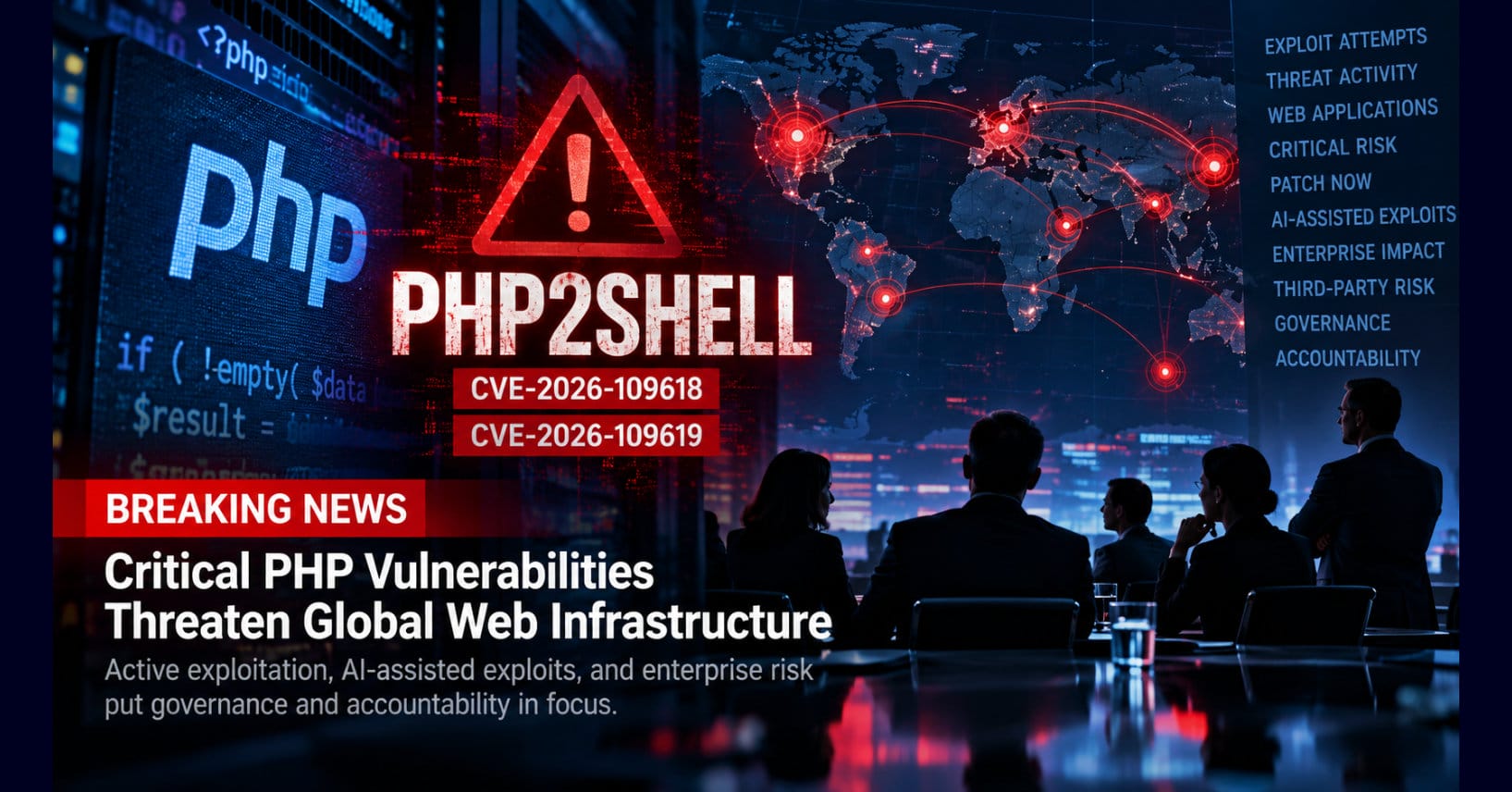
Two critical PHP vulnerabilities, CVE-2026-109618 and CVE-2026-109619, collectively known as PHP2Shell, have prompted emergency security updates and warnings across the cybersecurity industry. Researchers have demonstrated unauthenticated remote code execution against major PHP-based platforms, while Cloudflare has reported attack activity targeting the vulnerabilities. This Cyber Governance Center analysis examines the implications for enterprise cybersecurity, including AI-assisted exploitation, vulnerability management, third-party assurance, incident materiality, and evidentiary closure. The central governance challenge is ensuring organizations can demonstrate that affected systems have been identified, remediated, and independently verified.
Two critical vulnerabilities in PHP, the programming language supporting WordPress and a substantial portion of the world’s web infrastructure, have triggered emergency security releases, government warnings, and protective action by major infrastructure providers.
The vulnerabilities, designated CVE-2026-109618 and CVE-2026-109619 and collectively known as PHP2Shell, carry CVSS v4.0 severity scores of 9.2.
Successful exploitation could allow an unauthenticated attacker to execute malicious code within an affected server environment.
For enterprise security teams, the immediate priority is identifying vulnerable PHP installations, applying security fixes, and investigating potential compromise.
For boards and executive leadership, the incident exposes a more fundamental question:
Can the organization demonstrate that every affected business service has been identified, assigned an accountable owner, remediated, and independently verified?
That distinction matters because a vulnerability can be technically corrected without the enterprise having sufficient evidence to establish that its exposure has been resolved.
PHP2Shell is therefore more than a software security emergency. It is a test of vulnerability governance, third-party accountability, and the organization’s ability to make defensible risk decisions under pressure.
What Researchers Discovered
The vulnerabilities affect PHP itself rather than any particular content management system or application.
This distinction is essential.
An organization may operate a fully updated WordPress installation, maintain current plugins, and enforce strong administrative authentication while remaining exposed through the PHP runtime executing the application.
The two vulnerabilities involve different memory-management weaknesses.
CVE-2026-109618 concerns improper handling of out-of-memory conditions. Under certain circumstances, PHP can interrupt processing while internal data structures remain partially initialized. Subsequent cleanup operations may encounter invalid memory states, potentially creating exploitable memory corruption.
CVE-2026-109619 involves a use-after-free condition in which internal request state may reference memory that has already been released. Subsequent operations can access that invalid state, potentially enabling information disclosure or arbitrary code execution.
The significance of these vulnerabilities extends beyond their severity scores.
They affect a widely deployed server-side execution environment, and successful exploitation may not require valid application credentials.
Traditional application controls, including administrative authentication and WordPress user permissions, cannot be assumed to prevent exploitation of a vulnerability occurring beneath the application layer.
Researchers Demonstrate Remote Code Execution Against Major Web Platforms
The risk is no longer confined to theoretical analysis.
Researchers at Wiz report demonstrating unauthenticated remote code execution against deployments of WordPress, Drupal, and Joomla.
These demonstrations are particularly significant because the affected platforms represent different application environments built on the same underlying PHP technology.
The finding illustrates how a vulnerability in a shared runtime can create exposure across otherwise unrelated business applications.
It does not mean that WordPress, Drupal, or Joomla independently introduced these vulnerabilities. Nor does it establish that every deployment of those platforms is exploitable.
The exposure depends on the underlying PHP version, execution environment, and relevant technical conditions.
Nevertheless, the demonstrations establish that the vulnerabilities can have consequences extending beyond application crashes or isolated memory errors.
An attacker who achieves code execution within a PHP process may be able to access application configuration, database credentials, stored information, or other resources available to that process.
Depending on the permissions and isolation controls in place, the attacker may also be able to modify application content, establish persistence, or attempt to move into other connected systems.
For organizations operating multiple web applications on shared infrastructure, the potential consequences warrant particular scrutiny.
AI-Assisted Exploitation Changes the Risk Equation
Another important finding from the Wiz research concerns the role of artificial intelligence in vulnerability exploitation.
Researchers describe using frontier AI models to assist in developing and adapting exploits for complex PHP memory vulnerabilities.
Memory-corruption exploitation has traditionally required specialized technical expertise, including knowledge of runtime internals, memory allocation, execution flow, and techniques for manipulating corrupted program state.
AI-assisted analysis does not eliminate those requirements or guarantee successful exploitation.
It can, however, accelerate portions of the research process, assist with interpreting complex program behavior, and help researchers evaluate alternative exploitation approaches.
This development has direct implications for enterprise vulnerability management.
Organizations have historically relied, at least in part, on the technical complexity of exploitation when prioritizing remediation.
A vulnerability that appeared difficult to weaponize might receive a lower immediate priority than one with a publicly available, reliable exploit.
That assumption becomes less dependable when AI tools can help capable researchers move more quickly from vulnerability disclosure to practical exploitation.
The relevant governance question is no longer limited to whether an exploit is publicly available.
It also concerns how rapidly the threat environment may change after disclosure.
Exploit complexity is not a permanent security control. It is a condition that advancing tools and attacker capabilities can change.
Vulnerability prioritization processes must account for that uncertainty.
Cloudflare Reports Attack Activity and Attempts to Evade Protections
Cloudflare has also reported observing traffic targeting PHP2Shell and attempts to modify attack payloads to evade protective controls.
This is an important escalation.
There is a material difference between a vulnerability that has been publicly disclosed, a vulnerability that researchers have demonstrated can be exploited, and a vulnerability that attackers are actively attempting to exploit.
PHP2Shell has progressed beyond the first two conditions.
Observed malicious traffic does not, by itself, establish widespread successful compromise. Attack attempts may fail because systems are patched, exploit conditions are absent, or protective controls prevent execution.
However, evidence of payload modification indicates that attackers are attempting to adapt their techniques.
That creates additional urgency for organizations relying on temporary mitigations.
Web application firewalls and other protective technologies can reduce exposure, particularly while infrastructure updates are being deployed.
They should not be treated as proof that the underlying vulnerability has been eliminated.
A blocked request demonstrates that a particular request was stopped. It does not establish that every possible exploitation technique has been prevented.
For enterprise security leaders, this distinction should shape both remediation decisions and executive reporting.
Emergency PHP Security Updates
The PHP project has released emergency security updates addressing the vulnerabilities.
| PHP branch | Fixed release |
|---|---|
| PHP 8.5 | 8.5.12 |
| PHP 8.4 | 8.4.27 |
| PHP 8.3 | 8.3.36 |
| PHP 8.2 | 8.2.35 |
Organizations operating these PHP branches should verify that the appropriate security corrections have been installed.
Older unsupported releases require additional attention. Some operating-system distributors and commercial support providers may supply backported security fixes, but the presence of an older version number does not independently establish whether a vendor-maintained package contains the necessary correction.
Administrators must verify the actual security status of the installed package.
This is especially important in enterprise environments where operating-system package versions, container images, managed hosting configurations, and independently installed PHP runtimes may differ.
An infrastructure inventory that merely reports the presence of PHP is insufficient.
The organization needs to know which affected runtime is executing each business service and whether that runtime contains the relevant fix.
Why This Is an Enterprise Governance Incident
The immediate technical response to PHP2Shell is reasonably clear.
Identify vulnerable systems. Apply security updates. Validate remediation. Investigate suspicious activity.
The governance challenge is determining whether those actions occur consistently across the enterprise.
Consider an organization operating a corporate website, customer portal, employee benefits platform, investor relations site, marketing microsites, and several legacy applications.
Some systems may be managed by central IT. Others may be maintained by individual business units, external agencies, cloud providers, or managed hosting vendors.
All may depend on PHP.
When a critical vulnerability affects that shared technology, the organization must establish the scope of exposure across systems that may have different owners, different service providers, and different operational priorities.
This creates five distinct governance obligations.
1. Establish enterprise exposure. Management must identify the affected systems and the business services that depend on them.
2. Assign accountable ownership. Every affected service must have an identified individual or function responsible for coordinating remediation and validating closure.
3. Establish decision authority. The organization must know who can authorize emergency changes, restrict service availability, accept temporary risk, or suspend operations when necessary.
4. Verify corrective action. Remediation must be supported by evidence demonstrating that the relevant vulnerabilities have been addressed.
5. Determine residual risk. Remaining exposure, suspected compromise, compensating controls, and unresolved dependencies must be documented and escalated appropriately.
These obligations are not unique to PHP2Shell.
They are fundamental requirements of defensible enterprise cybersecurity governance.
The Third-Party Accountability Problem
Many organizations do not directly manage the infrastructure running their public websites and business applications.
They rely on managed hosting providers, cloud services, development agencies, and specialized platform operators.
Those relationships may provide substantial operational and security advantages.
They do not eliminate the organization’s responsibility to understand its exposure.
A hosting provider may announce that it has deployed protective controls or installed PHP security updates.
That announcement is useful, but it does not necessarily demonstrate that every customer environment, container, legacy runtime, or independently managed application has received the correction.
The organization should distinguish three conditions.
Vendor mitigation: The provider has implemented controls intended to reduce exploitation risk.
Verified technical remediation: The affected runtime has received the relevant security correction, and the organization has evidence that the corrected environment is operating as intended.
Enterprise risk closure: Management has established the scope of affected business services, validated remediation, assessed potential compromise, and documented the disposition of remaining risk.
These conditions should not be reported as though they are equivalent.
A provider’s statement that its infrastructure is protected may be sufficient to initiate customer validation.
It is not automatically sufficient to close the customer’s internal risk record.
The distinction becomes particularly important when multiple providers support the same business process or when responsibility for infrastructure, application maintenance, and security monitoring is distributed across different parties.
Outsourcing the technical service does not outsource the organization’s need for defensible assurance.
Why a Patch Confirmation Is Not Evidence of Incident Closure
One of the most consequential governance errors during critical vulnerability events is equating successful patch deployment with complete incident resolution.
A patch addresses the vulnerable software condition.
It does not establish that an attacker never exploited the vulnerability before the correction was installed.
Nor does it prove that every affected system was included in the remediation effort.
An enterprise closure determination should therefore distinguish between technical remediation and security assurance.
Technical remediation evidence may include installed package versions, vendor security advisories, deployment records, configuration verification, and successful functional testing.
Security assurance may require review of available logs, endpoint telemetry, file integrity changes, suspicious processes, authentication events, and other relevant indicators.
The depth of investigation should be proportionate to the exposure, threat intelligence, available evidence, and business consequences.
Not every vulnerable website requires a full forensic investigation.
But a critical, remotely exploitable vulnerability affecting an internet-facing system should not be closed solely because an administrator reports that an update completed successfully.
A defensible closure record should answer a more demanding question:
What evidence supports management’s conclusion that the vulnerability has been remediated and any material residual exposure has been appropriately addressed?
If that evidence cannot be reconstructed, the organization may have completed technical work without establishing governance closure.
The Materiality Question Cannot Be Ignored
PHP2Shell also creates potential disclosure and escalation considerations for publicly traded companies and regulated organizations.
The discovery of a critical vulnerability does not automatically establish that an organization has experienced a material cybersecurity incident.
Similarly, observing malicious requests against a public website does not necessarily mean that an intrusion occurred.
Materiality depends on the facts and circumstances, including the nature and extent of any actual incident, affected systems, operational consequences, financial exposure, legal obligations, and other relevant factors.
Nevertheless, organizations should not wait until a technical investigation is complete before determining whether the incident requires escalation through established disclosure and risk governance processes.
For U.S. public companies, the Securities and Exchange Commission’s cybersecurity incident disclosure requirements may become relevant if an incident is determined to be material.
The determination requires appropriate management judgment and supporting information.
Security teams provide technical findings. Legal, financial, operational, and executive stakeholders contribute to the broader assessment.
The governance failure occurs when no one has clear authority to coordinate those decisions or when materiality is treated as a one-time conclusion that cannot be revisited as new evidence emerges.
In a rapidly developing exploitation environment, that approach is particularly dangerous.
What Executive Leadership Should Require Immediately
Executive leadership should require a concise, evidence-supported assessment of PHP2Shell exposure.
The assessment should address the following questions.
Exposure and inventory
Which internet-facing and internally hosted business services depend on affected PHP runtimes? Have subsidiaries, independently managed websites, legacy applications, containers, and third-party environments been included?
Remediation status
Which systems have received verified security fixes? Which remain vulnerable? What deadlines and compensating controls apply to unresolved systems?
Threat activity
Has the organization identified suspicious activity consistent with attempted exploitation? If so, what evidence supports the assessment, and what additional investigation is required?
Third-party assurance
Which providers have confirmed remediation? Does their confirmation cover the specific services and environments used by the organization?
Decision authority
Who can authorize emergency changes, service restrictions, temporary shutdowns, or documented acceptance of residual risk?
Closure evidence
What artifacts will establish that remediation is complete, the affected services have been validated, and any suspected compromise has been appropriately investigated?
These questions do not require directors to become PHP engineers.
They require management to demonstrate that the enterprise can recognize a critical infrastructure risk, assign ownership, exercise authority, and produce reliable evidence of its response.
A Defensible Response Requires More Than Speed
Speed matters when attackers are actively attempting to exploit critical vulnerabilities.
Organizations should prioritize internet-facing affected systems, deploy verified security corrections, and use appropriate temporary protections where patching cannot be completed immediately.
But speed without traceability creates another problem.
Emergency changes may be deployed without consistent documentation. Vendor assurances may be accepted without validation. Vulnerability records may be closed before all affected systems are identified. Operational teams may restore services without confirming whether suspicious activity requires investigation.
These weaknesses can undermine the organization’s ability to demonstrate what happened, what decisions were made, and why management concluded that the risk was resolved.
The appropriate response is not to slow remediation with unnecessary bureaucracy.
It is to ensure that emergency processes preserve essential evidence while enabling rapid action.
At minimum, the organization should be able to reconstruct the vulnerability disclosure, affected asset identification, risk prioritization, decision authority, remediation actions, verification results, and closure determination.
That record is not simply an audit artifact.
It is evidence that the organization’s governance system functioned under pressure.
The Larger Warning: Shared Infrastructure Creates Shared Exposure
PHP2Shell illustrates how a vulnerability in a common software component can cross organizational and application boundaries.
WordPress, Drupal, Joomla, and custom enterprise applications may have different developers, administrators, and security configurations.
Yet they can depend on the same vulnerable execution environment.
That dependency creates a shared exposure that may not be visible through application inventories alone.
The emergence of AI-assisted exploit development adds further pressure by potentially shortening the time available to respond.
Observed attack traffic and attempts to evade protective controls reinforce the need to reassess risk as threat conditions evolve.
Together, these developments challenge three assumptions organizations can no longer safely make:
- That a fully updated application necessarily means the underlying infrastructure is secure.
- That a vendor’s remediation announcement establishes enterprise-wide risk closure.
- That technical exploitation complexity provides a dependable window for delayed remediation.
The enterprise must instead maintain visibility into critical technology dependencies, establish clear authority for urgent decisions, and require evidence that corrective action has achieved its intended outcome.
The Governance Test
PHP2Shell will eventually become another entry in the historical record of critical software vulnerabilities.
Security updates will be deployed. Infrastructure providers will strengthen protections. Incident investigations will establish the extent of successful exploitation.
But the governance questions raised by this event will remain.
Did the organization know where the vulnerable technology was operating?
Could it identify the business services at risk?
Was responsibility for remediation clear?
Could management make urgent decisions without uncertainty about authority?
And could the organization demonstrate, with reliable evidence, that the risk had been addressed?
These questions determine whether a critical vulnerability becomes a controlled security event or exposes deeper weaknesses in enterprise accountability.
The vulnerability exists in PHP. The responsibility to identify, govern, and demonstrate the resolution of enterprise exposure belongs to the organization.
That is the difference between patching software and governing cybersecurity risk.