
Executive Brief
On Monday, I examined Japan’s $63 million emergency cybersecurity initiative and raised a question every board should answer:
Who has the authority to act when a cybersecurity crisis demands immediate intervention?
The problem is not always a lack of technology, expertise, or even awareness.
Sometimes, organizations know exactly what is happening but cannot act because the people capable of intervening lack the authority to do so without additional approval.
I encountered a remarkably similar problem nearly fifty years ago.
Not in cybersecurity.
In emergency medicine.
I was among New Jersey’s early paramedics, participating in a pilot program during the formative years of advanced prehospital emergency medical services.
We were trained to perform interventions that could save lives. We understood the procedures, recognized the clinical conditions requiring treatment, and possessed the equipment necessary to act.
But possessing the capability to perform an intervention did not mean we possessed the authority to initiate it.
That authority generally remained with an emergency department physician, communicated through a telemetry connection. In some circumstances, a nurse directing the call provided the necessary authorization.
The distinction was unmistakable.
We could know what needed to be done, possess the ability to do it, and still be required to obtain permission before acting.
As emergency medical services matured, that operating model evolved.
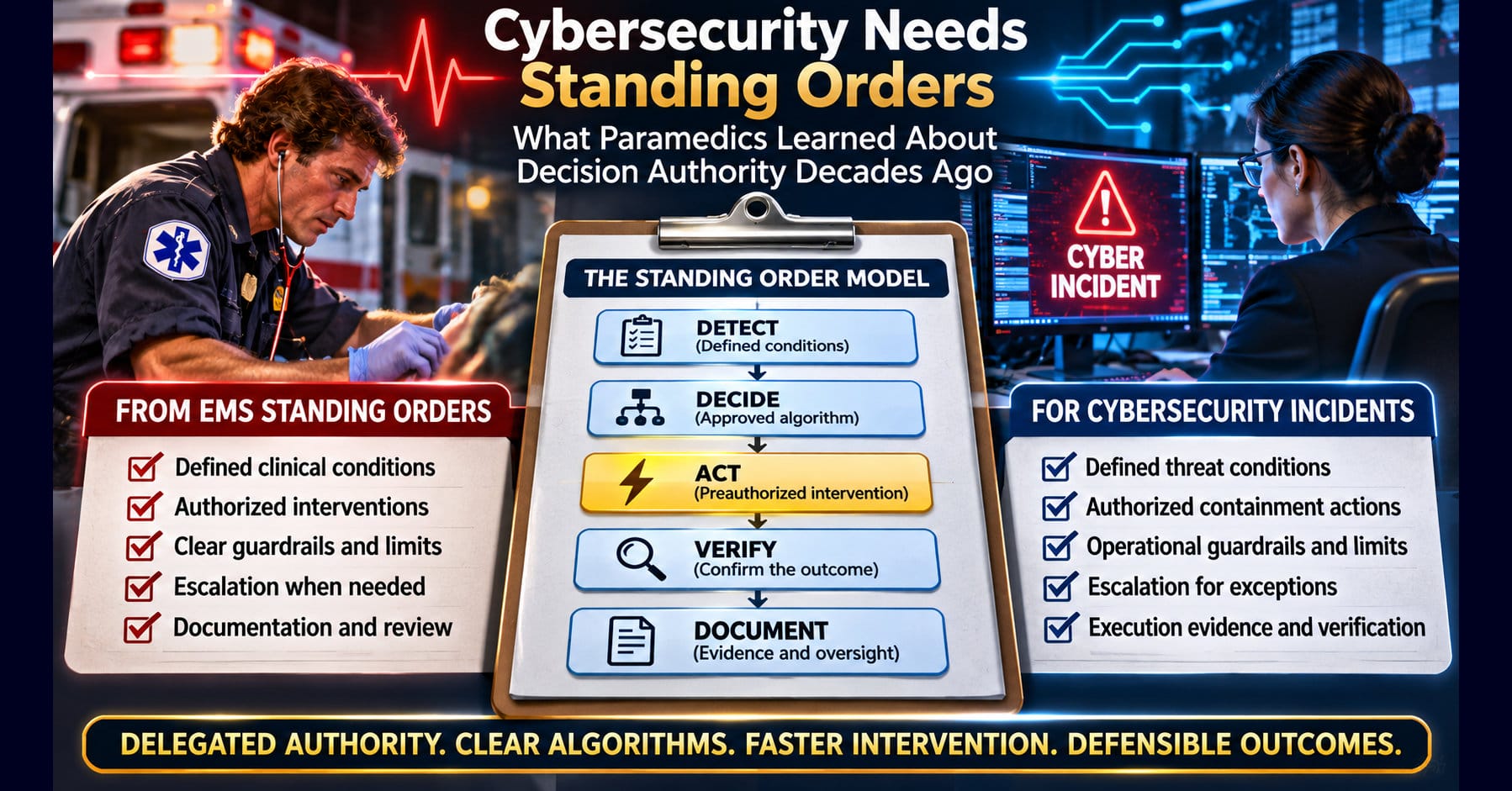
Standing orders allowed appropriately trained and credentialed paramedics to perform specified interventions without obtaining individual authorization for every action.
Medical oversight did not disappear.
It became structured, conditional, and executable.
Cybersecurity governance can learn an important lesson from that evolution.
When Capability Exceeds Authority
Consider what happens during a time-critical medical emergency.
A paramedic assesses the patient, recognizes a life-threatening condition, and identifies an appropriate intervention.
The equipment is available.
The paramedic has been trained.
But under a system requiring real-time medical direction, treatment may depend on establishing communication with the supervising medical authority.
When communication works efficiently, the process can function well.
When it is delayed, interrupted, or unavailable, the authorization requirement can become an operational constraint.
That was one of the challenges early paramedic systems had to address.
The issue was not whether physicians should retain responsibility for medical oversight.
They should.
The question was whether every clinical decision required a separate, real-time authorization when the medical director could establish appropriate treatment parameters beforehand.
Standing orders provided a practical answer.
They defined the clinical circumstances under which paramedics could initiate particular interventions, the conditions limiting those interventions, and the situations requiring additional medical direction.
The result was a more responsive system without abandoning medical accountability.
Now consider the cybersecurity equivalent.
A security operations team detects ransomware spreading through a production environment.
The analysts understand the threat.
They know which systems must be isolated.
They possess the technical capability to interrupt the attack.
But the affected environment supports critical business operations.
The security team must obtain authorization before initiating containment.
The CISO wants immediate action.
The COO is concerned about service disruption.
The CFO is evaluating financial consequences.
Legal counsel is considering contractual and regulatory implications.
Meanwhile, the attack continues.
The organization has the technical capability to intervene.
What it lacks is a sufficiently defined mechanism for exercising that capability without negotiating authority during the emergency.
This is not fundamentally a technology problem. It is a problem of governance design.
What Standing Orders Actually Changed
Standing orders are sometimes misunderstood as permission for paramedics to practice independently of medical oversight.
That is not what they represent.
A standing order is an expression of medical authority established in advance.
The medical director defines the conditions under which a particular intervention is authorized.
The paramedic operates within that delegated authority, subject to training, credentialing, protocols, contraindications, documentation, and quality review.
The underlying medical authority remains accountable for the framework.
The paramedic remains accountable for applying it appropriately.
The essential innovation is that authorization no longer needs to be recreated for every qualifying event.
Instead, authority is embedded in a structured decision process.
The protocol effectively says:
When these clinical conditions exist, and these contraindications are absent, this intervention is authorized within these limits.
When the situation falls outside those parameters, additional medical direction is required.
That is an algorithm.
Not necessarily a software algorithm, but a defined sequence of conditions, decisions, and permitted actions.
It transforms general medical authority into operationally executable instructions.
The paramedic is not acting without authorization. The paramedic is acting under authorization already granted.
That distinction is precisely what cybersecurity incident response needs.
The Cybersecurity Equivalent of Medical Standing Orders
Imagine an organization establishes standing cybersecurity intervention orders approved through its enterprise governance structure.
The framework defines specific threats, intervention thresholds, authorized responders, permitted actions, operational safeguards, and escalation requirements.
For example, a ransomware containment standing order might authorize the security operations team to isolate designated endpoints when predefined indicators establish a sufficiently high confidence of active compromise.
A privileged-access standing order might authorize immediate revocation of a compromised credential when defined evidence demonstrates unauthorized use.
A cloud-security standing order might authorize temporary suspension of an exposed service account when its activity exceeds established risk thresholds.
An AI-agent standing order might authorize suspension of an autonomous workflow when the agent attempts to exceed its delegated permissions or initiate prohibited transactions.
Each intervention would operate within established boundaries.
The authority would be granted before the incident.
The trigger would be defined.
The permitted response would be documented.
Exceptions would require escalation.
Execution would generate evidence.
The outcome would be verified.
This does not eliminate human judgment.
It establishes the conditions under which judgment can be exercised without unnecessary authorization delays.
A Practical Example
Consider an organization with a critical financial transaction platform.
Its standing cybersecurity orders might establish the following decision sequence:
Condition: Security monitoring identifies activity meeting an approved threshold for suspected credential compromise.
Assessment: The affected identity, permissions, transaction activity, and business dependencies are evaluated against predefined criteria.
Authorized intervention: If the conditions fall within approved boundaries, the security team may revoke affected sessions and suspend the compromised identity.
Guardrail: If suspension could interrupt a designated safety-critical or essential service, the protocol requires an approved alternative containment procedure or immediate escalation.
Notification: The designated executives and operational owners are notified according to established severity thresholds.
Verification: The security team confirms that the affected access has actually been disabled and that unauthorized activity has stopped.
Evidence: The system preserves the triggering telemetry, decision record, authorization basis, execution timestamps, and verification results.
No new executive approval is required for an intervention already authorized within the standing order.
The organization has made the governance decision in advance.
The incident responder executes it when the specified conditions arise.
That can materially reduce the time between detection and effective containment.
The Guardrails Are as Important as the Authority
Standing orders work because they are bounded.
A paramedic cannot treat every medical condition using any intervention considered potentially beneficial.
The protocol establishes a defined scope of practice and specific clinical limitations.
Cybersecurity requires the same discipline.
An intervention that protects one system may create unacceptable consequences elsewhere.
Automatically isolating a compromised workstation may be relatively straightforward.
Automatically shutting down an industrial control system could threaten physical safety.
Revoking a compromised employee credential may be necessary.
Disabling an identity used by critical infrastructure could interrupt essential operations.
Suspending an AI agent may stop unauthorized activity.
But the suspension mechanism itself must not create uncontrolled downstream effects.
The governance framework must therefore distinguish between actions that are safe to preauthorize and actions requiring additional authority.
Those distinctions should be based on operational dependencies, consequence severity, reversibility, and the organization’s risk tolerances.
A mature standing-order framework should establish five elements:
- Scope of authority: Who may act, against which assets, and under what conditions?
- Objective triggers: What evidence must exist before intervention is authorized?
- Operational guardrails: Which consequences, dependencies, or contraindications restrict the action?
- Exception authority: Who resolves situations that fall outside the approved protocol?
- Verification and accountability: How does the organization establish that the intervention was appropriate, executed correctly, and effective?
The objective is not unrestricted autonomy.
It is controlled autonomy within a deliberately governed operating model.
Artificial Intelligence Makes Standing Orders Even More Important
The connection becomes especially significant as organizations introduce autonomous AI agents into cybersecurity operations.
An AI-enabled security platform may identify malicious activity and recommend containment.
An autonomous defensive agent may go further, executing actions without waiting for a human operator.
That creates a familiar governance challenge.
The agent possesses technical capability.
But what authority has the organization delegated to it?
A defensive AI agent should not receive unlimited permission to modify production systems simply because its purpose is cybersecurity.
Its authority should be expressed through defined permissions, conditions, and restrictions.
In effect, the organization needs standing orders for its AI agents.
An agent might be authorized to isolate a noncritical endpoint when multiple approved detection conditions are satisfied.
It might be authorized to revoke a short-lived access token associated with confirmed credential misuse.
But it might be prohibited from shutting down a production database, modifying a safety-critical system, or suspending an enterprise-wide identity service without additional approval.
The distinction is not between automation and governance.
It is between ungoverned automation and governance that has been translated into executable controls.
A properly designed standing-order model makes delegated authority explicit.
It also creates a mechanism for reviewing whether that authority remains appropriate as systems, threats, and operational dependencies change.
The more capable autonomous systems become, the more important those boundaries will be.
Standing Orders Must Be Tested Before the Emergency
A written protocol is not proof that an intervention can be performed.
Emergency medical services recognized the importance of training, simulation, competency assessment, and continuing quality assurance.
Paramedics needed to demonstrate that they could recognize the relevant conditions, apply the protocol correctly, and perform the authorized intervention.
Cybersecurity organizations should apply the same principle.
A standing order authorizing emergency credential revocation has little value if the security team cannot revoke the credential quickly enough.
A containment playbook is ineffective if a third-party provider must approve an action that the organization assumed was already authorized.
An AI-agent suspension procedure is inadequate if disabling the agent does not terminate its active sessions or downstream processes.
The board should expect management to demonstrate that standing cybersecurity orders work under realistic conditions.
That means testing not merely whether the team knows the procedure, but whether the complete authority-to-execution process functions.
Can the triggering condition be recognized?
Can the authorized responder act without unnecessary delay?
Are the guardrails enforceable?
Can exceptions be escalated?
Does the intervention actually stop the activity?
Can the outcome be independently verified?
These are measurable operational capabilities.
They should not remain assumptions embedded in incident response documentation.
Evidentiary Architecture™: From Delegated Authority to Defensible Action
The standing-order model also illustrates a fundamental principle of Evidentiary Architecture™.
Governance becomes defensible when the organization can demonstrate the relationship between an authorized decision and its operational consequences.
The evidence chain can be expressed as:
Governance Authority → Standing Order → Triggering Condition → Authorized Action → Execution Evidence → Verified Outcome
Each element establishes something important.
Governance Authority: The legitimate organizational authority responsible for approving the intervention framework.
Standing Order: The documented conditions, permissions, limitations, and escalation requirements.
Triggering Condition: The evidence demonstrating that the circumstances justified invoking the protocol.
Authorized Action: The specific intervention permitted under the standing order.
Execution Evidence: The records demonstrating what was performed, by whom or by which system, and when.
Verified Outcome: The evidence establishing whether the intervention achieved its intended purpose.
This architecture is particularly important when interventions are executed autonomously.
An AI agent may act in milliseconds.
But the organization must still be able to explain why the action was permitted, which conditions triggered it, whether the agent remained within its authority, and what consequences followed.
A successful technical intervention does not automatically establish a defensible governance decision.
The evidence must connect the action to the authority that permitted it.
That is how organizations move from policy-based governance to operationally demonstrable accountability.
Five Questions Every Board Should Ask
1. Which cybersecurity interventions are currently delayed by authorization requirements?
Management should identify where qualified responders possess the technical capability to act but must obtain additional approval before intervention.
2. Which interventions could be safely preauthorized?
The organization should evaluate recurring incident scenarios and determine where standing orders could reduce response delays without creating unacceptable operational risk.
3. Who establishes the boundaries of delegated authority?
Standing orders should be approved through appropriate executive governance, with operational, legal, security, and risk-management participation.
4. Have the standing orders been tested under realistic conditions?
Boards should require evidence that responders can execute authorized interventions, enforce guardrails, escalate exceptions, and verify outcomes.
5. Do autonomous AI agents operate under equivalent authority constraints?
Management should demonstrate that machine-executed actions are subject to defined permissions, triggering conditions, intervention limits, and auditable oversight.
Governance Takeaway: The Authority to Act Should Not Begin With the Emergency
Nearly fifty years ago, emergency medical services faced a challenge that cybersecurity organizations continue to encounter.
Highly trained professionals possessed the knowledge and capability to intervene, but their authority depended on obtaining permission from someone who was not physically present.
The solution was not to eliminate medical oversight.
It was to establish a governance structure that allowed qualified responders to exercise defined medical authority without waiting for approval that could be granted in advance.
Standing orders made that possible.
They converted medical direction into actionable protocols while preserving professional accountability.
Cybersecurity can apply the same operating principle.
Executives do not need to approve every intervention in real time if they have already established the conditions under which that intervention is authorized.
Security professionals do not need unrestricted autonomy to respond effectively.
AI agents do not need unlimited permissions to act quickly.
They need clearly defined authority, objective triggers, enforceable guardrails, tested procedures, and evidence of execution.
The objective is not to remove governance from the response process.
It is to move the necessary governance decisions to a point before the emergency, when leadership has the time and information required to make them deliberately.
The paramedics of my generation learned that the ability to save a life could depend on whether the authority to act was available when it mattered.
Cybersecurity leaders face a comparable challenge today.
The time to authorize a foreseeable emergency intervention is before the emergency makes authorization the obstacle.
Editorial note: This article draws on my firsthand experience in New Jersey’s early paramedic pilot program. The comparison concerns the structure of delegated authority, not an equivalence between medical practice law and corporate cybersecurity governance. EMS standing orders operate under applicable medical direction, licensing, and clinical oversight requirements. Cybersecurity standing orders would require their own organizational, legal, contractual, and operational authorization frameworks.