Evidence-Driven Cybersecurity Governance Series—Article 1
When a significant cyber incident occurs, regulators, insurers, auditors, and litigators increasingly focus on one question: Can leadership demonstrate that it exercised informed, documented, and defensible governance?
This opening article in the Evidence-Driven Cybersecurity Governance Series explores why post-incident investigations begin with governance rather than technology. It explains how board oversight, executive decision-making, and governance documentation have become critical evidence of organizational accountability.
Readers will discover why perfect cybersecurity is not the standard, why governance naturally produces evidence, and why organizations that document oversight as governance occurs are better positioned to withstand regulatory and legal scrutiny.
Most organizations don’t fail because they lacked cybersecurity. They fail because they cannot prove they governed it.
That distinction is becoming increasingly important.
When a significant cyber incident occurs, organizations often assume investigators will begin by examining firewalls, endpoint protection, vulnerability scans, or the latest penetration test. While those technical controls certainly matter, they are rarely the starting point for regulators, auditors, insurers, or opposing counsel.
Their first question is much simpler:
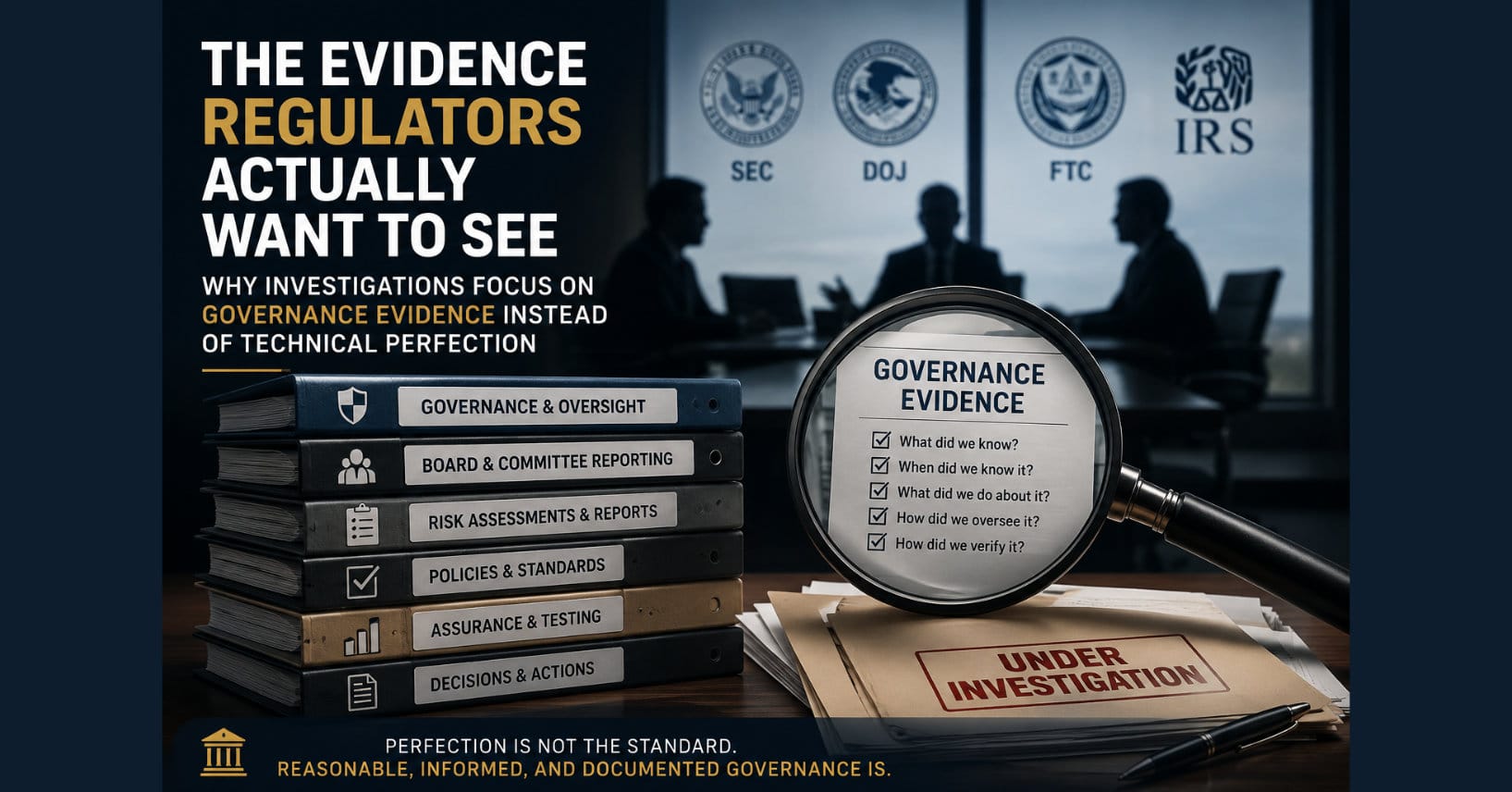
What did leadership know, when did they know it, and what did they do about it?
That is a governance question—not a technical one.
The Investigation Begins Long Before the Malware
Cyber incidents are often described as technology failures, but post-incident investigations tell a different story.
Investigators typically want to understand whether the organization’s leadership exercised reasonable oversight before the incident occurred. They examine whether cyber risk was identified, communicated, discussed, and acted upon—not whether an attacker was eventually successful.
This is why board minutes, executive reports, governance policies, risk registers, committee charters, and decision records frequently become more important than firewall configurations during an investigation.
The question isn’t whether an organization was attacked.
The question is whether leadership governed cyber risk responsibly.
Perfection Is Not the Standard
Many executives mistakenly believe they will be judged on whether they prevented every cyberattack.
That has never been a realistic standard.
Modern organizations operate in an environment where sophisticated adversaries continually evolve their tactics. No security program can guarantee absolute protection.
Regulators understand this.
What they increasingly expect is evidence that leadership exercised informed judgment, established appropriate governance, allocated resources based on risk, and maintained meaningful oversight.
Reasonableness—not perfection—is the standard.
Governance Leaves Evidence
Good governance produces artifacts.
Policies establish authority.
Risk assessments identify material exposures.
Board reporting demonstrates oversight.
Committee minutes document deliberation.
Assurance activities validate effectiveness.
Executive decisions establish accountability.
Together, these artifacts form a governance record that demonstrates leadership fulfilled its responsibilities before an incident occurred.
This evidence cannot be created convincingly after the fact.
Organizations that attempt to reconstruct months or years of governance history during an investigation often discover that important decisions were never documented, reporting was inconsistent, or oversight existed only through informal conversations.
By then, the opportunity to create credible governance evidence has already passed.
The Shift Every Board Should Recognize
For years, cybersecurity programs emphasized prevention.
Today’s governance environment demands something more.
Organizations must be prepared to demonstrate that leadership governed cyber risk with discipline, transparency, and accountability—even when an incident still occurs.
That’s an important shift in perspective.
Cybersecurity is no longer judged solely by technical capability.
Increasingly, it is judged by governance credibility.
The organizations best positioned to withstand regulatory scrutiny will not necessarily be those with the most technology. They will be the ones able to demonstrate that their boards and executive teams exercised informed oversight, made reasonable decisions, and documented those decisions as governance occurred.
That is the evidence regulators are increasingly looking for.
From the Framework
This article is adapted from The Defensible Evidence Framework™ White Paper, which explores how organizations can create defensible governance evidence naturally through disciplined oversight rather than attempting to reconstruct it after a crisis. The complete white paper is available for download here.
Coming Next
Article 2: Good Governance Creates Evidence Naturally
The strongest governance evidence isn’t assembled after an incident—it is created as governance occurs. In the next article, we’ll examine why organizations that treat evidence as a natural byproduct of oversight are far better prepared for audits, investigations, and regulatory scrutiny.