Evidence-Driven Cybersecurity Governance Series—Article 2
Many organizations view governance documentation as something to assemble when an audit, regulatory inquiry, or cyber incident occurs. That approach often results in incomplete records and weakened defensibility.
This second article in the Evidence-Driven Cybersecurity Governance Series introduces the central principle of the Defensible Evidence Framework™: good governance naturally creates evidence. Rather than treating documentation as a compliance exercise, organizations should view governance evidence as the natural byproduct of disciplined leadership, informed decision-making, and continuous oversight.
The article explains why reconstructing governance after an incident is both costly and unreliable, and why boards and executives should build governance processes that continuously generate credible evidence of oversight
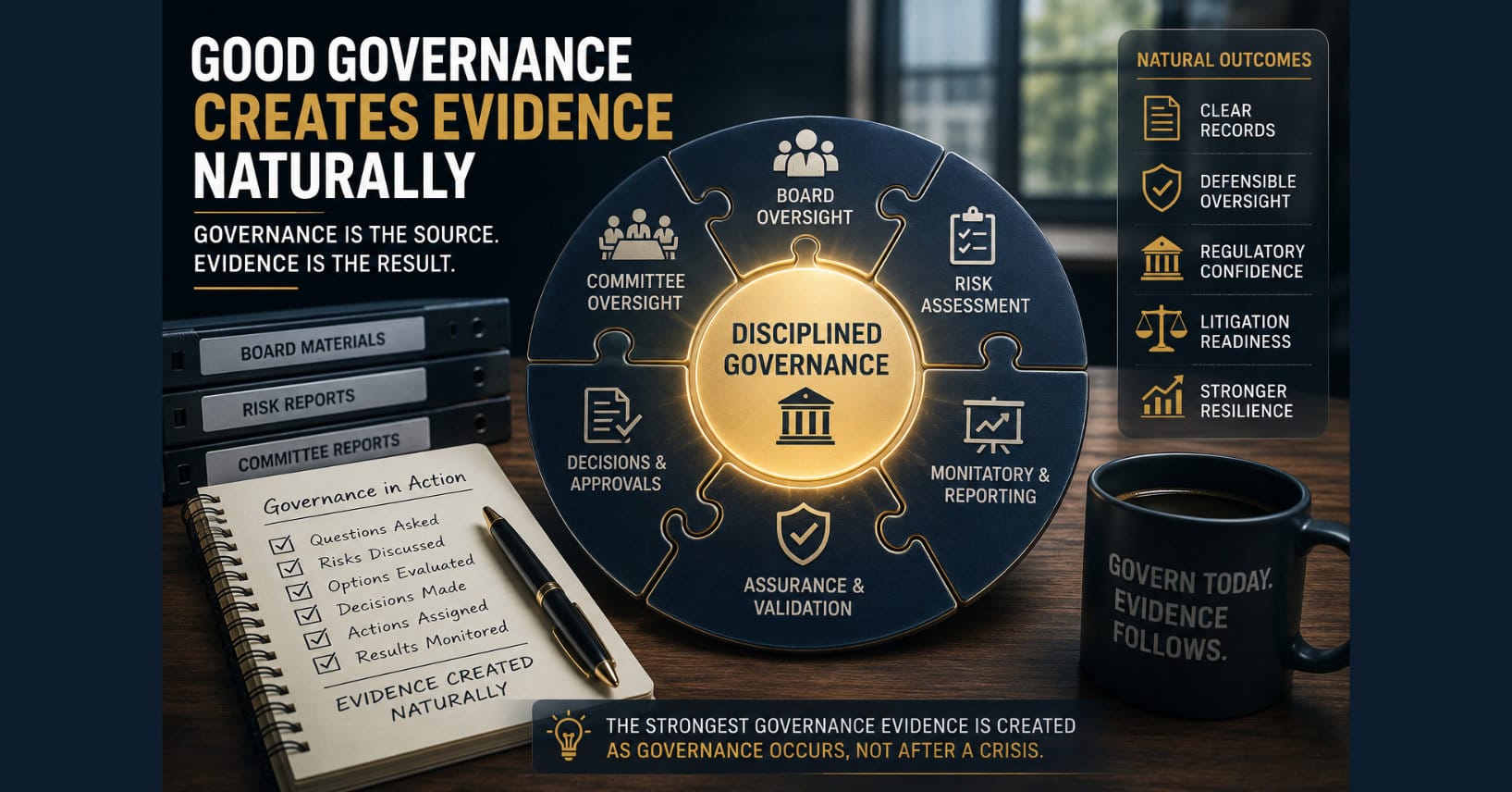
The strongest governance evidence isn’t assembled after an incident—it is created as governance occurs.
Organizations that treat governance evidence as a deliverable will always be behind those that treat it as a byproduct of disciplined leadership.
The phrase “governance evidence” often conjures images of auditors requesting documents, attorneys reviewing board minutes, or compliance teams scrambling to assemble records before an examination.
That thinking misses the point.
The strongest governance evidence is not created in response to an audit or investigation. It is created naturally every time leadership fulfills its governance responsibilities.
This simple principle lies at the heart of the Defensible Evidence Framework™.
Evidence Is an Outcome—Not an Assignment
Many organizations approach documentation as a separate administrative task.
A board meeting concludes, and someone later writes the minutes.
A risk committee meets, and a report is prepared afterward.
An executive approves a cybersecurity initiative, and weeks later someone searches for an email documenting the decision.
These activities produce records.
They do not necessarily produce governance evidence.
Governance evidence is different because it demonstrates that leadership exercised informed oversight, evaluated risk, made reasonable decisions, and followed through on those decisions.
When governance is intentional, evidence emerges as a natural consequence of leadership—not as an afterthought.
Governance Already Produces Evidence
Every effective governance activity leaves a trail.
A board agenda identifies the issues leadership considered.
A risk assessment documents how cyber threats were evaluated.
A committee report demonstrates oversight.
Management dashboards show how risk was monitored over time.
Executive decisions establish accountability.
Independent assurance validates that governance functions as intended.
None of these artifacts exist solely to satisfy regulators.
They exist because effective governance requires them.
When combined, they create a defensible record of leadership’s oversight.
The Cost of Reconstructing the Past
Organizations that neglect governance documentation often discover the problem only after a significant cyber incident.
An investigation begins.
Legal counsel requests records.
Regulators ask for evidence.
Insurance carriers seek documentation supporting governance decisions.
The organization responds by searching email archives, interviewing executives, reconstructing timelines, and attempting to explain decisions that were never adequately documented.
This is one of the most expensive forms of organizational debt.
Reconstructed evidence is rarely as credible as evidence created contemporaneously.
Human memory fades.
Personnel change.
Context disappears.
What could have been demonstrated with confidence becomes difficult to prove.
Governance Should Never Be Performed for the Investigator
Some organizations respond by documenting everything.
That creates a different problem.
Governance should not become a paperwork exercise performed for hypothetical investigators.
Its purpose is to improve decision-making.
The documentation simply reflects that good governance occurred.
When boards ask informed questions…
When executives evaluate risk…
When committees monitor progress…
When assurance activities validate effectiveness…
…the resulting evidence becomes a natural product of governance itself.
Documentation follows discipline.
It does not replace it.
The Principle Behind the Framework
The Defensible Evidence Framework™ is built on a simple but powerful observation:
The strongest governance evidence is created naturally as governance occurs—not reconstructed months later.
Organizations that embrace this principle spend less time preparing for audits because they are continually creating the evidence those audits require.
They spend less time defending decisions because those decisions are already documented.
Most importantly, they strengthen governance itself.
Evidence is not the objective.
Better governance is.
Evidence is simply what good governance leaves behind.
From the Framework
This article is adapted from The Defensible Evidence Framework™ White Paper, which explores how organizations can create defensible governance evidence naturally through disciplined oversight rather than attempting to reconstruct it after a crisis.
The complete white paper is available for download here.
Coming Next
Article 3: Why Board Minutes Are Not Governance Evidence
Meeting minutes record that a board convened. They do not necessarily demonstrate that directors exercised informed oversight. In the next article, we’ll explore the critical difference between documenting meetings and documenting governance—and why that distinction matters when organizations face regulatory scrutiny, litigation, or post-incident investigations.