
Evidence-Driven Cybersecurity Governance Series—Article 15
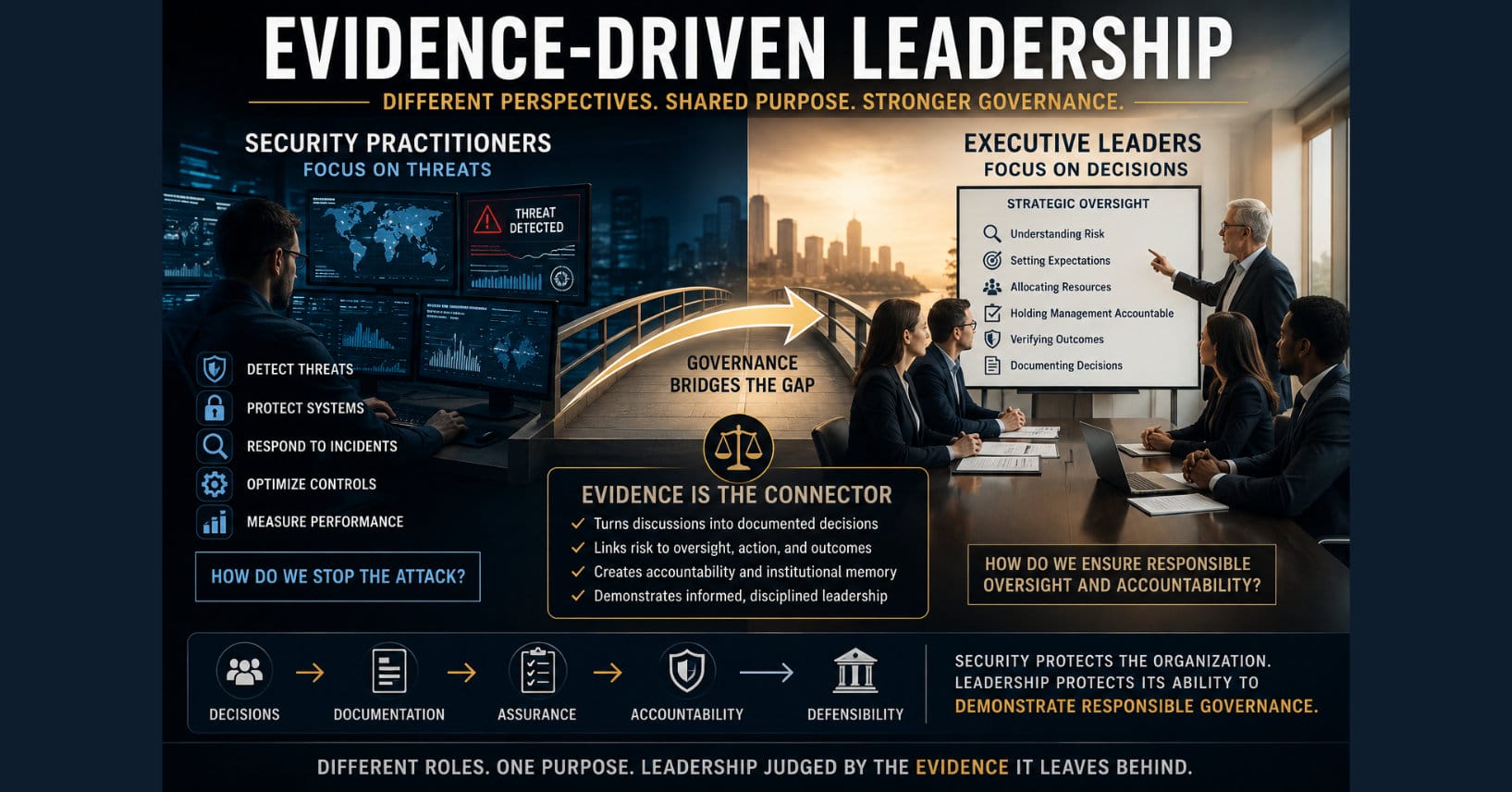
Cybersecurity professionals and executive leaders share the same objective—protecting the organization—but they approach that responsibility from different perspectives. While security practitioners concentrate on threats, controls, and incident response, executives must focus on governance, accountability, strategic decision-making, and demonstrating that cyber risk is being responsibly overseen.
This article explains why evidence-driven leadership is essential to mature cybersecurity governance. It explores how boards and executive teams should evaluate cyber risk through the lens of governance rather than technology alone, intentionally producing evidence through board discussions, executive briefings, decision records, management accountability, and independent assurance. Readers will discover why effective leadership is measured not only by the decisions executives make, but by the evidence those decisions leave behind to demonstrate informed, disciplined, and defensible oversight.
Why executives should think differently than security practitioners.
Security practitioners protect systems. Executive leaders protect the organization’s ability to demonstrate responsible governance.
Cybersecurity professionals and executive leaders share the same objective.
Protect the organization.
Yet they approach that objective from fundamentally different perspectives.
Security practitioners naturally focus on threats.
Executives must focus on decisions.
Security teams ask:
“How do we stop the attack?”
Executive leaders ask:
“How do we ensure the organization is governing cyber risk responsibly?”
Both perspectives are essential.
Neither replaces the other.
The strongest organizations recognize that cybersecurity is not simply a technical discipline.
It is a leadership responsibility.
Security Thinks in Controls
Security professionals are trained to reduce technical risk.
They deploy technologies.
Monitor threats.
Harden systems.
Test defenses.
Respond to incidents.
Measure vulnerabilities.
Their work protects information assets.
It is operational by design.
Success is often measured through technical performance.
Detection rates.
Patch cycles.
Mean time to respond.
Control effectiveness.
These are valuable metrics.
But they do not answer the questions boards ultimately face.
Leadership Thinks in Accountability
Boards and executives operate in a different environment.
They rarely configure firewalls.
They do not tune detection rules.
They seldom review endpoint telemetry.
Instead, leadership must answer questions such as:
Are we governing cyber risk appropriately?
Are material risks reaching decision-makers?
Have responsibilities been clearly assigned?
Are management’s actions independently verified?
Can we demonstrate informed oversight?
These questions are not technical.
They are governance questions.
Evidence Changes Executive Thinking
Evidence-driven leaders ask different questions.
Not:
“Did the team complete the work?”
But:
“What evidence demonstrates leadership exercised oversight?”
Not:
“Did we hold the meeting?”
But:
“What governance evidence did the meeting produce?”
Not:
“Did we receive a cyber briefing?”
But:
“What decisions resulted from that briefing, and how were they followed through?”
Evidence shifts leadership’s attention from activity to accountability.
The Board Does Not Manage Cybersecurity
One of the most common governance misunderstandings occurs when boards attempt to manage cybersecurity directly.
That is management’s responsibility.
The board governs.
Governance means asking the right questions.
Setting expectations.
Approving risk appetite.
Holding management accountable.
Verifying outcomes.
Boards succeed not by becoming cybersecurity experts, but by becoming governance experts.
Evidence supports that responsibility.
Executive Leadership Creates Organizational Memory
Technical systems record events.
Governance records decisions.
Those records become part of the organization’s institutional memory.
Future executives understand why risks were accepted.
Future directors understand previous priorities.
Future investigators understand leadership’s reasoning.
Without governance evidence, each leadership transition begins with assumptions.
With evidence, governance becomes continuous across changing people and changing threats.
Evidence Improves Executive Decisions
Evidence is often viewed as something created for auditors.
Its greatest value is much broader.
It improves leadership itself.
Executives make better decisions when previous decisions are visible.
Boards ask better questions when historical oversight is traceable.
Management becomes more accountable when actions are documented.
Assurance becomes more meaningful when expected outcomes are clearly defined.
Evidence strengthens governance before anyone asks to see it.
Leadership Is Ultimately Judged by Evidence
History rarely remembers intentions.
It remembers decisions.
More importantly, it remembers the evidence supporting those decisions.
When a major cyber incident occurs, leadership is evaluated through its governance record.
Did executives understand the risks?
Did they challenge assumptions?
Did they allocate appropriate resources?
Did they verify management’s execution?
Did they continuously exercise oversight?
Those answers are found in evidence.
Not recollection.
Not opinion.
Evidence.
A Different Way to Lead
Evidence-driven leadership does not require executives to become cybersecurity engineers.
It requires them to become disciplined governors of cyber risk.
That means viewing governance as something that intentionally produces evidence.
Every board discussion.
Every executive briefing.
Every strategic decision.
Every assurance review.
Each should leave behind more than meeting notes.
Each should strengthen the organization’s ability to demonstrate informed leadership.
Because cybersecurity may be managed by specialists.
But governance is owned by leadership.
And leadership is ultimately judged by the evidence it leaves behind.
From the Framework
This article is adapted from The Defensible Evidence Framework™ White Paper, which explores how organizations can create defensible governance evidence naturally through disciplined oversight rather than attempting to reconstruct it after a crisis.
The complete white paper is available for download here.
Coming Next
Article 16: The Board’s Monday Morning Question
Every board should begin the week with one simple question:
“What evidence would we produce if investigators walked in today?”
In the next article, we’ll introduce the defining question of evidence-driven governance and show how this single mindset shift can transform board oversight from a compliance exercise into a disciplined, defensible governance practice that is always prepared for scrutiny.