
Evidence-Driven Cybersecurity Governance Series—Article 16
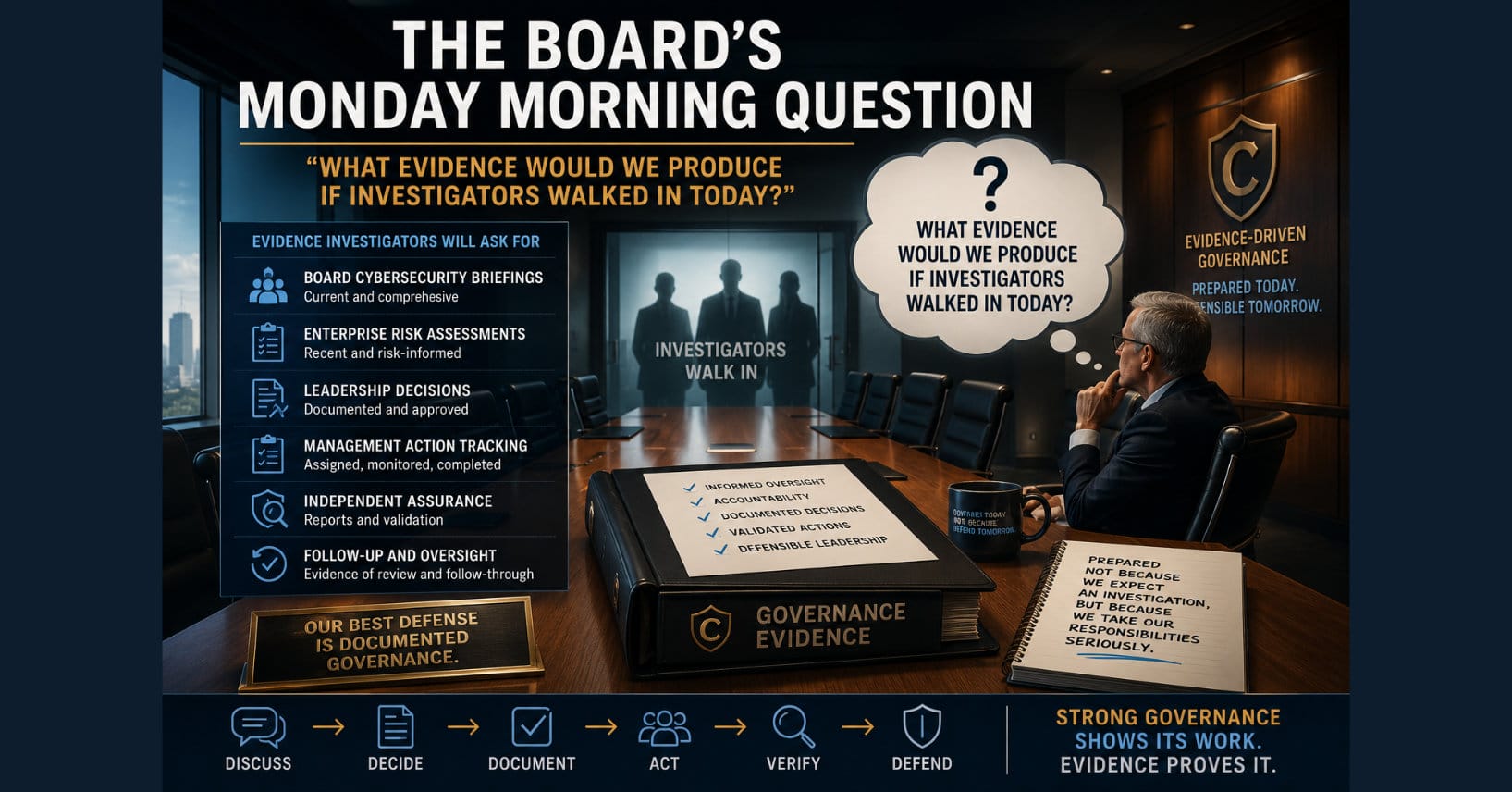
Every board should begin the week with a simple but powerful question: What evidence would we produce if investigators walked in today? More than a thought exercise, this question shifts cybersecurity governance from compliance and operational reporting to continuous evidence readiness. Rather than assuming oversight can be explained after an incident, boards are challenged to consider whether they could immediately produce the governance evidence that demonstrates informed leadership, accountability, and responsible decision-making.
This article introduces the “Monday Morning Question” as a practical governance discipline that encourages boards, executives, risk leaders, and assurance functions to maintain current, connected, and defensible evidence before it is ever requested. Readers will learn how this single question influences reporting, documentation, management follow-through, and board oversight, creating an organizational culture where evidence is produced naturally through governance rather than reconstructed under pressure. Evidence readiness begins with asking the right question—before anyone else does.
“What evidence would we produce if investigators walked in today?”
Every Monday morning, before the first meeting begins, every board should be able to answer one simple question: “What evidence would we produce if investigators walked in today?”
Organizations spend countless hours preparing for events they hope never occur.
Disaster recovery.
Business continuity.
Incident response.
Tabletop exercises.
Crisis communications.
These preparations matter.
But there is another exercise that receives far less attention.
It requires no technology.
No software.
No consultants.
Only one question.
“If investigators arrived this morning, what evidence would we immediately place on the table?”
That question changes everything.
It Is the Right Question
Most governance discussions begin with familiar topics.
Are we compliant?
Are risks decreasing?
Are controls effective?
Have projects been completed?
These are valuable questions.
But they are largely operational.
The Monday Morning Question is different.
It asks whether governance itself is demonstrable.
Not whether leadership believes it exercised oversight.
Whether leadership can prove it.
The Question Reveals Readiness
Imagine a regulator requests evidence before lunch.
Could the organization immediately produce:
- Current board cybersecurity briefings?
- Recent enterprise risk assessments?
- Documented leadership decisions?
- Management action tracking?
- Independent assurance reports?
- Evidence that follow-up occurred?
If those materials are complete, connected, and readily available, governance is likely healthy.
If they require weeks of searching, reconstruction, and explanation, the organization has discovered an evidence readiness problem.
The Question Changes Behavior
One question can reshape governance culture.
Boards begin asking for clearer reporting.
Executives insist on documented decisions.
Management improves action tracking.
Assurance becomes more intentional.
Evidence repositories remain current.
Not because investigators have arrived.
Because they could.
Organizations that routinely ask the Monday Morning Question naturally strengthen governance long before anyone examines it.
Evidence Readiness Becomes Continuous
Evidence-driven organizations no longer prepare for investigations.
They remain prepared.
Every board packet contributes evidence.
Every executive briefing strengthens accountability.
Every risk review updates organizational awareness.
Every assurance activity validates governance.
Evidence readiness becomes part of normal operations.
Not an emergency project.
The Board’s Responsibility
Cybersecurity management belongs to executives.
Cybersecurity governance belongs to the board.
That distinction matters.
Boards are not expected to configure security tools.
They are expected to exercise informed oversight.
The Monday Morning Question helps boards evaluate whether that oversight is visible.
Not simply believed.
Visible.
Evidence transforms oversight from an internal confidence into an external demonstration.
The Question Every Executive Should Ask
The Monday Morning Question should not remain confined to board meetings.
Executive leadership teams should ask it.
Risk committees should ask it.
Internal audit should ask it.
Compliance should ask it.
Information security leadership should ask it.
Each group contributes part of the evidentiary record.
Together, they create the governance story investigators eventually review.
A Different Definition of Readiness
Organizations often define readiness operationally.
Systems recover quickly.
Backups succeed.
Incident response plans work.
Those capabilities remain essential.
Evidence-driven organizations add another dimension.
Governance readiness.
Can leadership demonstrate reasonable oversight?
Can decisions be explained?
Can accountability be shown?
Can governance be defended?
Those questions matter just as much as technical recovery.
One Question That Changes Governance
Every governance framework encourages boards to ask better questions.
Few questions are as powerful—or as practical—as this one.
It requires no new technology.
No regulatory mandate.
No consulting engagement.
Only the discipline to examine governance through the eyes of someone who may someday ask for proof.
Organizations that make this question part of every board cycle begin governing differently.
Documentation becomes intentional.
Accountability becomes visible.
Evidence becomes continuous.
And governance becomes defensible.
Because in the end, the strength of governance is not measured by what leaders remember doing.
It is measured by what they can demonstrate they did.ty naturally produces credible, connected, and defensible evidence of informed leadership.
Because in cybersecurity governance, evidence is not the byproduct of good leadership.
It is one of its defining characteristics.
From the Framework
This article concludes the Evidence-Driven Cybersecurity Governance Series, adapted from The Defensible Evidence Framework™ White Paper. Together, these sixteen articles present a practical model for shifting cybersecurity governance from compliance-focused oversight to evidence-driven leadership.
The complete white paper is available for download here.
Coming Next
Article 17: Evidence Readiness as a Governance Metric
Most organizations measure governance through activities completed, meetings held, or policies approved. In the next article, we’ll explore a more meaningful measure of governance maturity: evidence readiness. You’ll learn why the ability to consistently produce credible governance evidence may become one of the most important metrics boards use to evaluate the effectiveness of cybersecurity governance.