Evidence-Driven Cybersecurity Governance Series—Article 19
When a major cyber incident occurs, organizations immediately begin collecting technical evidence. Unfortunately, many also begin searching for governance evidence that should have been created long before the crisis began. This article explains why attempting to reconstruct board oversight, executive decisions, management accountability, and governance timelines after an incident almost always produces incomplete and less credible results.
Readers will learn why defensible evidence must become a natural byproduct of everyday governance rather than a post-incident exercise. The article demonstrates how board briefings, risk reviews, documented decisions, management follow-through, and independent assurance create a continuous evidentiary record that strengthens organizational preparedness. By shifting the focus from incident response to evidence preparation, organizations improve regulatory readiness, legal defensibility, executive accountability, and stakeholder confidence before the first alert is ever triggered.
Shifting the conversation from response to preparation.
The best time to create governance evidence is before anyone asks for it.
When a major cyber incident occurs, organizations immediately shift into response mode.
Incident response teams assemble.
Legal counsel is notified.
Executives receive briefings.
The board convenes.
Forensic investigators begin collecting evidence.
That sequence is both necessary and expected.
What often surprises leadership is that investigators are collecting more than technical evidence.
They are looking for governance evidence.
Unfortunately, many organizations begin thinking about governance evidence only after the incident has already occurred.
By then, the opportunity to create the strongest evidence has already passed.
The Wrong Time to Build Evidence
One of the most common reactions after a cyber incident is the search for documentation.
Someone begins looking for board minutes.
Someone else searches email archives.
Risk reports are gathered.
Presentations are reconstructed.
Timelines are assembled.
Meeting participants are interviewed.
Leadership attempts to recreate months—or years—of governance activity.
This is not evidence creation.
It is evidence reconstruction.
And reconstructed evidence is almost never as complete, credible, or persuasive as evidence created naturally when governance occurred.
Evidence Is a Byproduct of Good Governance
Organizations often treat evidence as a compliance obligation.
Something to prepare for an audit.
Something to collect for regulators.
Something to organize after an incident.
Evidence-driven organizations think differently.
Every governance activity should naturally produce evidence.
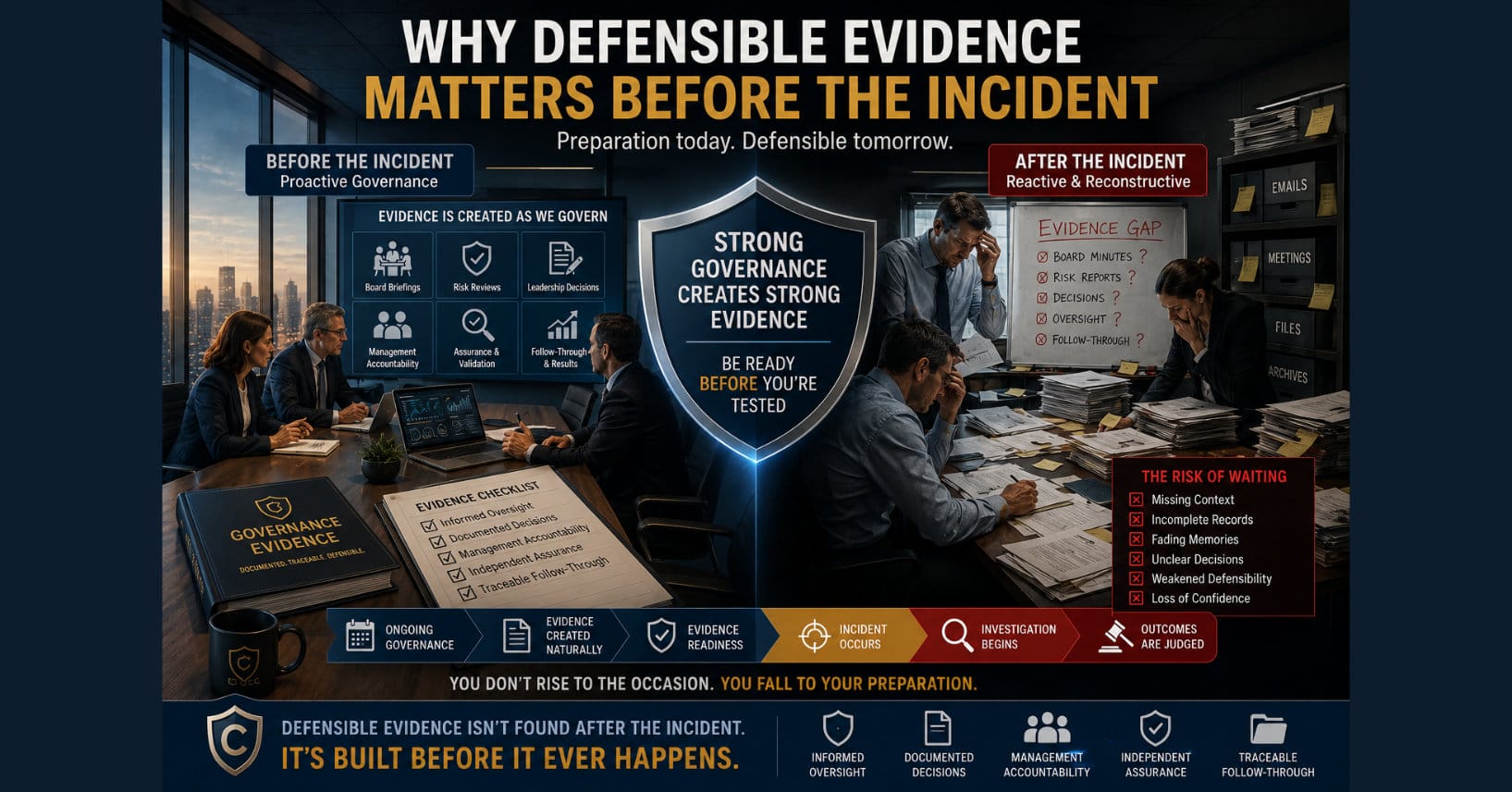
Board briefings.
Risk reviews.
Executive decisions.
Management accountability.
Independent assurance.
The evidence is created as leadership governs—not because someone anticipates an investigation.
Preparedness Is More Than Incident Response
Most organizations define preparedness operationally.
Incident response plans.
Business continuity.
Disaster recovery.
Backups.
Tabletop exercises.
These capabilities are essential.
But governance preparedness deserves equal attention.
Can leadership demonstrate informed oversight?
Can the board explain why decisions were made?
Can management show how actions were tracked to completion?
Can assurance verify outcomes independently?
These questions determine governance readiness—not operational readiness.
Pressure Is the Enemy of Good Evidence
Evidence created under pressure often contains gaps.
Memories differ.
Documents are incomplete.
Context is lost.
Decisions become difficult to reconstruct.
Timelines become uncertain.
The strongest evidence is created when there is no pressure at all.
When governance follows its normal rhythm.
When discussions are documented.
When accountability is recorded.
When follow-through is verified.
Normal governance creates extraordinary evidence.
Preparation Changes Outcomes
Two organizations may experience nearly identical cyber incidents.
Both respond effectively.
Both restore operations.
Both communicate responsibly.
Yet their investigations unfold very differently.
One organization produces a coherent evidentiary record within hours.
Board briefings.
Risk assessments.
Decision records.
Management reporting.
Assurance reviews.
The other spends weeks assembling fragments from email archives, meeting notes, and individual recollections.
The technical outcomes may be similar.
The governance outcomes rarely are.
Preparation changes the investigation before the first question is asked.
The Best Governance Is Already Ready
Evidence readiness is not something organizations achieve the week before an audit.
It is not a project completed after a breach.
It is the result of disciplined governance practiced continuously over time.
Organizations that consistently produce governance evidence rarely need to “prepare” for scrutiny.
They already are.
Their governance tells its own story.
Think Before the Incident
One of the most valuable governance exercises a board can perform is to imagine the day before the incident.
Not the day after.
Ask questions such as:
- What evidence are we creating today?
- What decisions are we documenting?
- What oversight can we demonstrate?
- What accountability will investigators be able to trace?
- Would our governance make sense to someone who has never attended one of our meetings?
Those questions reshape governance long before a crisis occurs.
Preparation Is the Real Competitive Advantage
Organizations often compete through technology.
Through innovation.
Through operational excellence.
Evidence-driven organizations gain another advantage.
Preparedness.
Not merely preparedness to respond.
Preparedness to demonstrate leadership.
That distinction becomes increasingly important as expectations from regulators, insurers, investors, and courts continue to evolve.
The organizations that emerge strongest from tomorrow’s investigations will not necessarily be those that experienced the fewest incidents.
They will be those that prepared for scrutiny before the first incident ever occurred.
Because defensible evidence is not created during the crisis.
It is created every ordinary day that leadership governs with intention.
From the Framework
This article is adapted from The Defensible Evidence Framework™ White Paper, which explores how organizations can create defensible governance evidence naturally through disciplined oversight rather than attempting to reconstruct it after a crisis.
The complete white paper is available for download here.
Coming Next
Article 20: Building an Organization That Documents Itself
What if governance evidence didn’t depend on people remembering to document their work? In the final article of this series, we’ll introduce the concept of Evidentiary Architecture™—a new way of designing organizations so that governance activities naturally generate complete, connected, and defensible evidence as a normal byproduct of doing business. It is the bridge from evidence-driven governance to an enterprise that effectively documents itself.