
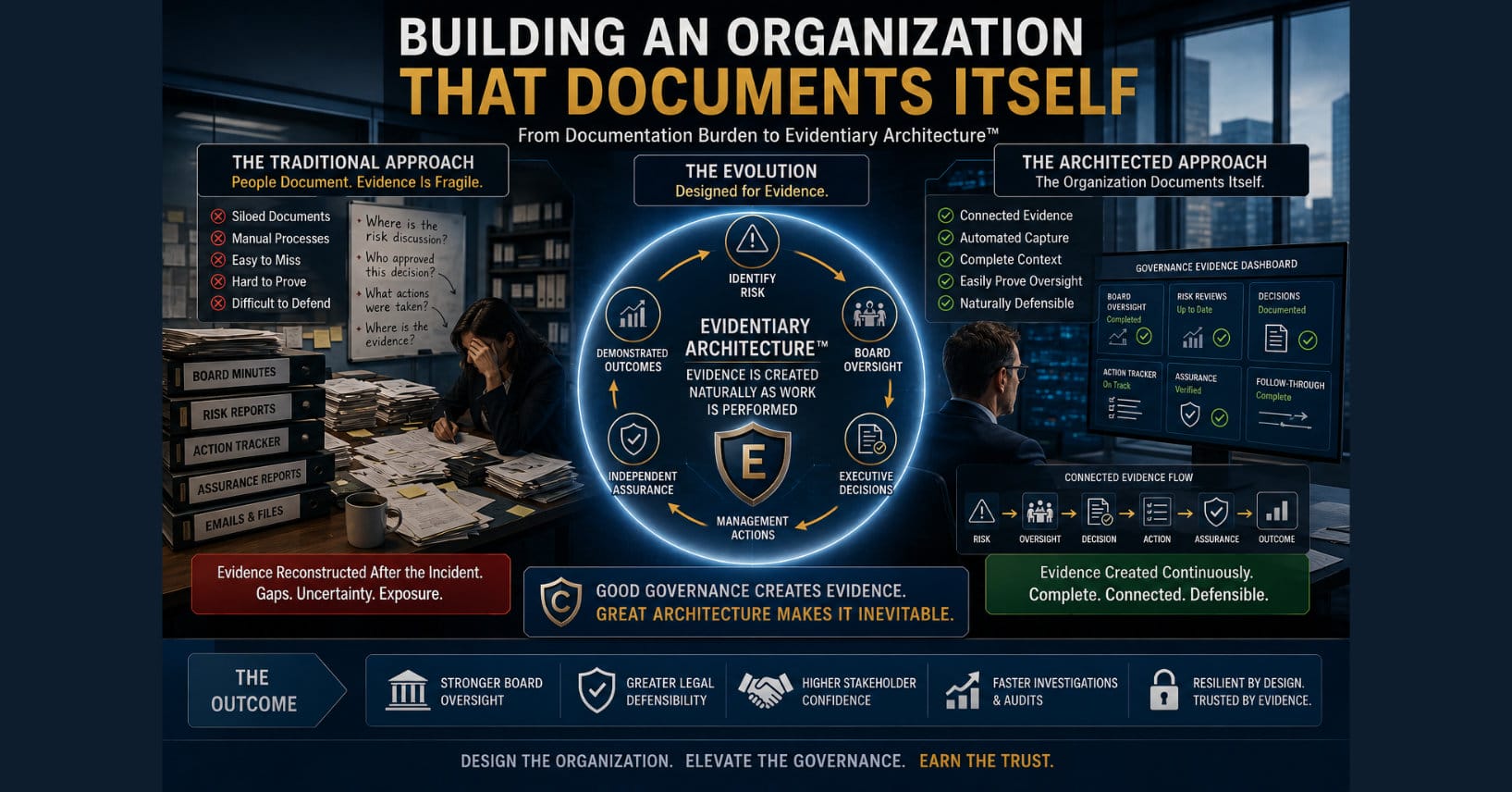
The highest level of governance maturity is not producing more documentation—it is designing the organization so that governance evidence is created naturally as work is performed. This article introduces Evidentiary Architecture™, a new architectural approach that connects governance activities into a continuous evidentiary lifecycle. Instead of relying on people to manually document decisions after the fact, organizations intentionally design processes, workflows, and governance structures that produce complete, connected, and traceable evidence as a normal byproduct of leadership.
As the concluding article in the Evidence-Driven Cybersecurity Governance Series, this article bridges the principles of the Defensible Evidence Framework™ with a broader enterprise vision. Readers will discover how Evidentiary Architecture™ transforms fragmented governance artifacts into a connected evidentiary ecosystem that strengthens board oversight, executive accountability, regulatory readiness, legal defensibility, and organizational trust. The future of governance is not simply documenting better—it is architecting organizations that naturally document themselves.
Evidence-Driven Cybersecurity Governance Series—Article 20
The bridge to Evidentiary Architecture™.
The highest form of governance maturity is not better documentation. It is designing the organization so that evidence is created naturally as work is performed.
Throughout this series, we have explored a simple but transformative idea.
Good governance creates evidence.
Not because someone remembers to document it.
Because governance is intentionally designed to produce it.
That distinction points toward the next evolution in cybersecurity governance.
Not another compliance framework.
Not another reporting standard.
A new way of thinking about how organizations themselves are designed.
Documentation Is Not the Goal
Most organizations depend upon people to create governance evidence.
Someone writes the meeting minutes.
Someone updates the risk register.
Someone records management actions.
Someone saves the presentation.
Someone files the report.
This approach works—until it doesn’t.
People change jobs.
Projects move quickly.
Deadlines intervene.
Documentation is postponed.
Context disappears.
Evidence becomes fragmented.
The problem is not the people.
The problem is the architecture.
Evidence Should Be an Organizational Output
Imagine an organization where governance evidence is produced automatically because governance itself has been intentionally designed.
A board decision automatically links to the supporting risk assessment.
Management actions are connected to executive directives.
Assurance activities validate completed work.
Evidence follows the lifecycle of the decision rather than existing as isolated documents.
Nothing depends upon remembering where information was stored months earlier.
The organization naturally documents itself.
That is a fundamentally different model.
Designing for Evidence
Enterprise architects have long designed organizations around information.
Business processes.
Applications.
Data.
Infrastructure.
Technology.
Governance deserves the same architectural discipline.
Instead of asking:
“Where should we store this document?”
Organizations begin asking:
“How should this governance activity naturally produce evidence?”
That question changes system design.
Workflow design.
Reporting design.
Even meeting design.
Evidence becomes intentional.
Connecting the Governance Story
One of the greatest weaknesses in traditional governance is fragmentation.
Board materials exist in one repository.
Risk registers exist somewhere else.
Action tracking lives in another system.
Assurance reports are maintained independently.
Each artifact has value.
Together, they rarely tell a connected story.
Architecture solves that problem.
Instead of documenting isolated activities, organizations create connected evidence.
Every governance event becomes part of a larger evidentiary chain.
From identified risk…
To board oversight…
To executive decision…
To management action…
To independent assurance…
To demonstrated outcome.
That chain becomes organizational memory.
The Architecture of Defensibility
Defensibility is not created by collecting more documents.
It is created by designing governance so that evidence naturally reflects how leadership governs.
When architecture supports governance…
Evidence becomes consistent.
Traceability improves.
Context is preserved.
Relationships remain intact.
Discovery becomes faster.
Investigations become clearer.
Leadership becomes easier to defend.
Evidence is no longer an administrative burden.
It becomes an architectural capability.
Beyond Cybersecurity
Although this series has focused on cybersecurity governance, the principle is much broader.
Financial governance.
Privacy governance.
Operational resilience.
Artificial intelligence governance.
Enterprise risk management.
Each depends upon informed leadership.
Each produces decisions.
Each benefits from defensible evidence.
The architectural principles remain the same.
The Next Evolution
Evidence-driven governance changes how boards think.
Evidentiary Architecture™ changes how organizations are built.
It moves evidence from the end of the governance process…
…to the design of the governance process itself.
That is the natural progression.
First, organizations recognize the value of evidence.
Next, they intentionally produce it.
Finally, they architect the enterprise so evidence becomes a normal output of work.
That is where governance becomes truly sustainable.
The Future Is Architectural
Throughout these twenty articles, we have challenged a common assumption.
That governance is demonstrated through meetings.
Policies.
Reports.
Minutes.
Documentation.
Those artifacts matter.
But they are not the destination.
They are the evidence produced by a well-designed organization.
The organizations that lead the next decade will not simply have better governance documentation.
They will have organizations intentionally designed to produce governance evidence.
Not through additional administrative effort.
Through architecture.
Because the strongest governance evidence is created naturally as governance occurs—not reconstructed months later.
That principle inspired The Defensible Evidence Framework™.
The next step is Evidentiary Architecture™.
Not simply documenting governance.
Designing organizations that document themselves.
From the Framework
This concludes the Evidence-Driven Cybersecurity Governance Series, adapted from The Defensible Evidence Framework™ White Paper. Across twenty articles, we’ve explored a fundamental shift from compliance-focused oversight to evidence-driven governance—and finally to the architectural principles that make defensible evidence a natural product of leadership.
The complete Defensible Evidence Framework™ White Paper is available in the Publications section of my LinkedIn profile.
Series Conclusion
This series began with a simple observation:
Cyber incidents are increasingly investigated through the lens of governance rather than technology alone.
It concludes with a broader vision:
The future of governance belongs to organizations that intentionally produce evidence as they lead.
That future begins with evidence-driven governance.
It matures through measurable evidence readiness.
And it culminates in Evidentiary Architecture™—an architectural approach that embeds evidence creation into the design of governance itself.
When evidence becomes an organizational output rather than an administrative task, accountability becomes visible, trust becomes demonstrable, and governance becomes naturally defensible.
Because in the end, the strongest governance evidence is never created for investigators.
It is created every day that leadership governs with intention.