AI Governance Series | Article 17 of 20
Governing Intelligence Before It Governs You
Summary: Many organizations mistake advances in AI technology for organizational maturity. In reality, deploying larger or more accurate models does not reduce governance risk. True AI maturity is measured by an organization’s ability to govern AI through defined accountability, repeatable oversight, independent assurance, and evidence-driven decision-making. This article introduces a five-level AI governance maturity model—from Experimental to Evidence-Driven—and explains why boards should evaluate governance capability alongside technical performance. Sustainable AI adoption depends not on better models alone, but on governance that scales with innovation and consistently demonstrates responsible leadership.
Ask most organizations whether their AI program is maturing, and they’ll describe their technology.
Larger language models.
Higher accuracy.
Faster inference.
More automation.
Greater integration.
Those improvements certainly represent technical progress.
They do not necessarily represent organizational maturity.
True AI maturity is measured by governance—not by models.
Technology Matures Faster Than Organizations
AI capabilities improve almost monthly.
Governance rarely does.
Many organizations have adopted increasingly sophisticated AI while relying on governance practices designed for traditional software.
That creates a dangerous imbalance.
As AI capabilities accelerate, governance gaps grow wider.
Eventually, those gaps become organizational risk.
Maturity Is About Decision-Making
An immature organization asks:
Can we build this?
A mature organization asks:
- Should we build it?
- Who approves it?
- What risks does it introduce?
- How will it be monitored?
- What evidence will demonstrate responsible operation?
- Who remains accountable after deployment?
The technology may be identical.
The governance is entirely different.
Better Models Do Not Reduce Governance Risk
Organizations often assume improved AI models reduce organizational risk.
In reality, more capable AI frequently creates greater governance complexity.
Advanced AI systems may:
- Make higher-impact decisions.
- Process more sensitive information.
- Influence more business functions.
- Operate with greater autonomy.
- Affect larger populations.
- Increase regulatory exposure.
As AI capability grows, governance capability must grow with it.
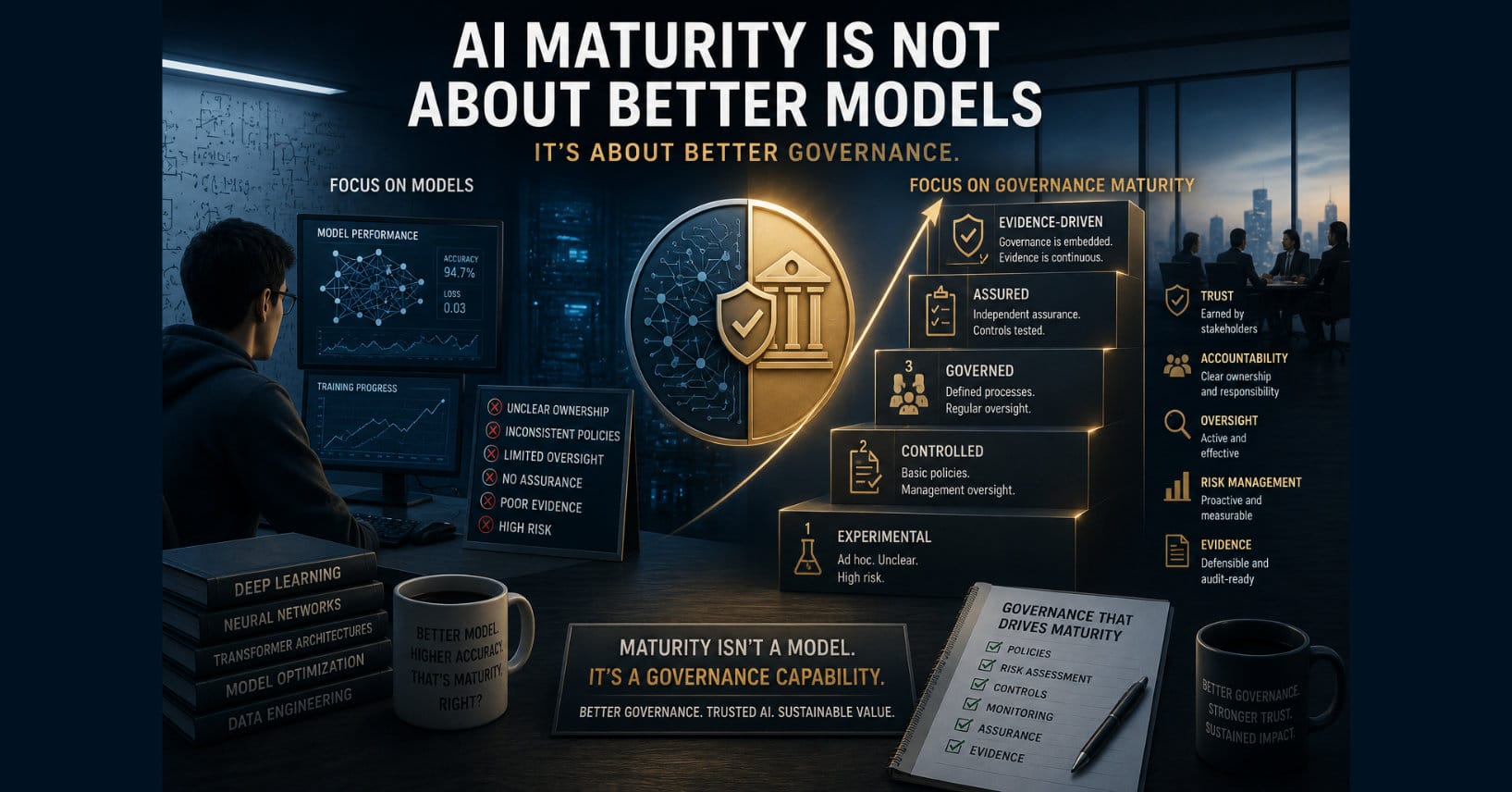
Governance Maturity Has Levels
Organizations generally evolve through recognizable governance stages.
Level 1 — Experimental
AI projects are isolated.
Policies are informal.
Accountability is unclear.
Success is measured by technical performance.
Level 2 — Controlled
Basic policies emerge.
Projects receive management oversight.
Some risk assessments occur.
Governance remains inconsistent.
Level 3 — Governed
Decision rights are defined.
Risk management becomes standardized.
AI inventories exist.
Boards receive regular reporting.
Oversight becomes repeatable.
Level 4 — Assured
Independent reviews validate governance effectiveness.
Metrics measure organizational performance.
Controls are regularly tested.
Leadership receives evidence rather than assumptions.
Level 5 — Evidence-Driven
Governance becomes part of everyday operations.
Evidence is created naturally through governance activities.
Boards receive continuous assurance.
Organizations demonstrate—not merely claim—responsible AI.
The difference between these levels has little to do with model sophistication.
It has everything to do with governance capability.
Mature Organizations Scale Responsibly
Immature organizations often slow AI adoption because governance cannot keep pace.
Mature organizations accelerate adoption because governance creates confidence.
When governance is consistent:
- Business units innovate safely.
- Leadership makes faster decisions.
- Regulators receive credible evidence.
- Customers gain confidence.
- Employees understand responsibilities.
Governance enables sustainable growth.
Boards Should Measure Governance Maturity
Many AI dashboards focus on technical metrics:
- Model accuracy
- Response time
- Adoption rates
- Cost savings
Those metrics matter.
Boards should also monitor:
- Governance maturity
- Policy compliance
- Control effectiveness
- Risk acceptance
- Assurance findings
- Incident trends
- Third-party oversight
- Evidence readiness
Technical maturity explains what AI can do.
Governance maturity explains whether the organization can responsibly manage it.
Maturity Is Demonstrated, Not Declared
Organizations frequently describe themselves as “AI mature.”
That statement means little without evidence.
A mature organization can demonstrate:
- Clear accountability
- Repeatable governance processes
- Effective oversight
- Independent assurance
- Continuous monitoring
- Measurable improvement
- Defensible evidence
Governance maturity is observable.
It does not depend upon self-assessment.
The Highest Level Is Organizational Confidence
The ultimate goal of AI maturity is not deploying the smartest model.
It is creating an organization that consistently makes sound decisions about AI.
An organization that understands:
When to deploy AI.
When not to.
Who is accountable.
How risk is managed.
How trust is maintained.
How evidence is produced.
That is governance maturity.
And it lasts far longer than any particular AI model.
Boardroom Takeaway
AI maturity should not be measured by the sophistication of technology alone. The organizations that will lead in the AI era are those that mature their governance alongside their AI capabilities. Sustainable AI success comes from accountable leadership, disciplined oversight, independent assurance, and evidence that governance is functioning effectively—not simply from deploying more advanced models.
Coming Next
Governance Drift Will Become the Next AI Crisis
Organizations rarely lose control of AI overnight. More often, governance quietly erodes as responsibilities blur, exceptions multiply, oversight weakens, and undocumented decisions accumulate. The next article explores how governance drift develops, why it often goes unnoticed until after an incident, and how organizations can detect and correct it before it becomes a crisis.