
Evidence-Driven Cybersecurity Governance Series—Article 11
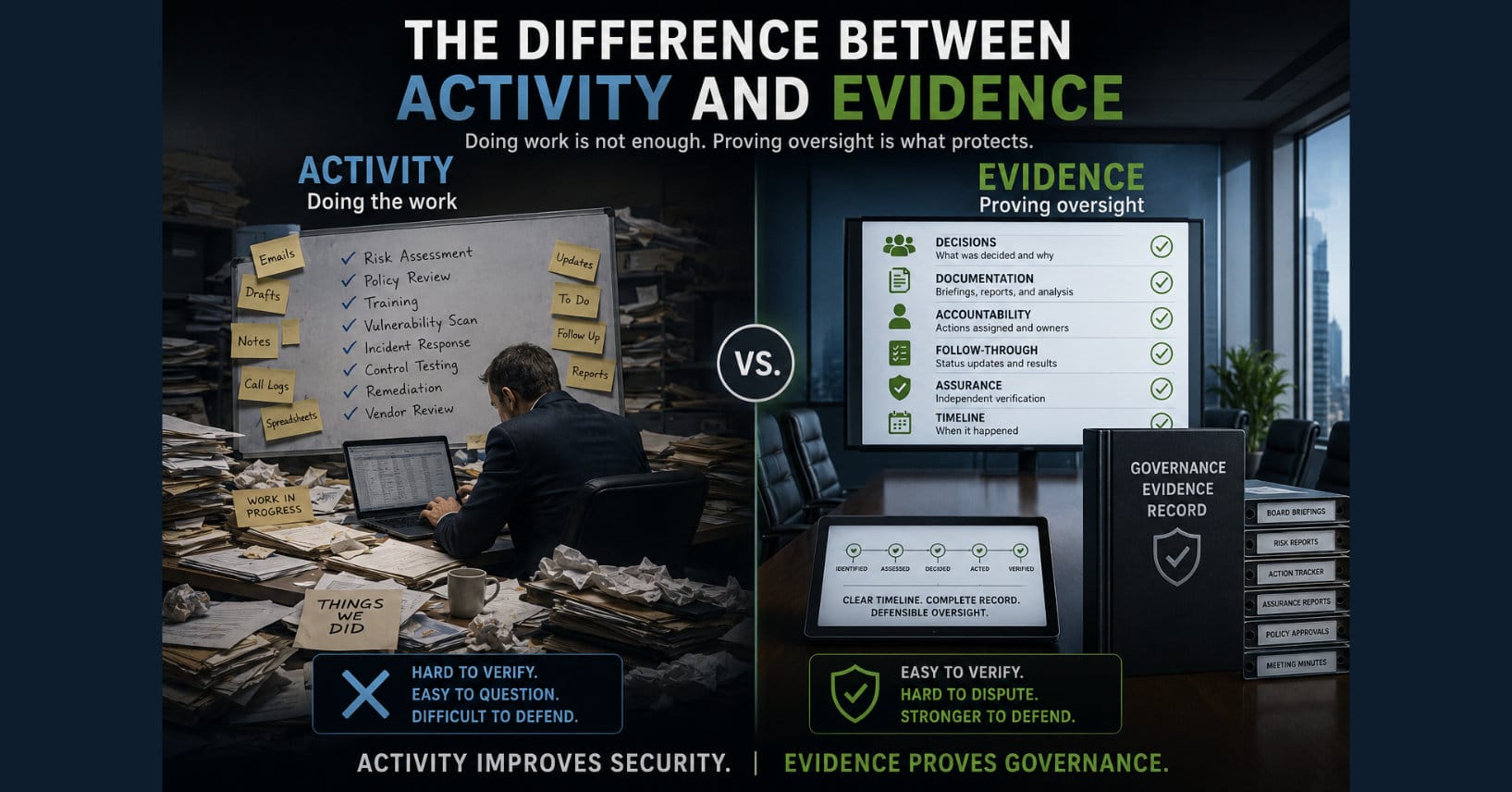
Cybersecurity governance is measured by more than the work an organization performs. It is measured by the evidence that proves leadership exercised informed oversight. This article explores the critical distinction between governance activity and governance evidence, explaining why completed tasks alone rarely satisfy regulators, auditors, insurers, or opposing counsel after a cyber incident.
Readers will learn why evidence must be created as governance occurs—not reconstructed afterward—and how board briefings, decision records, management follow-up, and assurance activities transform operational work into a defensible record of leadership accountability. Mature governance produces two essential outputs: stronger cybersecurity and stronger evidence. Organizations that understand the difference are better prepared to demonstrate responsible oversight when it matters most.
Doing work versus proving oversight.
Organizations are judged not only by what they did, but by what they can demonstrate they did.
Most organizations are busy.
Risk assessments are performed.
Policies are reviewed.
Security awareness training is completed.
Vulnerabilities are remediated.
Board meetings are held.
Cybersecurity briefings are delivered.
Controls are tested.
The work is real.
The effort is substantial.
But when a regulator, insurer, auditor, or opposing counsel asks for proof, many organizations discover an uncomfortable truth:
They can describe what happened.
They cannot always demonstrate it.
That is the difference between activity and evidence.
Activity Creates Outcomes
Cybersecurity depends on activity.
Without action, nothing improves.
Controls are never implemented.
Risks remain unmanaged.
Incidents go unresolved.
Governance exists because leaders act.
There is nothing inherently wrong with focusing on activity.
The problem arises when organizations assume activity automatically creates evidence.
It does not.
Evidence Demonstrates Oversight
Evidence answers questions that activity alone cannot.
What decision was made?
Who made it?
What information was considered?
When did leadership become aware of the issue?
How was management directed?
What follow-up occurred?
How was success verified?
These questions require more than completed work.
They require documentation that demonstrates informed governance.
Evidence transforms invisible leadership into observable accountability.
The Invisible Organization
Imagine two organizations responding to the same cyber risk.
Both identify the threat.
Both allocate resources.
Both implement additional controls.
Both reduce organizational risk.
Operationally, they perform equally well.
Months later, each becomes the subject of regulatory scrutiny.
The first organization presents a clear governance record.
Risk assessments.
Board briefings.
Decision memoranda.
Management action tracking.
Independent assurance reports.
The second organization explains that these activities occurred but cannot produce consistent documentation showing how leadership exercised oversight.
The work may have been identical.
The outcomes during the investigation will not be.
Because visible governance is stronger than remembered governance.
Evidence Is Created During the Work
One of the most common misconceptions is that evidence can be assembled later.
It rarely can.
The strongest evidence is created while governance occurs.
A board presentation demonstrates what directors knew.
Meeting materials preserve decision context.
Action logs establish accountability.
Status reports document follow-through.
Assurance reviews validate effectiveness.
Each governance activity naturally produces evidence when intentionally designed to do so.
Waiting until after an incident almost always results in incomplete reconstruction.
Measuring the Wrong Thing
Organizations often measure governance activity.
How many policies were updated?
How many meetings were held?
How many risks were reviewed?
How many employees completed training?
These metrics have value.
But they measure effort.
Evidence measures accountability.
A more revealing question is:
“What evidence did each governance activity produce?”
That question changes how organizations think about governance.
Every activity becomes an opportunity to strengthen the evidentiary record.
Evidence Builds Organizational Memory
People change roles.
Executives retire.
Board members rotate.
Knowledge leaves.
Evidence remains.
Well-designed governance creates institutional memory that survives personnel changes.
Future leaders understand why decisions were made.
Auditors understand how risks were managed.
Investigators understand how oversight evolved.
Evidence preserves continuity long after individual participants have moved on.
Governance Should Produce Two Outputs
Every governance activity should produce two outcomes.
First, it should improve the organization’s security posture.
Second, it should create evidence that demonstrates informed oversight.
Both outputs are essential.
One protects the organization operationally.
The other protects it organizationally.
Without evidence, effective governance becomes difficult to distinguish from governance that never occurred.
The Measure of Mature Governance
Organizations do not become evidence-driven by documenting everything.
They become evidence-driven by intentionally preserving the decisions, accountability, context, and verification that matter.
That is the difference between activity and evidence.
One reflects work performed.
The other proves leadership fulfilled its governance responsibilities.
In today’s regulatory and legal environment, both are necessary.
Only one is defensible.
From the Framework
This article is adapted from The Defensible Evidence Framework™ White Paper, which explores how organizations can create defensible governance evidence naturally through disciplined oversight rather than attempting to reconstruct it after a crisis.
The complete white paper is available for download here.
Coming Next
Article 12: Governance That Survives Discovery
What would your governance look like if every board paper, email, briefing, and decision record were reviewed by opposing counsel? In the final article of this series, we’ll examine how organizations can design governance that withstands regulatory investigations, litigation, and discovery by creating evidence that is complete, credible, and defensible from the very beginning.