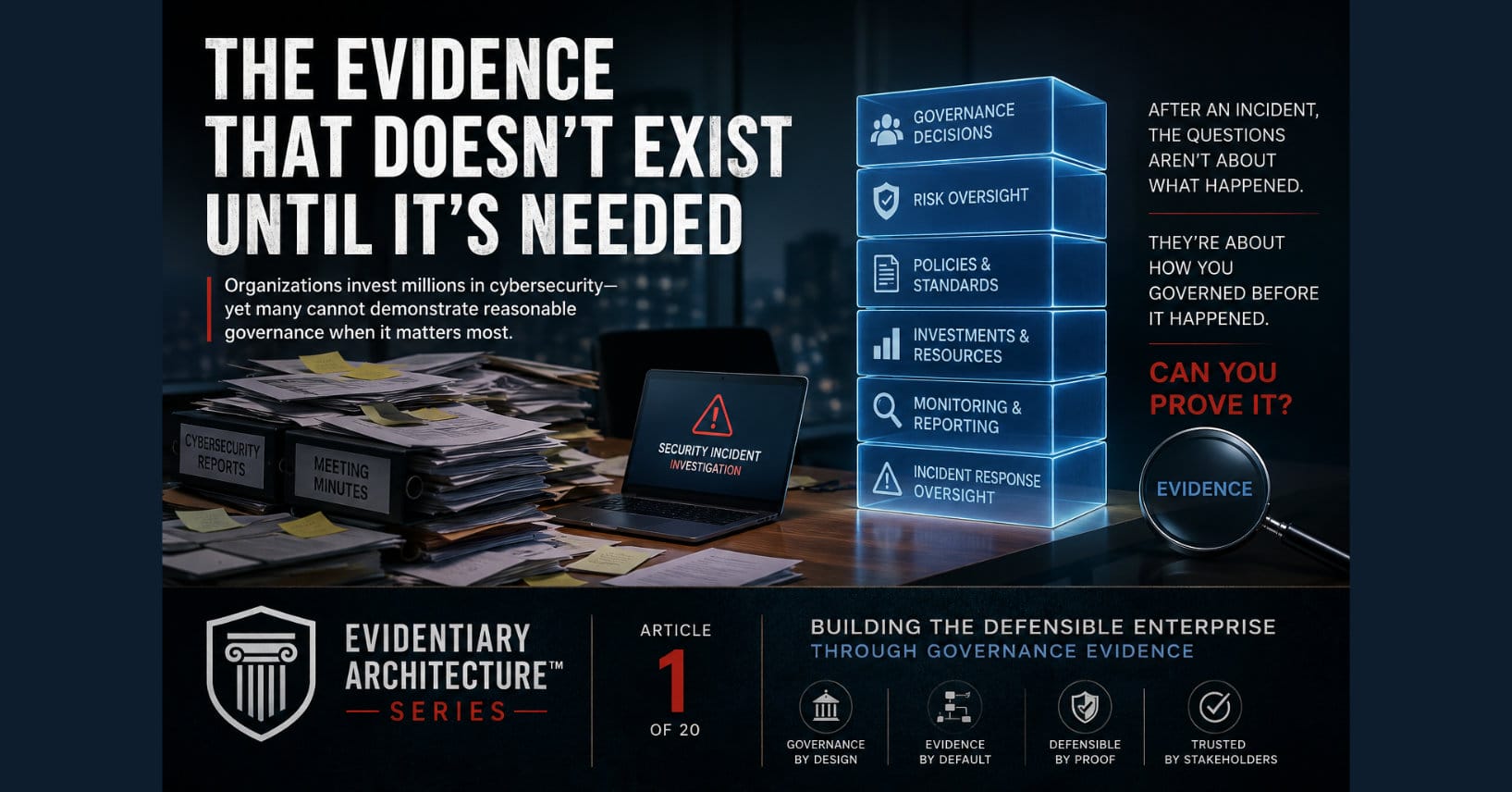
The piece argues that many organizations perform cybersecurity activities but fail to document them well enough to prove diligence during investigations. It explains that regulators, insurers, auditors, and attorneys look for evidence of risk assessments, approvals, oversight, and remediation, not just the existence of security tools or processes.
It emphasizes that governance is evidence-driven and that defensible programs preserve records such as board reports, meeting minutes, training logs, and incident exercise results. The central point is that organizations are often judged on what they can demonstrate they did, not what they intended to do.
Organizations spend millions of dollars on cybersecurity technologies.
They deploy firewalls, endpoint protection platforms, vulnerability scanners, security awareness training, identity management systems, and incident response tools. They hire security professionals, engage consultants, and conduct assessments.
Yet when regulators, auditors, insurers, attorneys, or investigators arrive after an incident, many organizations discover a troubling reality.
They cannot prove what they did.
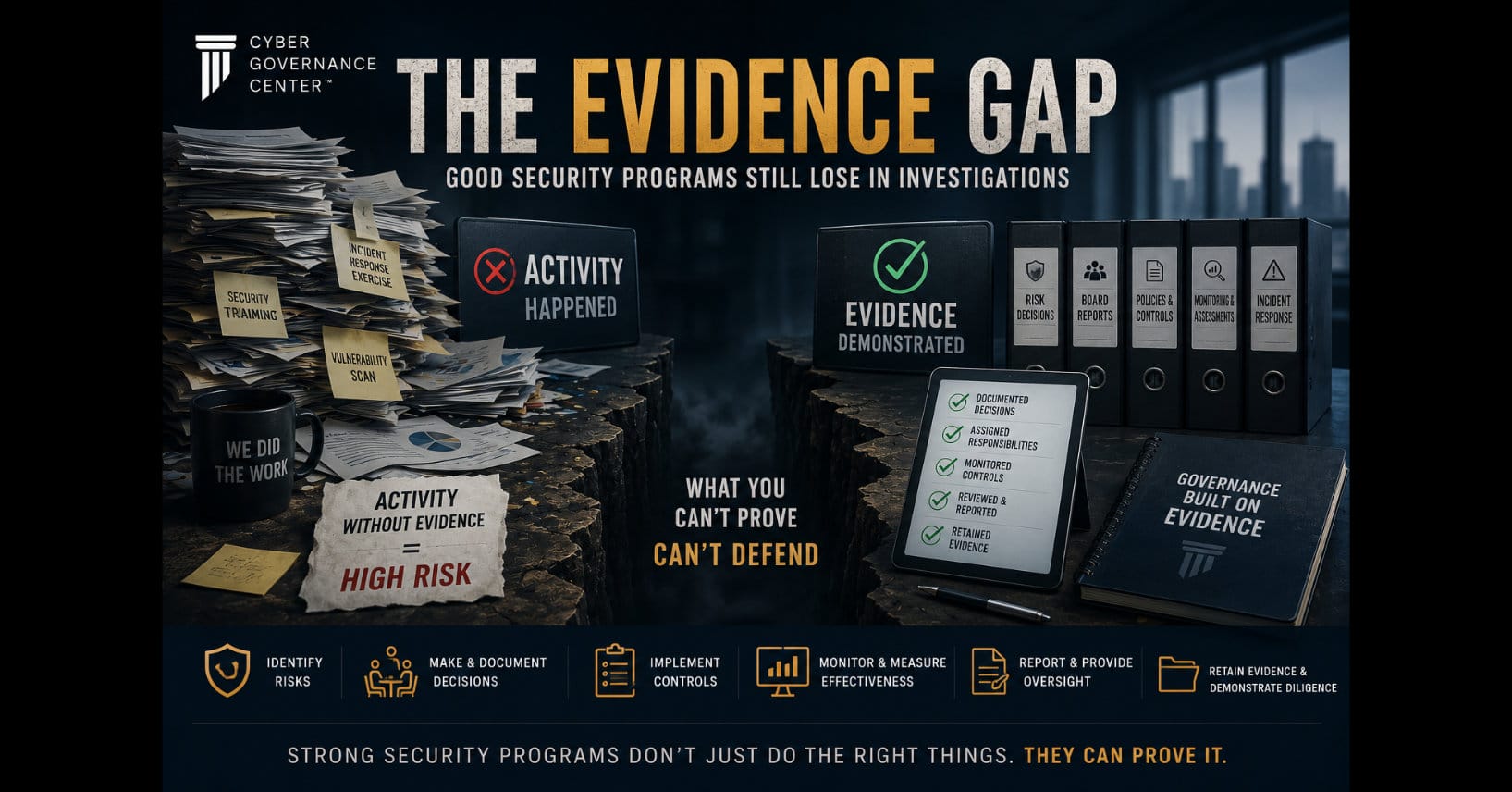
This is the Evidence Gap.
It is the difference between performing security activities and demonstrating that those activities occurred.
Unfortunately, during an investigation, the distinction can determine whether an organization appears diligent or negligent.
Activity Is Not Evidence
Many organizations confuse activity with evidence.
A security team may conduct risk assessments annually.
Were the results documented?
Recommendations may have been provided to leadership.
Were decisions recorded?
Controls may have been implemented.
Was effectiveness measured?
Incident response exercises may have occurred.
Were lessons learned captured and tracked?
In each case, the activity may have happened.
But if evidence does not exist, outside parties have no reliable way to verify it.
Investigations are not based on assumptions.
They are based on evidence.
The Questions Investigators Ask
After a significant cyber event, investigators rarely begin by asking about technical tools.
Instead, they often ask questions such as:
- When was the last risk assessment conducted?
- What risks were identified?
- What decisions were made regarding those risks?
- Who approved those decisions?
- What information was provided to leadership?
- How often was cybersecurity discussed at the executive level?
- What controls were implemented?
- How was effectiveness measured?
- What evidence demonstrates oversight?
Notice the pattern.
Each question seeks documentation.
Each question seeks proof.
Each question seeks evidence.
The Cost of Missing Evidence
Organizations often underestimate the consequences of poor documentation.
When evidence is unavailable:
- Regulators may question oversight.
- Insurers may challenge coverage claims.
- Attorneys may argue negligence.
- Auditors may identify governance deficiencies.
- Leadership credibility may suffer.
In many cases, the issue is not that the organization failed to act.
The issue is that the organization cannot demonstrate that it acted responsibly.
The absence of evidence frequently creates a perception of inaction, even when significant work was performed.
Governance Runs on Evidence
Cybersecurity governance is fundamentally an evidence-driven discipline.
Governance requires organizations to demonstrate:
- Risks were identified.
- Decisions were evaluated.
- Responsibilities were assigned.
- Controls were monitored.
- Oversight occurred.
Every one of these activities generates evidence.
Meeting minutes.
Risk registers.
Board reports.
Control assessments.
Policy reviews.
Training records.
Incident response exercises.
Audit findings.
Corrective action plans.
These artifacts collectively tell the story of organizational diligence.
Without them, that story becomes difficult to defend.
Building an Evidence Culture
Creating evidence does not require excessive bureaucracy.
In fact, the most effective organizations focus on documenting a few critical governance activities consistently.
For example:
- Record major risk decisions.
- Document risk acceptance approvals.
- Maintain board reporting records.
- Preserve incident response exercise results.
- Track remediation activities.
- Retain control assessment evidence.
The objective is not paperwork.
The objective is defensibility.
Organizations should be able to demonstrate how decisions were made, who participated, and what actions followed.
Evidence and Defensibility
Defensibility is becoming one of the most important concepts in cybersecurity governance.
No organization can prevent every incident.
No organization can eliminate every risk.
What organizations can do is demonstrate that they acted reasonably, responsibly, and with appropriate oversight.
That demonstration depends on evidence.
When investigators arrive after a breach, they are not simply evaluating technical controls.
They are evaluating whether leadership exercised due diligence.
Evidence is what allows organizations to answer that question.
The Governance Perspective
Strong cybersecurity programs are not defined solely by the technologies they deploy.
They are defined by their ability to demonstrate informed decision-making, effective oversight, and responsible risk management.
Security activities matter.
But evidence matters more.
Because during an investigation, organizations are rarely judged by what they intended to do.
They are judged by what they can prove they did.
The difference between the two is the Evidence Gap.
And for many organizations, that gap is larger than they realize.