Evidence-Driven Cybersecurity Governance Series—Article 13
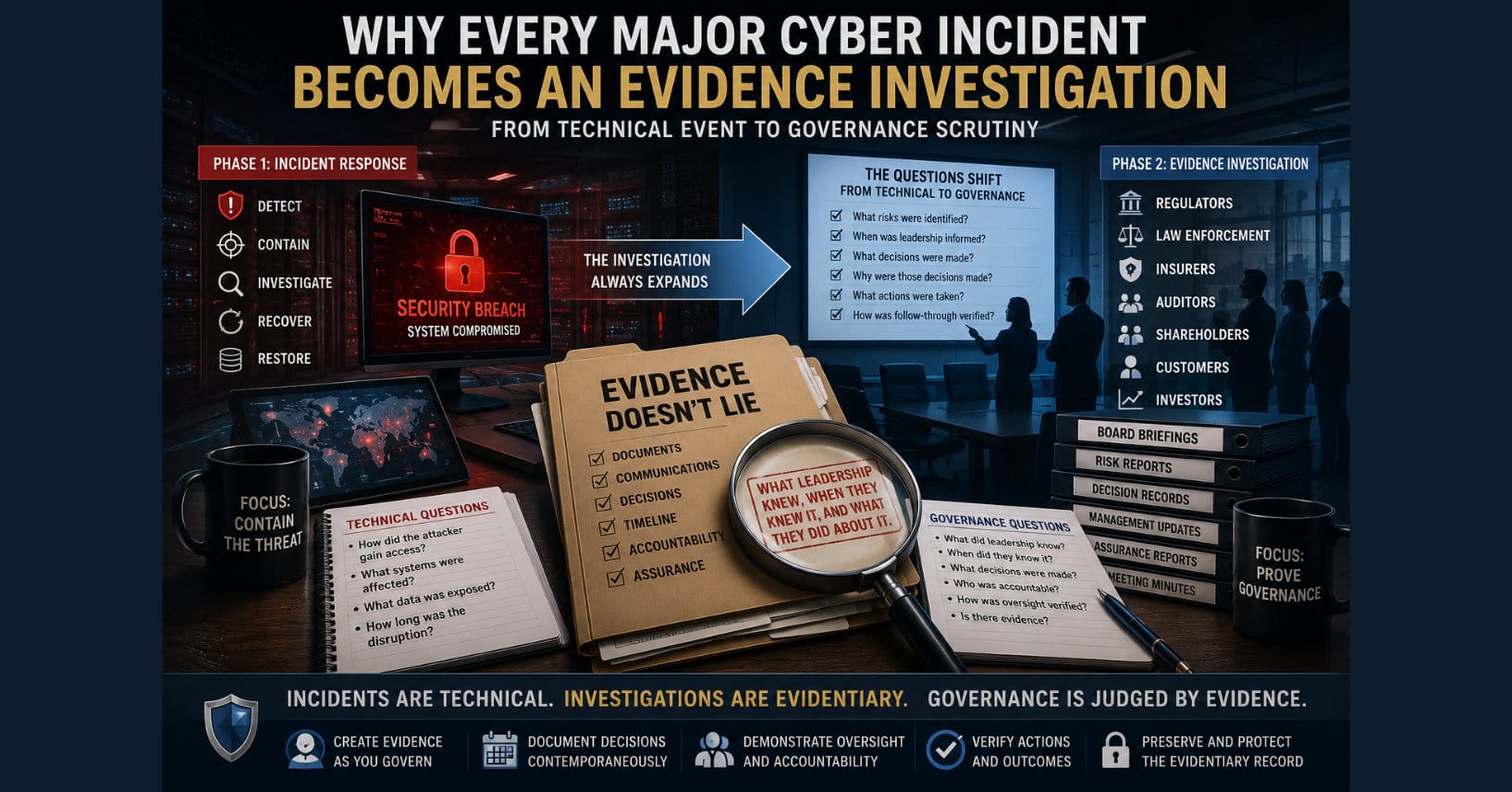
The first phase of a major cyber incident focuses on technical response: containing the attack, restoring operations, and understanding what happened. As regulators, insurers, auditors, and legal counsel become involved, however, the investigation shifts from technical failures to governance decisions. The central questions become what leadership knew, when it knew it, what decisions were made, and whether those decisions reflected reasonable oversight.
This article examines how post-incident investigations evolve into evidence investigations and why organizations must be prepared long before a breach occurs. It explains how governance evidence—including board briefings, risk assessments, decision records, management reporting, and assurance activities—provides the factual record investigators rely upon to evaluate leadership accountability. Organizations that intentionally produce governance evidence before an incident are better positioned to demonstrate disciplined oversight, preserve stakeholder confidence, and withstand regulatory and legal scrutiny.
How post-incident investigations evolve.
Cyber incidents begin as technical events. They almost always end as evidence investigations.
The headlines tell one story.
A ransomware attack.
A data breach.
A cloud compromise.
An insider threat.
A supply chain attack.
The public conversation focuses on technology.
How did attackers get in?
What systems were affected?
How many records were exposed?
How long did recovery take?
Those questions matter.
But they are only the beginning.
As the technical investigation progresses, the focus inevitably shifts.
Attention moves from the attackers…
…to the organization.
And eventually…
…to leadership.
Every Investigation Evolves
The first hours of a cyber incident belong to responders.
Contain the threat.
Protect critical systems.
Preserve forensic evidence.
Restore operations.
Understand the attack.
These activities dominate the early response.
Soon afterward, a second investigation begins.
Legal counsel becomes involved.
Regulators request information.
Cyber insurers ask for documentation.
Auditors review governance processes.
Boards demand answers.
The investigation is no longer limited to what happened.
It now asks:
“How was this governed?”
The Questions Change
As investigations mature, technical questions become governance questions.
Instead of asking:
“How did the attacker gain access?”
Investigators ask:
“Had leadership already identified this risk?”
Instead of asking:
“Why wasn’t the vulnerability patched?”
They ask:
“Who accepted the risk, and why?”
Instead of asking:
“When was management notified?”
They ask:
“When was the board informed?”
Technical failures explain the incident.
Governance evidence explains leadership.
The Timeline Becomes Evidence
One of the first tasks during any investigation is reconstructing events.
Not only technical events.
Governance events.
When was the risk first identified?
When did management become aware?
When did executives receive briefings?
When did the board discuss the issue?
What actions were approved?
How were those actions monitored?
This timeline becomes one of the most important artifacts in the investigation.
Without documentation, organizations rely on memory.
With evidence, they rely on facts.
Evidence Determines Credibility
Organizations often assume credibility comes from cooperation.
Cooperation matters.
Evidence matters more.
Risk assessments establish awareness.
Board materials demonstrate oversight.
Decision records explain leadership judgment.
Management reporting demonstrates execution.
Assurance reviews validate effectiveness.
Together, these artifacts tell a coherent governance story.
Without them, investigators must infer what occurred.
Those inferences are not always favorable.
The Investigation Expands
Major cyber incidents rarely involve a single stakeholder.
One incident may trigger inquiries from:
Regulators.
Law enforcement.
Cyber insurers.
External auditors.
Customers.
Business partners.
Investors.
Shareholders.
Each group asks different questions.
Yet nearly all request the same underlying resource:
Evidence.
Not assumptions.
Not recollections.
Evidence.
Organizations with mature governance answer those requests confidently.
Others begin searching emails, reconstructing timelines, and interviewing participants.
The difference becomes immediately apparent.
Leadership Is Evaluated
Technical teams are evaluated on response.
Leadership is evaluated on governance.
Investigators want to know whether executives exercised reasonable judgment.
Whether directors fulfilled their fiduciary responsibilities.
Whether material risks were communicated appropriately.
Whether management was held accountable.
Whether oversight evolved as circumstances changed.
These questions cannot be answered by technical controls alone.
They require governance evidence.
The Best Evidence Already Exists
Organizations often ask:
“What evidence should we prepare after an incident?”
A better question is:
“What evidence should already exist before one?”
The strongest evidence is never assembled under pressure.
It is created naturally through disciplined governance.
Board discussions.
Risk reporting.
Decision documentation.
Management accountability.
Independent assurance.
These activities produce an evidentiary record long before anyone requests it.
Every Incident Is Ultimately About Trust
Technology restores systems.
Governance restores confidence.
Customers decide whether to stay.
Investors decide whether to continue believing leadership.
Regulators decide whether oversight was reasonable.
Courts evaluate accountability.
Boards evaluate performance.
Every one of those judgments depends upon evidence.
That is why every major cyber incident eventually becomes an evidence investigation.
Not because investigators distrust organizations.
But because evidence is the only reliable way to distinguish responsible governance from unsupported claims.
The organizations that emerge strongest are not always those that prevent every incident.
They are the ones that can demonstrate—clearly, consistently, and credibly—that leadership fulfilled its governance responsibilities before the incident ever occurred.
From the Framework
This article is adapted from The Defensible Evidence Framework™ White Paper, which explores how organizations can create defensible governance evidence naturally through disciplined oversight rather than attempting to reconstruct it after a crisis.
The complete white paper is available for download here.
Coming Next
Article 14: The Cost of Governance Drift
Governance rarely fails overnight. More often, it slowly loses focus, discipline, and evidentiary value through small compromises that accumulate over time. In the next article, we’ll examine how governance drift quietly weakens accountability, erodes the evidentiary record, and leaves organizations increasingly vulnerable long before anyone recognizes the risk.