Evidence-Driven Cybersecurity Governance Series—Article 3
Board minutes are an essential corporate record, but they are not the same as governance evidence. While minutes document that a meeting occurred and record formal actions, they rarely demonstrate how directors exercised informed oversight, evaluated cyber risk, challenged management, or verified that decisions were implemented.
In this third installment of the Evidence-Driven Cybersecurity Governance Series, we examine the critical distinction between recording meetings and documenting governance. The article explains why regulators, insurers, auditors, and litigators look beyond board minutes to reconstruct an organization’s governance process through risk assessments, executive reporting, decision records, management action plans, assurance activities, and follow-up reporting.
Organizations that understand this distinction build a defensible body of governance evidence that demonstrates continuous oversight rather than isolated meetings. The result is stronger accountability, greater regulatory readiness, and a more complete record of leadership’s fulfillment of its governance responsibilities.
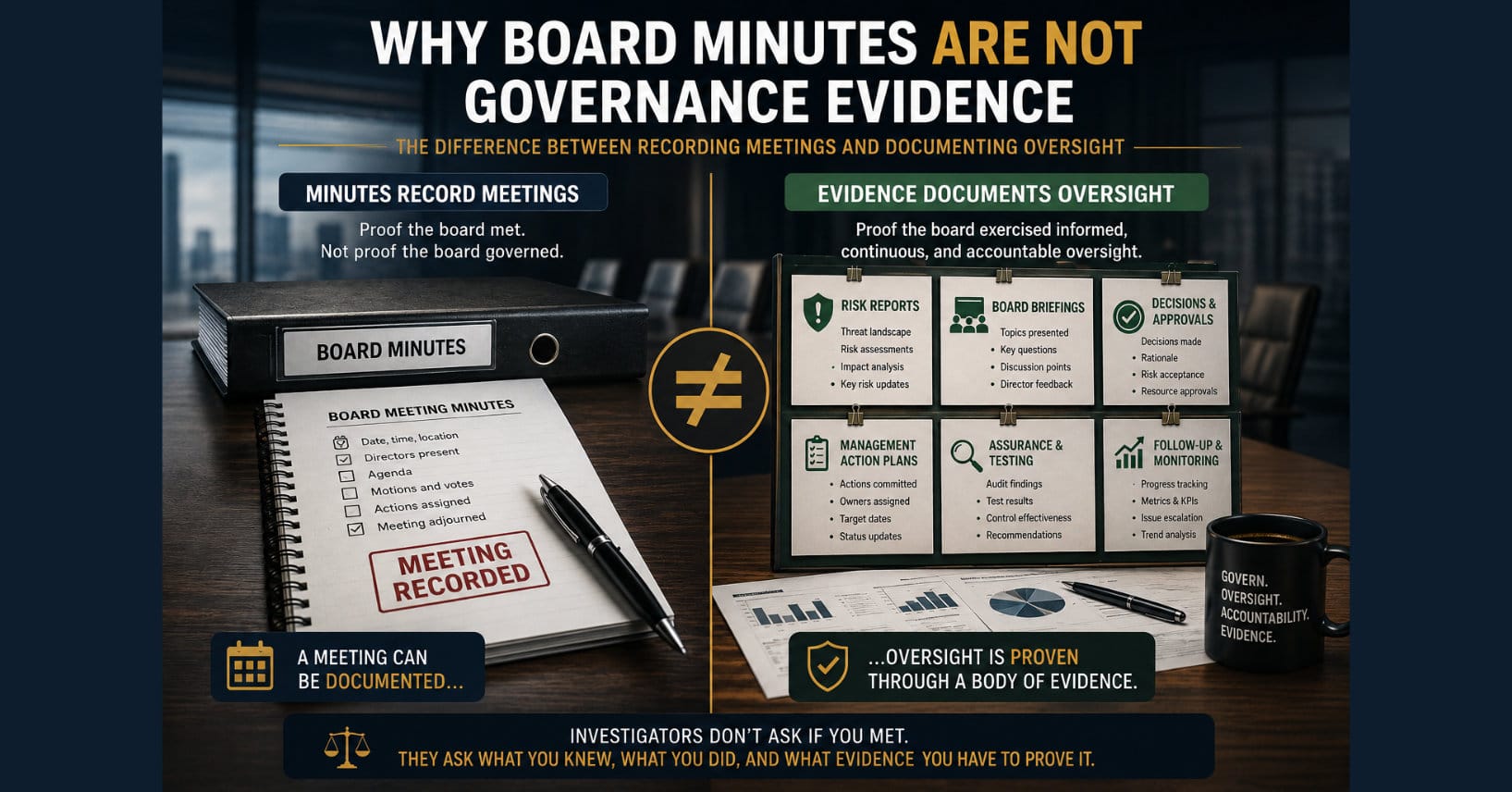
The difference between recording meetings and documenting oversight.
A board meeting proves directors met. Governance evidence proves they governed.
One of the most common misconceptions in corporate governance is that board minutes are sufficient evidence of board oversight.
They are not.
Board minutes serve an important legal and corporate purpose. They establish that a meeting occurred, identify who attended, record motions, and document formal actions taken by the board.
But they rarely answer the questions investigators ask after a significant cyber incident.
Those questions are fundamentally different.
They seek to understand whether directors exercised informed oversight—not merely whether they convened a meeting.
That distinction lies at the heart of evidence-driven governance.
Minutes Record Meetings
Every organization should maintain accurate board minutes.
Without them, an organization struggles to demonstrate basic corporate governance.
Yet minutes have limitations by design.
Good board minutes are not transcripts. They intentionally summarize discussions rather than documenting every question, analysis, or decision considered by directors. They capture governance actions without attempting to preserve every detail of the deliberative process.
That is appropriate for corporate recordkeeping.
It is not sufficient evidence of governance maturity.
A meeting can be perfectly documented while providing little insight into how leadership exercised oversight.
Oversight Leaves a Different Kind of Evidence
Effective governance creates evidence long before the secretary prepares the minutes.
Consider a typical cybersecurity briefing to the board.
Directors receive a quarterly cyber risk report.
Management identifies emerging threats.
Material risks are evaluated.
Questions are asked about mitigation plans.
Funding priorities are discussed.
Management commits to specific follow-up actions.
Independent assurance validates progress during the next reporting cycle.
The board reviews updated risk metrics and determines whether management’s response remains appropriate.
Each of these activities produces evidence.
Risk reports…
Presentation materials…
Decision records…
Management action plans…
Assurance findings…
Follow-up status reports…
Together, they demonstrate a continuous process of oversight rather than a single meeting.
Investigators Want the Governance Story
After a significant cyber incident, investigators rarely rely on board minutes alone.
Instead, they attempt to reconstruct the organization’s governance process.
They ask questions such as:
- How was cyber risk communicated to leadership?
- What information did directors receive?
- What concerns did they raise?
- What actions did management commit to?
- How did leadership verify those actions were completed?
- Did oversight improve over time?
Minutes may answer only one of those questions.
The remaining answers are found across the organization’s governance evidence.
This broader body of documentation tells the complete governance story.
Oversight Is Continuous
One reason organizations struggle during investigations is that they view governance as a series of meetings.
Governance is not an event.
It is a continuous cycle of oversight.
Boards establish expectations.
Management reports progress.
Directors evaluate information.
Resources are adjusted.
Risks are reassessed.
Independent assurance validates effectiveness.
The cycle repeats.
Every step leaves evidence.
When viewed collectively, these records demonstrate that leadership exercised reasonable care and fulfilled its governance responsibilities.
The Goal Is Not Better Minutes
Some organizations respond by making board minutes increasingly detailed.
That misses the point.
Longer minutes do not necessarily create stronger governance evidence.
In fact, attempting to force every governance activity into meeting minutes often produces documents that are cumbersome to maintain while still failing to demonstrate the complete oversight process.
The objective is not to transform minutes into investigative reports.
The objective is to ensure governance naturally produces evidence across the entire governance lifecycle.
Minutes become one piece of that evidentiary record—not the record itself.
Governance Is Bigger Than the Meeting
The Defensible Evidence Framework™ encourages organizations to think beyond individual governance artifacts.
Board minutes matter.
Risk assessments matter.
Executive reporting matters.
Management action tracking matters.
Independent assurance matters.
Together, they create a defensible body of evidence demonstrating that leadership exercised informed, continuous, and accountable oversight.
That is what investigators increasingly seek.
Not proof that a board met.
Proof that a board governed.
From the Framework
This article is adapted from The Defensible Evidence Framework™ White Paper, which explores how organizations can create defensible governance evidence naturally through disciplined oversight rather than attempting to reconstruct it after a crisis.
The complete white paper is available for download here:
Coming Next
Article 4: The Governance Evidence Stack
Governance evidence is not a single document—it’s a layered system of interconnected artifacts that collectively demonstrate leadership oversight. In the next article, we’ll introduce the Governance Evidence Stack and explain how policies, risk assessments, reporting, assurance, and decision records work together to create defensible governance evidence.