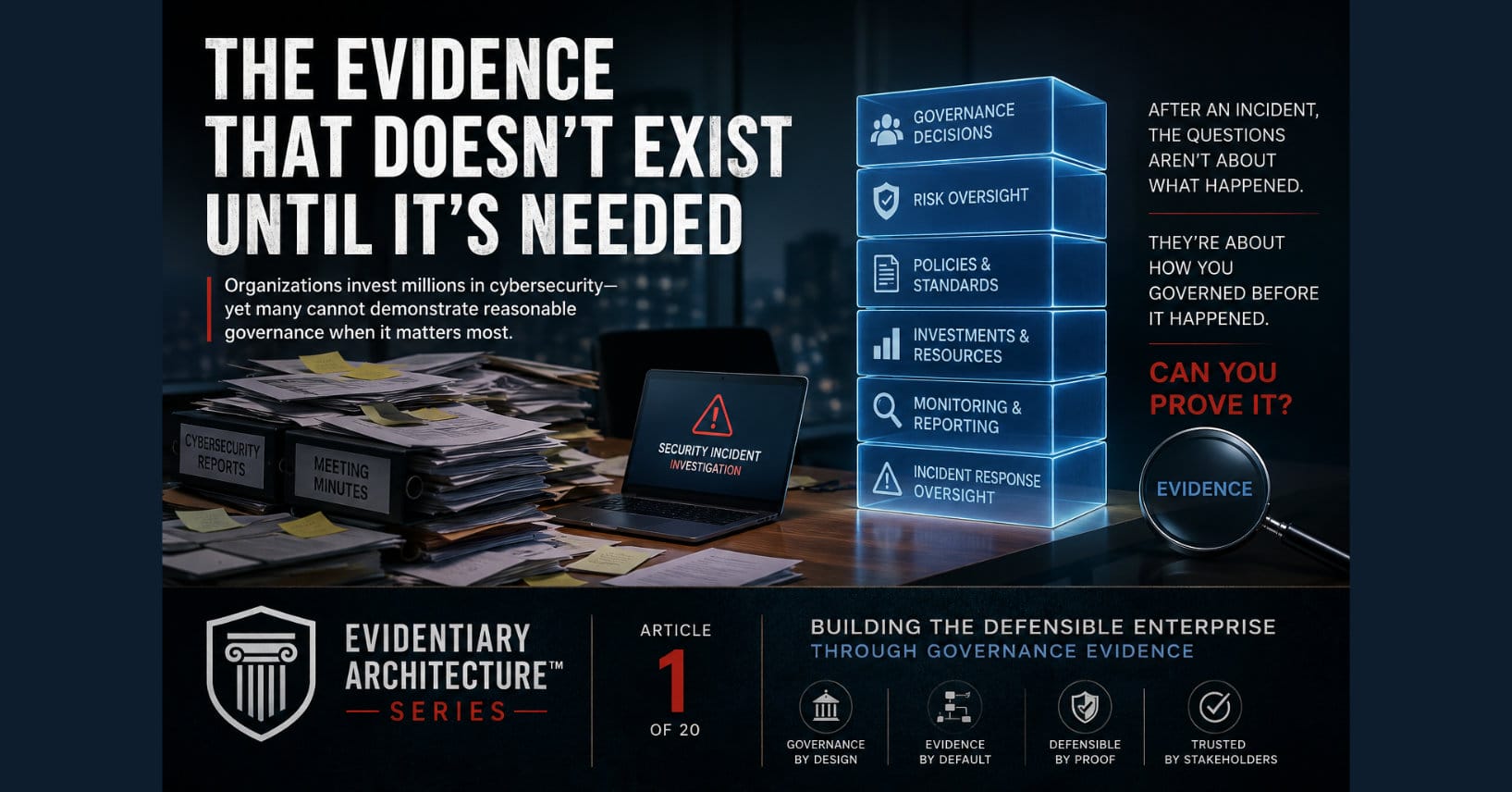

Evidence-Driven Cybersecurity Governance Series—Article 6
Governance should produce more than meetings, reports, and decisions. It should also produce credible evidence that leadership exercised informed oversight, assigned accountability, and followed through on cyber risk decisions.
In this sixth installment of the Evidence-Driven Cybersecurity Governance Series, we examine why evidence should be treated as an intentional governance product—not an audit scramble, legal afterthought, or compliance artifact. The article explains how routine governance activities such as board oversight, cyber risk assessments, executive briefings, management action tracking, and assurance reviews should naturally generate evidence outputs.
By designing governance processes to produce evidence continuously, organizations strengthen accountability, improve regulatory readiness, and create a defensible record of leadership judgment before that record is ever requested.
Governance should intentionally produce evidence as an operational output.
Governance doesn’t simply reduce risk. It should continuously produce evidence that risk is being governed.
Most organizations think of governance as a management activity.
Policies are written.
Committees meet.
Risks are reviewed.
Reports are presented.
Budgets are approved.
These are all important governance functions.
But they overlook something equally important:
Every governance activity should intentionally produce evidence.
Not as an administrative burden.
Not as an audit requirement.
As an operational output.
This shift in thinking changes how organizations design governance itself.
Governance Produces Many Outputs
Every governance program produces outcomes.
Better decisions.
Greater accountability.
Improved risk visibility.
Stronger alignment between business objectives and cybersecurity.
Most organizations stop there.
The Defensible Evidence Framework™ proposes one additional output that should be viewed as equally valuable:
Governance evidence.
Just as manufacturing produces products…
Finance produces financial statements…
Human Resources produces personnel records…
Governance should produce credible evidence demonstrating how leadership exercised oversight.
Evidence becomes part of the organization’s governance value stream.
Evidence Should Be Designed—Not Discovered
One of the reasons organizations struggle during investigations is that evidence was never intentionally produced.
The organization assumed documentation would exist if it were ever needed.
Instead, investigators discover fragmented records.
Meeting notes exist, but decision records do not.
Risk assessments exist, but management follow-up is undocumented.
Policies exist, but assurance activities were never recorded.
The problem is rarely that governance failed.
The problem is that governance was never designed to produce evidence.
Organizations should ask a different question:
“What evidence should this governance activity naturally generate?”
That question changes everything.
Every Governance Activity Has an Evidence Output
Consider several routine governance activities.
A board meeting should produce more than minutes.
It should produce documented oversight.
A cyber risk assessment should produce more than a risk score.
It should demonstrate how leadership evaluated organizational priorities.
An executive briefing should produce more than presentation slides.
It should document decisions, assigned responsibilities, and follow-up expectations.
An internal audit should produce more than findings.
It should validate governance effectiveness.
Every governance process has an evidentiary output waiting to be captured.
The objective is not additional paperwork.
The objective is intentional governance.
Operational Thinking Changes Governance
Manufacturing organizations carefully define outputs.
Software development defines deliverables.
Quality programs define acceptance criteria.
Governance deserves the same discipline.
Organizations should define:
- What governance activities occur?
- What evidence should each activity produce?
- Where is that evidence maintained?
- Who is accountable for its quality?
- How is its completeness verified?
These are operational questions.
When answered consistently, governance becomes repeatable.
Repeatability creates reliability.
Reliability creates defensibility.
Evidence Is an Asset
Organizations invest heavily in financial records.
Operational metrics.
Customer information.
Intellectual property.
Governance evidence deserves similar attention.
It represents organizational knowledge.
It demonstrates leadership accountability.
It supports regulatory examinations.
It informs future decision-making.
It protects directors and executives by documenting reasonable oversight.
Most importantly, it accumulates value over time.
Each board cycle.
Each risk assessment.
Each assurance review.
Each improvement initiative strengthens the organization’s evidentiary foundation.
Evidence compounds.
Governance Without Evidence Is Difficult to Demonstrate
An organization may have excellent governance.
Outstanding leadership.
Strong cybersecurity.
Thoughtful oversight.
Responsible decision-making.
But if those activities leave little evidence behind, proving that governance occurred becomes unnecessarily difficult.
The Defensible Evidence Framework™ encourages organizations to make evidence production intentional.
Not because investigators might ask.
Because evidence is one of governance’s most valuable products.
When governance is designed to produce evidence naturally, accountability becomes visible.
Oversight becomes demonstrable.
Leadership becomes defensible.
That is evidence-driven governance.
From the Framework (LinkedIn)
This article is adapted from The Defensible Evidence Framework™ White Paper, which explores how organizations can create defensible governance evidence naturally through disciplined oversight rather than attempting to reconstruct it after a crisis.
The complete white paper is available for download here.
Coming Next
Article 7: What Makes Governance Defensible?
Good governance and compliant governance are not necessarily the same thing. In the next article, we’ll explore what makes governance defensible—why the ability to demonstrate informed oversight, reasonable decision-making, and continuous accountability ultimately provides greater protection than compliance alone.