
Evidence-Driven Cybersecurity Governance Series—Article 7
Cybersecurity incidents are inevitable. The organizations that emerge with their credibility intact are those that can demonstrate disciplined governance before the incident occurred. This article explains what makes governance defensible, why evidence matters more than intentions, and how boards create accountability through documented oversight, clear authority, and informed decision-making. Defensibility is not about proving perfection—it is about proving diligence.
Why defensibility—not compliance—is becoming the true measure of governance.
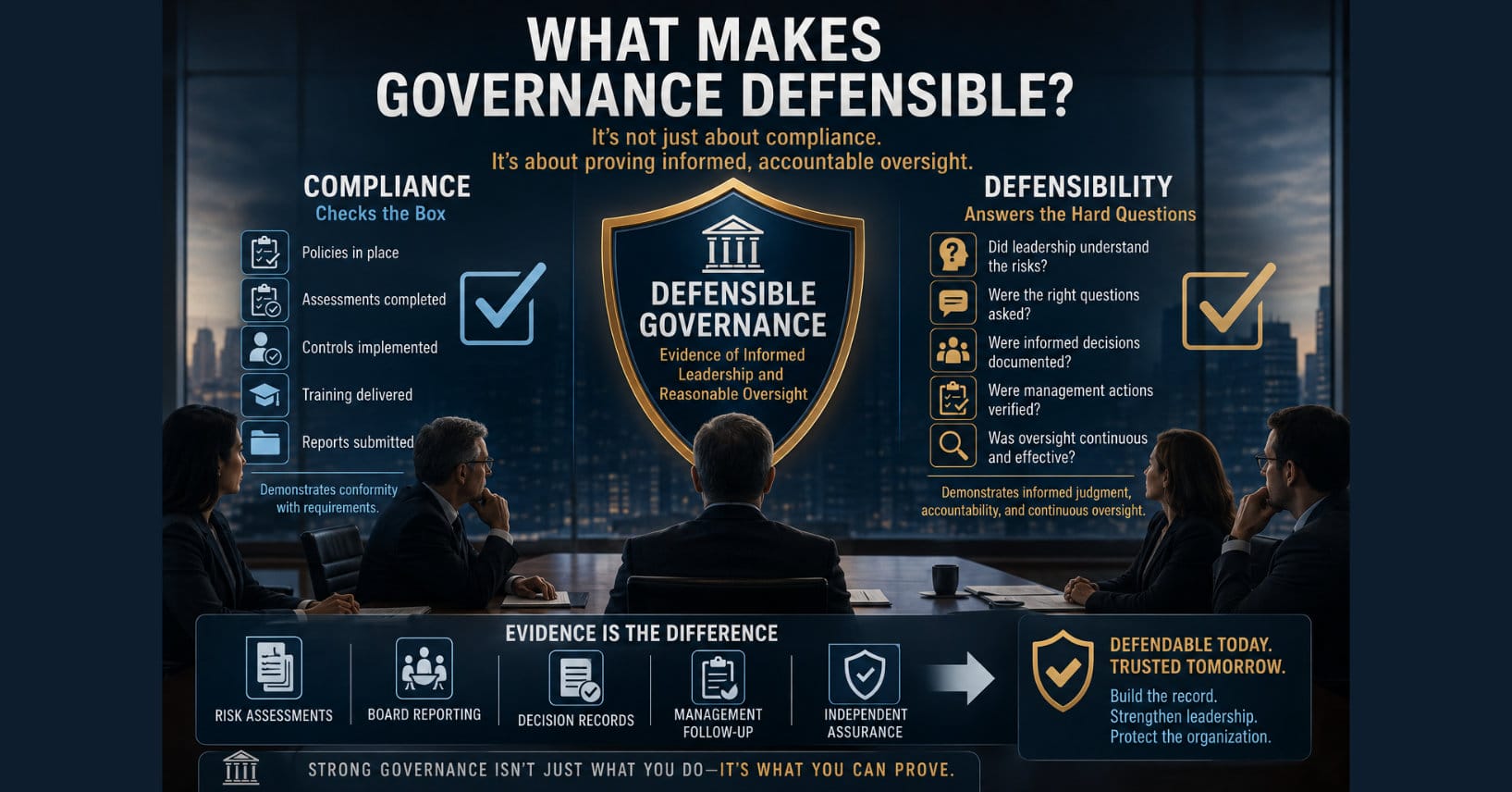
Compliance demonstrates that requirements were met. Defensibility demonstrates that leadership exercised informed judgment.
Organizations spend enormous amounts of time pursuing compliance.
They map controls.
Complete assessments.
Respond to audits.
Maintain certifications.
Prepare regulatory filings.
These activities are important.
But they raise an important question:
What happens after compliance?
A cyber incident does not pause because an organization passed an audit.
Regulators do not end an investigation because policies exist.
Litigators rarely stop asking questions because a framework was implemented.
Instead, they ask something much more significant:
“Can leadership demonstrate that it exercised reasonable oversight?”
That is the question defensible governance is designed to answer.
Compliance Is a Baseline
Compliance establishes that an organization met defined requirements.
It demonstrates conformity with laws, regulations, standards, or contractual obligations.
Organizations should absolutely pursue compliance.
It creates consistency.
It reduces risk.
It improves operational discipline.
But compliance is fundamentally a point-in-time measurement.
It answers questions such as:
- Was the required policy in place?
- Was the assessment completed?
- Was training performed?
- Was the control implemented?
These are valuable questions.
They are not the only questions.
Defensibility Goes Further
Defensible governance asks a different set of questions.
- Did leadership understand the organization’s cyber risks?
- Were material issues communicated to decision-makers?
- Were meaningful questions asked?
- Were informed decisions documented?
- Were management actions verified?
- Did governance improve as risks evolved?
These questions focus on leadership’s judgment rather than simply its compliance.
They examine the quality of governance—not merely its existence.
Evidence Makes Governance Defensible
Good intentions are difficult to prove.
Governance evidence is not.
A documented risk assessment demonstrates awareness.
Board reporting demonstrates oversight.
Decision records demonstrate accountability.
Management follow-up demonstrates execution.
Independent assurance demonstrates verification.
Together, these artifacts provide objective evidence that governance occurred.
Without them, organizations often rely on explanations.
With them, organizations demonstrate facts.
That distinction matters during investigations.
Defensibility Builds Trust
Defensible governance benefits more than regulators.
Boards gain confidence that oversight responsibilities are being fulfilled.
Executives gain a clearer understanding of organizational risk.
Auditors receive stronger evidence.
Cyber insurers gain greater visibility into governance maturity.
Investors see disciplined leadership.
Customers gain confidence that cybersecurity receives executive attention.
Evidence creates trust because it replaces assumptions with observable facts.
Defensibility Is Continuous
Organizations do not become defensible by producing one excellent report.
Defensibility develops over time.
Every governance cycle strengthens the evidentiary record.
Each board meeting.
Each risk review.
Each executive decision.
Each assurance activity.
Each improvement initiative.
The organization builds a history of informed oversight.
That history becomes increasingly difficult to dispute because it reflects years of disciplined governance rather than documentation assembled after a crisis.
Beyond Checking the Box
Compliance programs often encourage organizations to ask:
“Have we completed the requirement?”
Evidence-driven governance encourages a different question:
“Could we demonstrate why leadership made this decision?”
That subtle shift transforms governance.
Documentation becomes purposeful.
Oversight becomes visible.
Accountability becomes measurable.
Evidence becomes cumulative.
Governance becomes defensible.
Defensible Governance Is the Future
Cybersecurity governance is changing.
Boards are expected to do more than approve policies.
Executives are expected to do more than manage technical risk.
Organizations are increasingly expected to demonstrate—not simply assert—that leadership exercised informed, continuous oversight.
That expectation will continue to grow as regulators, insurers, investors, and courts place greater emphasis on governance accountability.
The organizations that thrive in this environment will not necessarily be those with the longest policy manuals or the largest compliance teams.
They will be the organizations whose governance naturally produces credible evidence of responsible leadership.
That is what makes governance defensible.
From the Framework
This article is adapted from The Defensible Evidence Framework™ White Paper, which explores how organizations can create defensible governance evidence naturally through disciplined oversight rather than attempting to reconstruct it after a crisis.
The complete white paper is available for download here.
Coming Next
Article 8: From Compliance to Evidence Readiness
Compliance is an important milestone, but it is not the finish line. In the next article, we’ll explore why organizations must move beyond proving they met requirements and begin building the evidence needed to demonstrate continuous governance, accountability, and defensible oversight before it is ever requested.