
Evidence-Driven Cybersecurity Governance Series—Article 10
This article examines how boards can unintentionally weaken legal defensibility by failing to preserve the evidence their governance activities naturally produce. It explains how incomplete minutes, undocumented decisions, missing follow-up, fragmented records, and post-incident reconstruction can make responsible oversight difficult to prove.
The article emphasizes that governance evidence must be preserved, connected, and maintained before scrutiny begins. Defensible governance is not created during an investigation; it is built through disciplined documentation, clear ownership, and evidence preservation as oversight occurs.
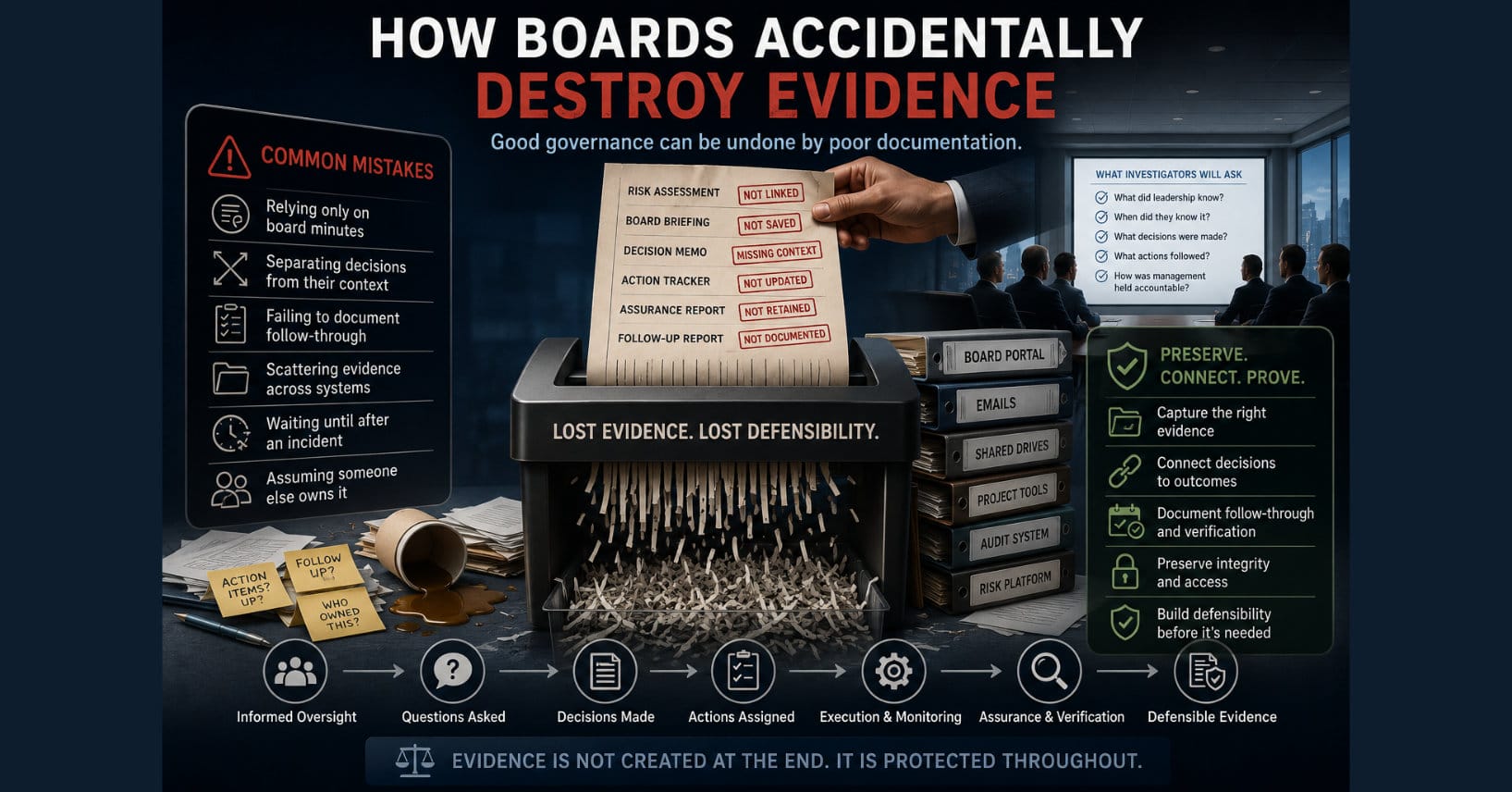
Common governance mistakes that weaken legal defensibility.
Organizations rarely lose defensibility because evidence never existed. More often, they lose it because governance failed to preserve, connect, or document it.
When a cyber incident occurs, investigators begin asking questions.
What did leadership know?
When did they know it?
What decisions were made?
What actions followed?
How was management held accountable?
Boards often assume the answers exist somewhere.
Unfortunately, “somewhere” is not an evidence strategy.
Many organizations unintentionally weaken their own legal defensibility—not because governance failed, but because evidence was never managed as a governance asset.
Mistake #1: Treating Minutes as the Entire Record
Board minutes serve an important purpose.
They record meetings.
They capture motions.
They memorialize formal actions.
But minutes are not the complete governance record.
The strongest evidence often exists elsewhere.
Risk assessments.
Board briefing materials.
Management reports.
Decision memoranda.
Action tracking.
Independent assurance.
When organizations rely exclusively on minutes, investigators see only part of the governance story.
Mistake #2: Separating Decisions from Their Context
A board approves additional cybersecurity funding.
Why?
What risk prompted the decision?
What alternatives were considered?
What information did leadership review?
Without context, a decision becomes little more than a vote recorded in meeting minutes.
Evidence should preserve not only what leadership decided, but why.
Context demonstrates informed judgment.
Mistake #3: Failing to Document Follow-Through
Governance does not end when the meeting adjourns.
Boards assign actions.
Management accepts responsibilities.
Deadlines are established.
Progress is reported.
Verification occurs.
When follow-through is undocumented, oversight appears incomplete.
Investigators naturally ask:
“How did the board know management actually addressed the issue?”
Without evidence, the organization has only verbal assurances.
Mistake #4: Scattering Evidence Across Systems
Evidence often lives everywhere.
Board portals.
Email.
Shared drives.
Risk platforms.
Audit systems.
Project management tools.
Policy repositories.
None of these systems are inherently problematic.
The problem is fragmentation.
If leadership cannot quickly connect evidence across systems, demonstrating governance becomes far more difficult.
Evidence architecture exists to solve this problem.
Mistake #5: Waiting Until After the Incident
Perhaps the most damaging mistake occurs after an incident.
Teams begin reconstructing timelines.
Searching inboxes.
Collecting documents.
Interviewing participants.
Attempting to remember discussions from months earlier.
None of this is malicious.
It is simply unreliable.
Memories fade.
Emails disappear.
Context is lost.
The credibility of reconstructed evidence is rarely equal to evidence created contemporaneously.
Mistake #6: Assuming Someone Else Owns Governance Evidence
Legal assumes Internal Audit owns it.
Internal Audit assumes Compliance owns it.
Compliance assumes Information Security owns it.
Information Security assumes Corporate Governance owns it.
Corporate Governance assumes board records are sufficient.
Everyone contributes.
No one owns the evidentiary architecture.
Governance evidence deserves intentional ownership.
Without accountability, important artifacts are overlooked, disconnected, or discarded.
Defensibility Is Lost Incrementally
Organizations seldom lose defensibility through one catastrophic failure.
Instead, it erodes gradually.
One undocumented decision.
One missing action log.
One absent assurance review.
One incomplete board briefing.
One deleted supporting document.
Individually, these omissions appear insignificant.
Collectively, they weaken the organization’s ability to demonstrate reasonable oversight.
Defensibility is built incrementally.
It can also be lost incrementally.
Better Governance Protects Better Evidence
The solution is not more documentation.
It is better governance design.
Organizations should intentionally define:
- What governance evidence each activity should produce.
- Where that evidence belongs.
- How evidence is connected across governance processes.
- Who is responsible for preserving it.
- How its completeness is periodically verified.
These practices strengthen governance long before anyone asks for proof.
The Cost of Invisible Governance
An organization may govern exceptionally well.
Its board may ask difficult questions.
Leadership may make thoughtful decisions.
Management may execute responsibly.
But if that governance cannot be demonstrated, others are left to make assumptions.
Evidence removes assumptions.
It allows organizations to demonstrate—not merely claim—that oversight occurred.
That is why protecting governance evidence is itself a governance responsibility.
Because evidence lost today cannot strengthen tomorrow’s defense.
From the Framework
This article is adapted from The Defensible Evidence Framework™ White Paper, which explores how organizations can create defensible governance evidence naturally through disciplined oversight rather than attempting to reconstruct it after a crisis.
The complete white paper is available for download here.
Coming Next
Article 11: The Difference Between Activity and Evidence
Organizations often mistake doing work for proving oversight. In the next article, we’ll examine why completing cybersecurity activities is only part of effective governance—and why the ability to demonstrate those activities through credible evidence ultimately determines whether governance is visible, accountable, and defensible.