
Evidence-Driven Cybersecurity Governance Series—Article 9
Many organizations assume governance flows directly into audit. In reality, there is a critical layer between them: assurance. Without continuous validation of controls, governance becomes assumption and audits become retrospective exercises. This article explains why assurance is the missing link that transforms board oversight into defensible evidence, providing leadership with confidence that governance is functioning before regulators, auditors, or investigators ask the question.
Where evidence architecture fits.
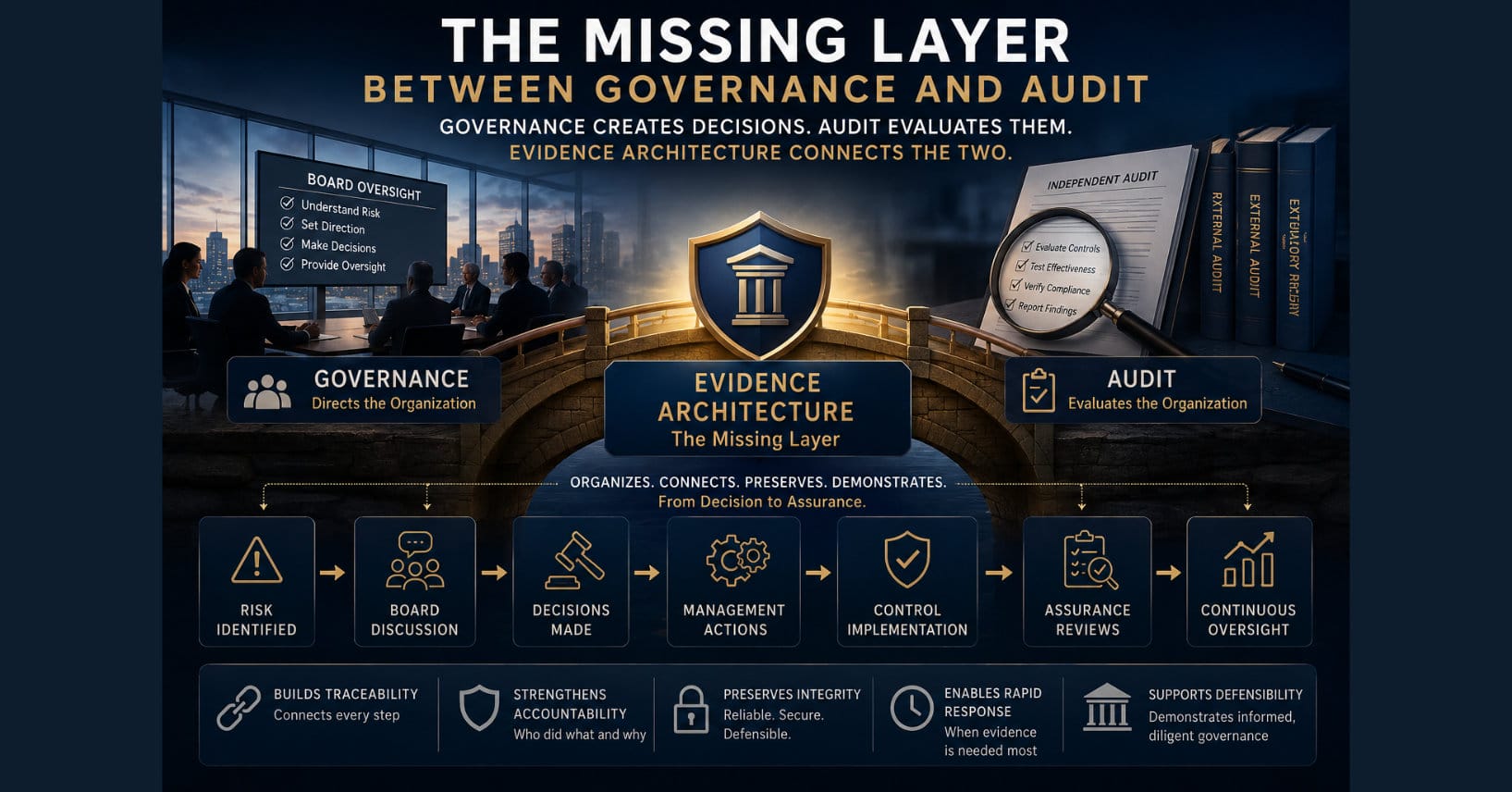
Governance creates decisions. Audits evaluate them. Evidence architecture connects the two.
Most organizations believe the relationship is straightforward.
Governance establishes oversight.
Auditors verify compliance.
The process appears complete.
Yet when regulators, insurers, litigators, or investigators request proof of governance, organizations often discover an uncomfortable reality:
The evidence exists.
They just can’t find it.
Or connect it.
Or demonstrate how it supports leadership’s decisions.
The missing layer is not governance.
It is not audit.
It is evidence architecture.
Governance and Audit Were Never the Same Thing
Governance is responsible for directing the organization.
Audit is responsible for independently evaluating whether governance and management are functioning as intended.
These responsibilities are complementary.
But neither one is responsible for organizing governance evidence into a coherent, defensible body of proof.
That responsibility belongs to evidence architecture.
Without it, governance produces artifacts.
Audit evaluates samples.
No one manages the complete evidentiary story.
What Is Evidence Architecture?
Evidence architecture is the intentional design, organization, traceability, and preservation of governance evidence throughout its lifecycle.
It answers questions such as:
- What governance evidence should exist?
- Where is it maintained?
- How is it connected?
- Who owns it?
- How is its integrity preserved?
- How quickly can it be produced?
These are architectural questions.
Just as enterprise architecture organizes business capabilities…
And security architecture organizes technical controls…
Evidence architecture organizes governance proof.
The Difference Between Documents and Evidence
Organizations often mistake document management for evidence management.
Documents are files.
Evidence demonstrates governance.
A policy stored in a document repository is simply a document.
A policy connected to board approval, executive communication, implementation activities, management reporting, assurance reviews, and continuous oversight becomes governance evidence.
Context creates evidentiary value.
Relationships create credibility.
Architecture preserves both.
Traceability Is Everything
Investigators rarely review documents in isolation.
They follow chains of evidence.
A cyber risk identified during an assessment should connect to:
Board reporting.
Leadership discussion.
Management decisions.
Resource allocation.
Risk treatment.
Independent assurance.
Follow-up reporting.
Without traceability, each artifact stands alone.
With traceability, the organization demonstrates continuous governance from awareness through verification.
That continuity is difficult to challenge because the evidence supports itself.
Evidence Should Flow Through Governance
Evidence architecture does not introduce new governance activities.
It strengthens existing ones.
Policies connect to standards.
Standards connect to controls.
Controls connect to risk.
Risk connects to board oversight.
Board oversight connects to management action.
Management action connects to assurance.
Assurance feeds governance improvement.
The result is not a collection of documents.
It is an integrated evidence ecosystem.
Every governance activity strengthens the next.
Why This Matters
Most organizations already possess far more governance evidence than they realize.
The problem is fragmentation.
Evidence lives in board portals.
Risk systems.
Email archives.
Audit platforms.
Policy repositories.
Project management tools.
Meeting minutes.
Compliance applications.
Each contains part of the story.
Evidence architecture connects those parts into a single defensible narrative.
That is the difference between producing documents and demonstrating governance.
The Next Evolution of Cyber Governance
For years, organizations invested in enterprise architecture because business complexity demanded it.
They invested in cybersecurity architecture because digital risk demanded it.
Evidence architecture represents the next logical evolution.
As expectations for board accountability continue to increase, organizations will need more than governance activities.
They will need governance evidence that is organized, traceable, accessible, and defensible.
The organizations that intentionally build evidence architecture today will be far better prepared for tomorrow’s audits, investigations, regulatory examinations, and litigation.
Because when governance can be traced from decision to assurance, accountability is no longer assumed.
It is demonstrated.
From the Framework
This article is adapted from The Defensible Evidence Framework™ White Paper, which explores how organizations can create defensible governance evidence naturally through disciplined oversight rather than attempting to reconstruct it after a crisis.
The complete white paper is available for download here.
Coming Next
Article 10: How Boards Accidentally Destroy Evidence
Strong governance can be undermined by poor documentation practices. In the next article, we’ll examine the common mistakes boards and leadership teams make—from undocumented decisions to incomplete follow-up—that unintentionally weaken the evidentiary record and reduce legal defensibility when governance is later scrutinized.