
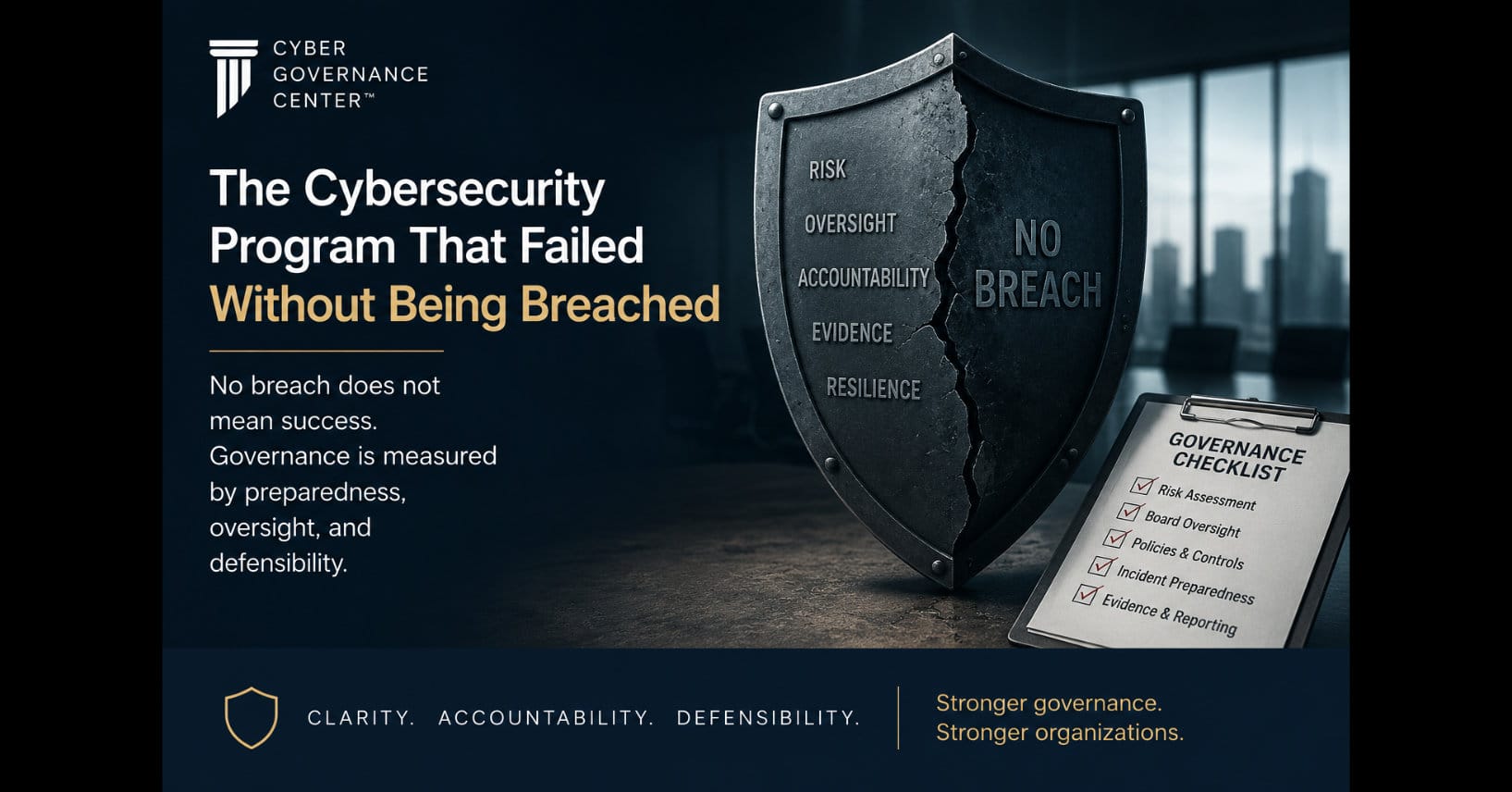
A breach-free record is not proof of an effective cybersecurity program. The piece argues that organizations can appear secure while lacking basic governance practices such as risk assessments, leadership reporting, board oversight, incident testing, and documented risk decisions.
It urges boards and executives to focus on preparedness, accountability, resilience, and defensibility instead of incident counts. A strong program is one that can show informed decision-making, oversight, and evidence of reasonable diligence if an incident occurs.
For years, organizations have measured cybersecurity success using a deceptively simple metric: “We haven’t had a breach.”
At first glance, that sounds reasonable. If no attackers have compromised systems, stolen data, or disrupted operations, the cybersecurity program must be working.
Not necessarily.
The absence of a breach is not evidence of an effective cybersecurity program. It may simply mean the organization has not yet encountered the right threat, the right adversary, or the right circumstances.
Governance requires a different perspective.
Security Outcomes vs. Governance Outcomes
Security teams focus on protecting systems, networks, and data. Governance focuses on ensuring that risks are understood, decisions are informed, responsibilities are assigned, and oversight is exercised.
A cybersecurity program can appear successful from an operational perspective while failing from a governance perspective.
Consider an organization that has:
- No documented risk assessments
- No formal reporting to leadership
- No evidence of board oversight
- No testing of incident response plans
- No documented risk acceptance decisions
If that organization avoids a breach for several years, has it succeeded?
From a governance standpoint, the answer is no.
It has simply been fortunate.
The Problem with Measuring What Didn’t Happen
One of the most common mistakes executives make is treating the absence of negative outcomes as proof of positive performance.
This phenomenon exists in many disciplines.
An organization may avoid a workplace injury despite poor safety practices. A company may avoid regulatory penalties despite weak compliance controls. A driver may avoid accidents while ignoring basic vehicle maintenance.
None of those outcomes prove effectiveness.
Cybersecurity is no different.
Organizations often celebrate a year without a significant incident while overlooking critical governance weaknesses that remain hidden beneath the surface.
The real question is not whether a breach occurred.
The real question is whether the organization was prepared if one had occurred.
What Boards Should Be Asking
Boards and executive leadership should shift the conversation away from incident counts and toward governance indicators.
Instead of asking:
“Have we been breached?”
They should ask:
- What are our most significant cyber risks?
- How frequently are those risks reassessed?
- What evidence demonstrates control effectiveness?
- How do we measure resilience?
- How quickly can we detect, contain, and recover from an incident?
- What risks have been formally accepted?
- What information is regularly reported to leadership?
These questions focus on preparedness, accountability, and oversight rather than luck.
Governance Is About Defensibility
When a significant cyber incident occurs, regulators, insurers, auditors, and legal counsel rarely begin by asking how many years the organization went without a breach.
Instead, they ask:
- What risks were known?
- Who was responsible?
- What decisions were made?
- What evidence exists?
- What oversight occurred?
These questions define whether an organization can demonstrate reasonable diligence.
A defensible organization is not one that never experiences an incident.
A defensible organization is one that can demonstrate that it identified risks, evaluated options, exercised oversight, and acted responsibly based on the information available at the time.
The Governance Perspective
Cybersecurity should never be measured solely by what did not happen.
Organizations that rely on the absence of incidents as proof of success are evaluating outcomes rather than preparedness.
Governance requires a more disciplined approach.
The strongest cybersecurity programs are not necessarily those that avoid every incident. They are the ones that can demonstrate effective oversight, informed decision-making, documented accountability, and operational resilience when challenged.
A breach may reveal a technical failure.
The investigation that follows often reveals a governance failure.
The difference matters.