Evidence-Driven Cybersecurity Governance Series—Article 5
Following a cyber incident, organizations often scramble to reconstruct governance records by searching emails, interviewing executives, and rebuilding timelines. While well-intentioned, this approach rarely produces evidence as credible as documentation created during the normal course of governance.
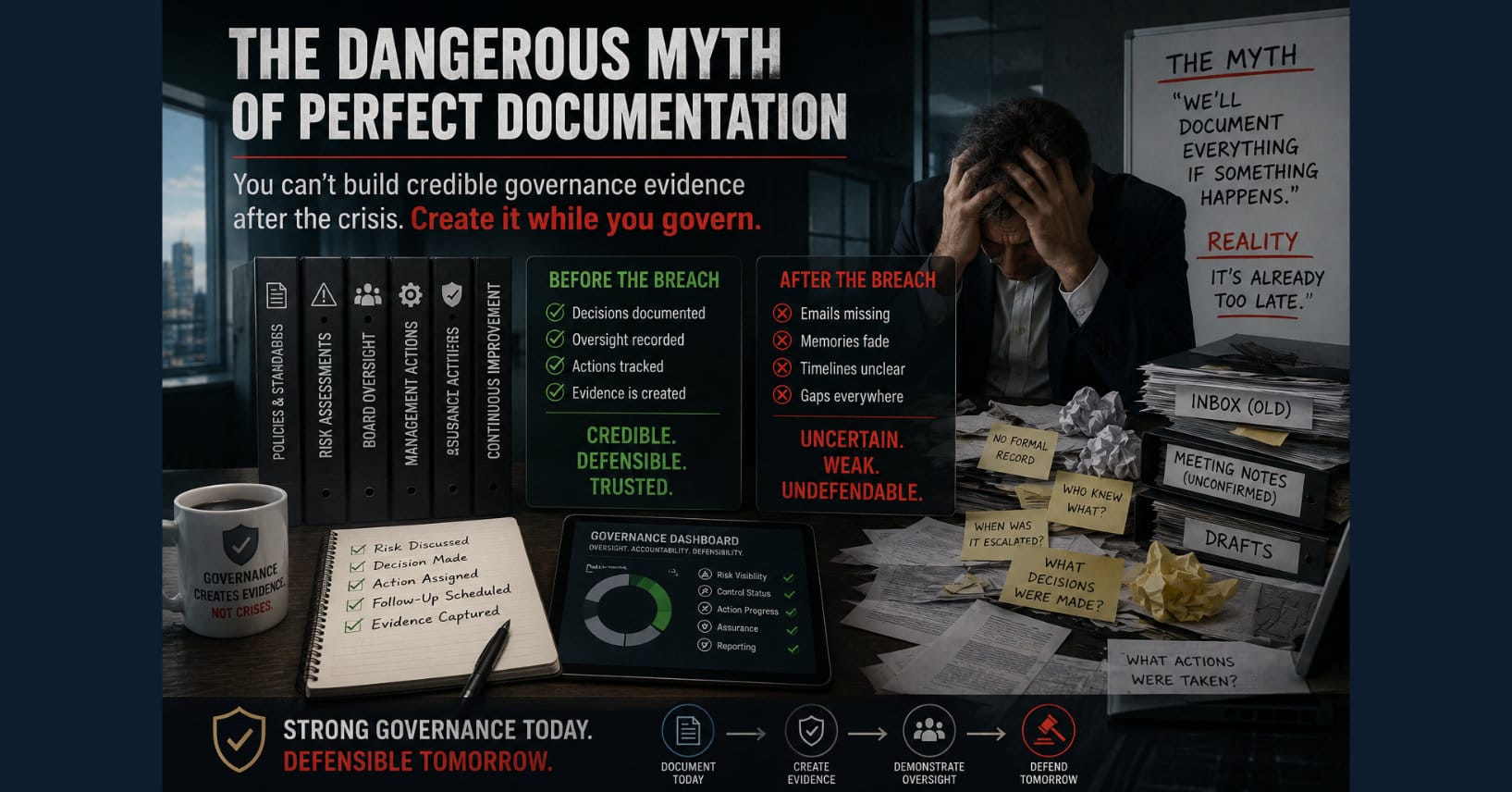
In this fifth installment of the Evidence-Driven Cybersecurity Governance Series, we examine the dangerous myth that organizations can simply “document everything later.” The article explains why memory is not evidence, why post-incident reconstruction introduces uncertainty, and why investigators place greater weight on contemporaneous records of leadership oversight.
The article reinforces a core principle of the Defensible Evidence Framework™: the strongest governance evidence is accumulated through disciplined governance over time—not manufactured after a crisis. Organizations that intentionally create evidence as governance occurs are better prepared for regulatory scrutiny, litigation, insurance reviews, and board accountability.
Why reconstructing evidence after a breach often fails.
The most credible governance evidence is created in real time—not recreated under pressure.
Every organization believes it has adequate documentation.
Until the breach.
Only then does leadership discover that documents are missing, timelines are incomplete, decisions were never formally recorded, and key personnel disagree about what actually happened.
This is one of the most dangerous myths in cybersecurity governance:
“If something happens, we’ll gather everything we need afterward.”
Unfortunately, governance doesn’t work that way.
Neither do investigations.
Memory Is Not Evidence
Immediately following a significant cyber incident, organizations often begin reconstructing events.
Executives search email archives.
Board members review old presentations.
Legal counsel interviews employees.
IT teams piece together timelines from logs and calendars.
Everyone works diligently to answer the same questions:
- What happened?
- Who knew?
- When did they know?
- What decisions were made?
- What actions followed?
The answers frequently depend on memory.
Memory is valuable.
It is not evidence.
Human recollection changes over time.
Context is forgotten.
Conversations become difficult to reconstruct.
Good-faith participants often remember the same meeting differently.
Investigators understand this.
That is why contemporaneous documentation carries far greater evidentiary weight than recollections formed months later.
The Reconstruction Problem
Organizations rarely fail because they lacked concern.
They fail because they lacked documentation created when decisions were made.
A board may have discussed ransomware preparedness several times.
Management may have prioritized critical vulnerabilities.
Budgets may have been approved.
Outside experts may have provided recommendations.
Yet if those activities were never documented as part of the governance process, leadership is forced to reconstruct them after the fact.
Reconstruction introduces uncertainty.
Dates become estimates.
Discussions become summaries.
Intent becomes interpretation.
Every gap weakens credibility.
Pressure Produces Poor Documentation
Ironically, the time organizations become most interested in documentation is the worst possible time to create it.
During an active cyber incident:
Executives are managing operations.
Legal counsel is coordinating response activities.
Technical teams are containing the attack.
Communications personnel are preparing public statements.
Boards are receiving continuous updates.
No one is focused on producing ideal governance records.
Nor should they be.
The organization’s priority is responding to the incident—not recreating months or years of governance history.
Evidence created under crisis conditions inevitably reflects the pressures of the moment.
Evidence created during ordinary governance reflects thoughtful leadership.
Documentation Should Follow Governance
Some organizations respond by documenting everything.
Every conversation.
Every email.
Every draft.
Every meeting.
Volume does not create defensibility.
Purpose does.
Governance documentation should exist because governance occurred—not because someone anticipated litigation.
The most persuasive evidence is produced naturally through disciplined governance:
Risk assessments…
Board reporting…
Management action plans…
Decision records…
Independent assurance…
Follow-up reporting…
Each artifact captures a portion of the organization’s governance journey at the moment it occurred.
Together, they create a reliable historical record.
Credibility Depends on Timing
Investigators often ask a simple question:
“When was this document created?”
The answer matters.
Documentation created before an incident demonstrates planning.
Documentation created during routine governance demonstrates oversight.
Documentation created immediately after an incident may demonstrate response.
Documentation created months later often demonstrates reconstruction.
Each serves a different purpose.
Only one provides contemporaneous evidence of governance.
Evidence Readiness Is Governance Readiness
The Defensible Evidence Framework™ does not encourage organizations to document more.
It encourages them to govern better.
When governance is disciplined, documentation naturally follows.
When documentation naturally follows, evidence already exists.
Organizations no longer scramble to assemble a defense because the record of leadership’s oversight has been developing continuously.
The strongest governance evidence is never manufactured.
It is accumulated.
One informed decision.
One board report.
One risk assessment.
One assurance activity at a time.
That is how organizations become evidence ready.
From the Framework
This article is adapted from The Defensible Evidence Framework™ White Paper, which explores how organizations can create defensible governance evidence naturally through disciplined oversight rather than attempting to reconstruct it after a crisis.
The complete white paper is available for download here.
Coming Next
Article 6: Evidence Is a Governance Product
Governance should intentionally produce evidence as an operational output. In the next article, we’ll examine why evidence should not be treated as an audit scramble or compliance afterthought, but as one of the expected outputs of disciplined cybersecurity governance.