Evidence-Driven Cybersecurity Governance Series—Article 8
Many organizations focus on achieving compliance, but compliance alone rarely satisfies regulators, auditors, insurers, or courts after a cyber incident. Increasingly, the question is not whether requirements were met, but whether leadership can demonstrate informed, documented, and continuous governance.
This article introduces the concept of evidence readiness—the practice of naturally creating defensible governance evidence as decisions are made, risks are evaluated, policies are approved, and oversight is exercised. Rather than scrambling to reconstruct documentation after an incident, organizations with mature governance continuously build an evidentiary record that demonstrates accountability, due diligence, and informed leadership.
Readers will learn why evidence readiness represents the next evolution of cybersecurity governance and how it transforms compliance activities into lasting proof of responsible oversight.
Why compliance isn’t the finish line.
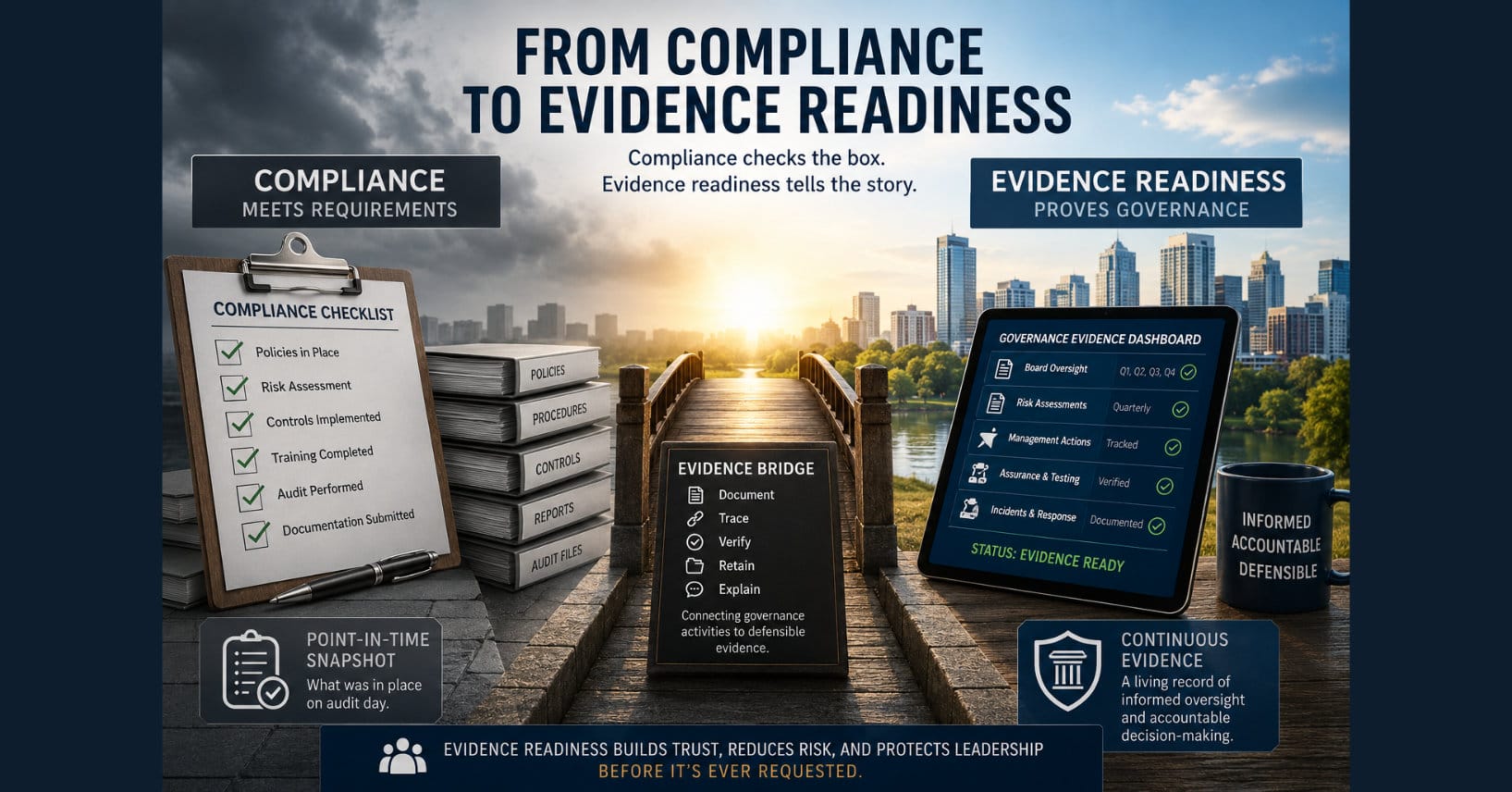
Compliance demonstrates that requirements were met. Evidence readiness demonstrates that governance can be proven.
For decades, organizations have viewed compliance as the destination.
Pass the audit.
Complete the assessment.
Maintain the certification.
Submit the filing.
Check the box.
These achievements matter. They establish discipline, reduce operational risk, and demonstrate conformity with recognized standards.
But compliance answers only one question:
“Did the organization satisfy the requirement?”
Increasingly, regulators, insurers, investors, and courts are asking a different question:
“Can the organization demonstrate how leadership governed?”
That is the difference between compliance and evidence readiness.
Compliance Is Necessary
Compliance remains an essential component of cybersecurity governance.
Frameworks such as NIST CSF, ISO 27001, CIS Controls, PCI DSS, HIPAA, and countless regulatory requirements provide valuable guidance for managing cyber risk.
Organizations should continue pursuing these objectives.
They improve security.
They establish consistency.
They define expectations.
But compliance alone cannot explain how leadership exercised oversight.
It cannot fully answer:
- What risks did the board understand?
- What decisions were made?
- Why were priorities established?
- How was management held accountable?
- What evidence demonstrates continuous governance?
Compliance creates confidence that requirements were addressed.
Evidence readiness creates confidence that governance occurred.
Compliance Is a Snapshot
An audit captures a moment in time.
A certification reflects conditions on the day it was issued.
An assessment evaluates current practices.
Each provides value.
But cybersecurity governance is continuous.
Boards meet throughout the year.
Risks evolve.
Threat actors change tactics.
Business priorities shift.
Management adjusts strategy.
Oversight never stops.
Evidence readiness recognizes that governance is an ongoing process rather than an annual event.
Every governance activity contributes another piece of the evidentiary record.
Evidence Readiness Is Continuous Readiness
Organizations often prepare for audits.
Evidence-ready organizations prepare for governance.
Every board presentation becomes evidence.
Every executive briefing contributes context.
Every risk assessment documents organizational awareness.
Every management action demonstrates follow-through.
Every assurance review validates effectiveness.
Rather than asking, “What will the auditor need?”
Evidence-ready organizations ask,
“What evidence should today’s governance activity naturally produce?”
That subtle change transforms documentation from a compliance exercise into an operational discipline.
Readiness Reduces Scramble
When an investigation begins, organizations without evidence readiness often enter reconstruction mode.
Teams search archives.
Executives review old emails.
Meeting notes are gathered.
Timelines are rebuilt.
Decision histories are reconstructed.
Every missing record increases uncertainty.
Evidence-ready organizations respond differently.
Their governance record already exists.
Policies establish expectations.
Risk assessments document awareness.
Board reporting demonstrates oversight.
Decision records explain leadership judgment.
Management tracking demonstrates execution.
Assurance activities verify effectiveness.
Instead of assembling a story, they present one.
Evidence Readiness Strengthens Governance
Some organizations assume evidence readiness exists primarily for regulators.
Its greatest value may be internal.
Boards gain greater visibility into cyber risk.
Executives make better-informed decisions.
Management improves accountability.
Lessons learned are easier to capture.
Governance maturity becomes measurable.
Evidence readiness strengthens governance because it encourages disciplined oversight every day—not just during audits.
The Future of Governance
Cybersecurity governance continues to evolve.
Organizations are no longer evaluated solely on technical controls or regulatory compliance.
They are increasingly evaluated on their ability to demonstrate informed leadership.
That requires more than policies.
More than certifications.
More than completed assessments.
It requires evidence.
The organizations best prepared for tomorrow’s regulatory environment will not simply comply with governance requirements.
They will continuously produce the evidence that proves governance occurred.
That is evidence readiness.
And it is rapidly becoming the new standard for defensible cybersecurity governance.
From the Framework
This article is adapted from The Defensible Evidence Framework™ White Paper, which explores how organizations can create defensible governance evidence naturally through disciplined oversight rather than attempting to reconstruct it after a crisis.
The complete white paper is available for download here.
Coming Next
Article 9: The Missing Layer Between Governance and Audit
Organizations often think governance leads directly to audit. In the next article, we’ll explore the missing architectural layer between them: evidence architecture. You’ll see how intentionally designing the collection, organization, and traceability of governance evidence bridges the gap between everyday oversight and successful audits, investigations, and regulatory reviews.