
Evidence-Driven Cybersecurity Governance Series—Article 12
When a significant cyber incident occurs, governance enters a new phase: discovery. Every board briefing, risk report, decision record, email, and meeting minute may become evidence subject to regulatory review, litigation, or investigative scrutiny. The question is no longer whether leadership believed it exercised good governance, but whether it can demonstrate that oversight through credible, contemporaneous evidence.
This article explains why organizations should evaluate their governance through the eyes of opposing counsel rather than through their own assumptions. It explores the importance of preserving decision context, maintaining consistent evidence across governance activities, and creating documentation that demonstrates accountability, follow-through, and informed leadership. Governance that survives discovery is not created after an incident—it is built continuously through disciplined oversight that leaves behind a complete, connected, and defensible evidentiary record.
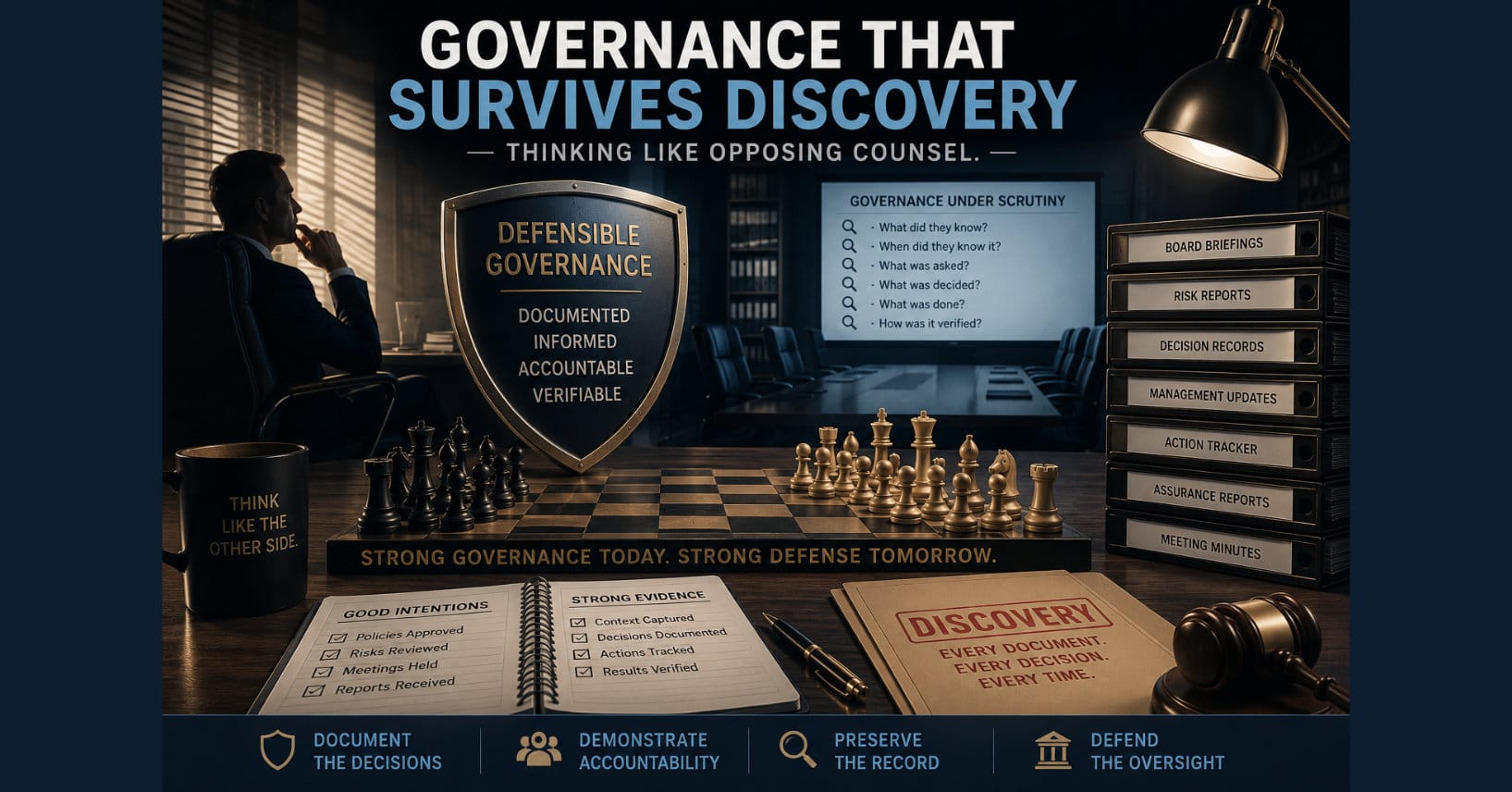
Thinking like opposing counsel.
The true test of governance is not whether it satisfies leadership. It is whether it survives scrutiny from those trying to prove leadership failed.
Every board believes its governance is sound.
Policies have been approved.
Cybersecurity receives regular attention.
Risk reports are presented.
Budgets are allocated.
Management provides updates.
From inside the organization, governance often appears effective.
Discovery changes the perspective.
During litigation, regulatory enforcement, shareholder actions, or major cyber investigations, every governance artifact may become evidence.
Board minutes.
Briefing materials.
Email correspondence.
Executive presentations.
Risk assessments.
Assurance reports.
Decision records.
Investigators are not trying to confirm good intentions.
They are looking for weaknesses.
That is why organizations should occasionally stop thinking like board members—and start thinking like opposing counsel.
Discovery Is About Questions
Discovery rarely begins with accusations.
It begins with questions.
When did leadership first become aware of this risk?
What information did the board receive?
What questions were asked?
Were management’s assurances independently verified?
Why was this course of action chosen?
What evidence supports that decision?
Every answer must be supported by evidence.
Unsupported explanations quickly become opinions.
Documented governance becomes fact.
Silence Speaks Loudly
One of the greatest risks during discovery is not what documents contain.
It is what they do not contain.
If board materials consistently omit cybersecurity discussions…
If risk reports never identify significant concerns…
If follow-up actions disappear after meetings…
If management updates lack measurable outcomes…
Opposing counsel notices.
Absence creates opportunity.
Missing evidence invites unfavorable assumptions.
Well-designed governance reduces those assumptions by making oversight visible.
Context Matters as Much as Conclusions
A board approves a major cybersecurity investment.
The vote is documented.
But what prompted the decision?
Which risks were evaluated?
What alternatives were discussed?
What expert advice influenced leadership?
Without context, investigators see only the outcome.
With context, they see informed governance.
Decision records should preserve not only what happened, but why.
That distinction often becomes critical during discovery.
Every Artifact Should Tell the Same Story
Governance evidence should be consistent.
Board reports should align with risk assessments.
Management updates should reflect board direction.
Action tracking should demonstrate execution.
Assurance reviews should validate reported progress.
Policies should support operational practice.
When evidence tells one coherent story, credibility increases.
When documents contradict one another, credibility erodes quickly.
Discovery often exposes inconsistencies long before it uncovers technical failures.
Think Like the Other Side
One useful governance exercise is remarkably simple.
Review your governance evidence as though your objective were to challenge it.
Ask questions such as:
- Can I determine what leadership knew?
- Is accountability clearly assigned?
- Can decisions be traced to supporting evidence?
- Is follow-through documented?
- Are assurance activities independent and complete?
- Does the timeline make sense?
If the answers are difficult to establish internally, they will be even more difficult for others to accept externally.
Governance Designed for Discovery
Organizations should never create governance for litigation.
They should create governance that remains credible if litigation occurs.
That means evidence should be:
- Created contemporaneously.
- Complete without being excessive.
- Connected across governance activities.
- Preserved with integrity.
- Easily traceable.
- Independently verifiable.
These characteristics strengthen governance regardless of whether discovery ever occurs.
Defensibility Begins Before the First Question
Discovery is not where governance begins.
It is where governance is evaluated.
Organizations cannot reconstruct years of informed oversight in the weeks following a major cyber incident.
Either the evidence already exists…
Or it does not.
That is why defensible governance is built continuously rather than retrospectively.
Every board meeting.
Every executive briefing.
Every management review.
Every assurance activity.
Each contributes another piece of the evidentiary record that may someday answer questions leadership hopes are never asked.
The organizations best prepared for discovery are not those with the most documents.
They are the ones whose evidence consistently demonstrates thoughtful, disciplined, and accountable governance.
Because governance that survives discovery is governance that was designed to withstand scrutiny long before anyone came looking for proof.
From the Framework (LinkedIn)
This article is adapted from The Defensible Evidence Framework™ White Paper, which explores how organizations can create defensible governance evidence naturally through disciplined oversight rather than attempting to reconstruct it after a crisis.
The complete white paper is available for download here.
Coming Next
Article 13: Why Every Major Cyber Incident Becomes an Evidence Investigation
The headlines focus on the breach. The investigation focuses on the evidence. In the next article, we’ll examine how major cyber incidents quickly evolve from technical response efforts into investigations centered on governance, leadership decisions, accountability, and the evidentiary record that organizations created—or failed to create—before the incident occurred.